
Reviewed · DIOCLETIAN'S PALACE & OLD TOWN
Split Diocletian Palace Highlights – Private walking tour
One walk. Ten minutes here, one thousand years there. This private Split Old Town tour keeps you moving through the walls, gates, and public spaces of Diocletian’s Palace without paying extra museum-style admission. I like how it mixes the famous postcard views with the smaller details that make the whole place feel real.
What I really like: you start with the Split Riva promenade so you learn the lay of the land before you dive into the palace core, and your guide shares the story behind the spaces instead of listing dates. One thing to plan for: everything is mostly outside-only and time is tight (about 1 hour 30 minutes), so if you want a slow, inside-only museum experience, this isn’t the format.
In This Review
- Key highlights you’ll care about
- What this private walk is really for
- Meeting point and first 10 minutes: Split Riva as your orientation tool
- Inside the palace without museum-ticket stress
- A note on what you actually see
- Stop-by-stop: the route that makes the palace make sense
- 1) The palace cellars: scale you can feel
- 2) The Peristyle: ceremony and power in one square
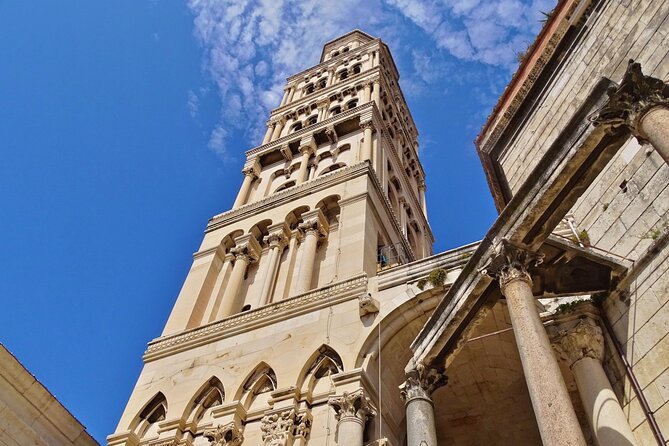
- 3) St. Domnius Cathedral from the outside: pagan to Christian
- 4) The Iron Gate / Silver Gate and the market pull
- 5) Triclinium: dining as a social statement
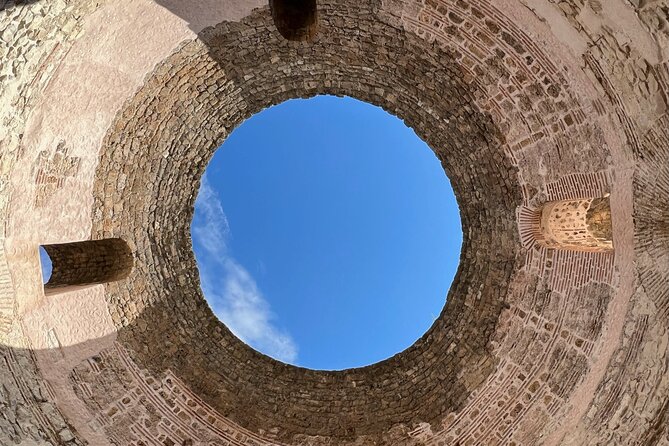
- 6) Vestibulum and the private-chambers doorway idea
- 7) Temple of Jupiter as a baptistery: another repurpose
- 8) West gate, the trap zone idea, and Pjaca square
- 9) Golden Gate: the Roman road connection
- 10) Green Market: everyday food routes
- 11) Ending back at the Riva
- Why the guide approach matters (especially in a short tour)
- Price and value: $137.80 for a focused 90-minute win
- Who should book this tour
- Practical tips for your walk
- Should you book Split Diocletian Palace Highlights?
- FAQ
- How long is the Split Diocletian Palace Highlights private walking tour?
- Where does the tour start and end?
- What language is the tour offered in?
- Is there an admission fee for the sights on this tour?
- What exactly does the itinerary cover?
- Does the tour include recommendations for food and leisure?
- How big is the group for this private tour?
- Do I get a mobile ticket?
- Is the tour suitable for most travelers?
- What if the weather is bad?
Key highlights you’ll care about
- No-entry-fee sightseeing. All stops are free to view or visit, and you’re not paying for timed tickets.
- A tight route with the right order. You connect the palace gates, squares, and markets in a logical flow.
- Old Town orientation in 90 minutes. You finish back near the water, which makes it easier to roam afterward.
- Cellars and major nodes, not random wandering. You get big structural context fast.
- Small group size for questions. It’s designed for up to 6 people (with an overall maximum of 10).
- English guide storytelling. The guide approach here is story-first, not textbook-first.
On your own schedule: more private tours in Split
- SPLIT-PRIVATE Walking Tour of Diocletian’s Palace & Old Town★ 5.0 · 467 reviews
- Private Krka Waterfalls tour with 30min Boat Cruse★ 4.0 · 458 reviews
- Split by Private Electric Rickshaw – Palace & Hidden Gems★ 5.0 · 412 reviews
- Private Blue cave, Mamma Mia and Hvar, 5 islands tour from Split★ 5.0 · 387 reviews
What this private walk is really for
This tour is built for people who want to understand Split’s Old Town quickly. You’re not just ticking off landmarks. You’re walking the palace like it’s an active living neighborhood—streets, markets, dining space ideas, and ceremonial areas all in one loop.
At roughly 1 hour 30 minutes, you’ll get a full orientation arc: sea-front → palace walls → spiritual and social center → gates → markets → back to the waterfront. That timing matters. Split can feel like a maze on your first day. This route gives you a mental map fast, so the rest of your trip feels easier.
The other big factor is value: the itinerary is ticket-free for the sights you’ll see. You’re paying for the guide and the route planning, not for a pile of separate admissions. For a short tour, that’s where the money makes sense.
And yes, it’s private. You’ll walk with your group at a pace that supports questions, photo stops, and just enough lingering to take it in without going off the rails.
Meeting point and first 10 minutes: Split Riva as your orientation tool
You start at the Model of the historical core of the city of Split near Obala Hrvatskog narodnog preporoda. That’s a smart start. The model gives you instant context for the palace layout and how the old streets relate to the waterfront.
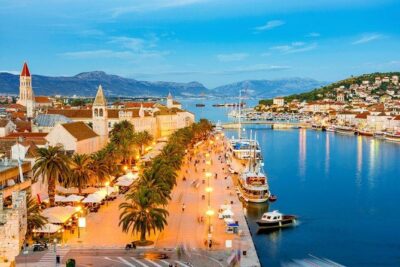
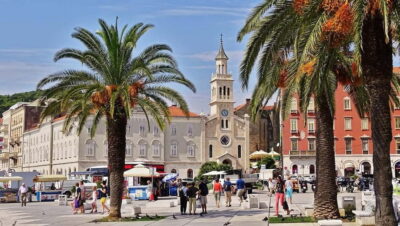
From there, the tour heads to the Riva, Split’s promenade. This is the “see and be seen” part of town—cafes, restaurants, and that feeling of locals and visitors sharing the same stretch of sun and stone. I like the way this first segment frames the palace. Instead of entering the Roman world cold, you warm up with the modern street life that still hugs the same shoreline.
In practical terms, the Riva start also helps you reset your timing. If you’re arriving from a ferry, bus, or cruise day, you’ll likely need a moment to get your bearings. The Riva gives you that runway.
Inside the palace without museum-ticket stress
The centerpiece is Diocletian’s Palace, built and inhabited by Emperor Diocletian more than 1700 years ago. The tour approach is key: it’s not treated as a museum you passively scan. Inside the palace walls, there are still houses and stores—so it feels like an inhabited ancient container rather than a dead exhibit.
You also get something many walking tours skip: you’re guided through how the palace functions as a system. Where gates control movement. Where key ceremonial space sits. Where everyday life tucks into the same stone.
A note on what you actually see
The sights along the route are mostly visited from the outside, and the stated stops are free where admission is required. Even when you enter an area like the cellars, you’re not paying extra. So you can focus on your time and comfort instead of hunting ticket counters.
Prefer to walk it? More guided strolls through Split


Stop-by-stop: the route that makes the palace make sense
1) The palace cellars: scale you can feel
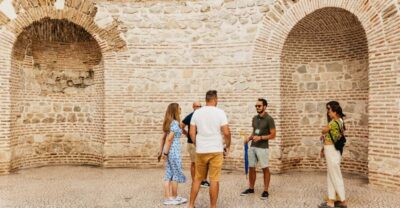
Next you go from the south gate into Diocletian’s Cellars. Cellars can sound boring on paper, but in a palace context they’re powerful. Here, you get a strong sense of the palace dimensions and construction style—what was built to last, and how the underground spaces supported the whole complex.
This stop is short (about 5 minutes), but it’s designed as a reset. After the open feel of streets and walls, the cellars give you structure. You start thinking in terms of engineering and support, not just monuments.
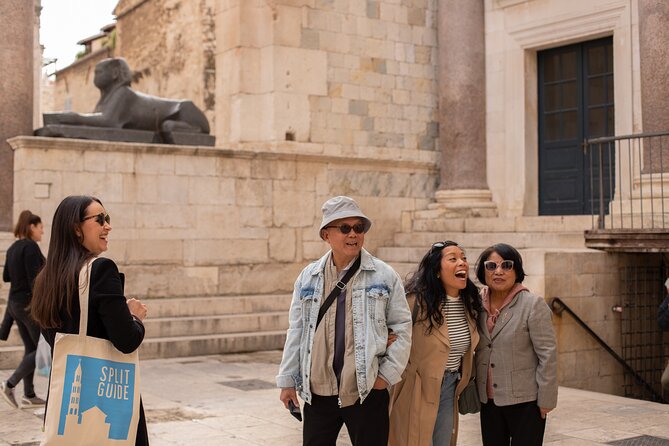
2) The Peristyle: ceremony and power in one square
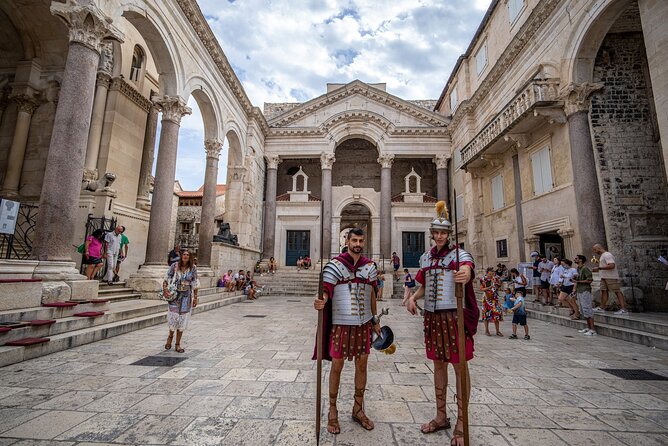
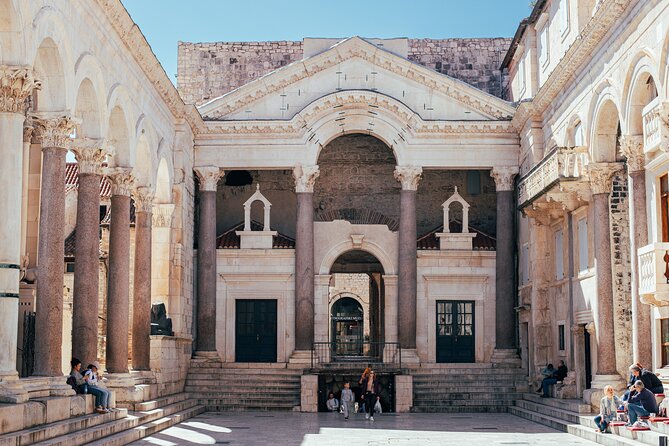
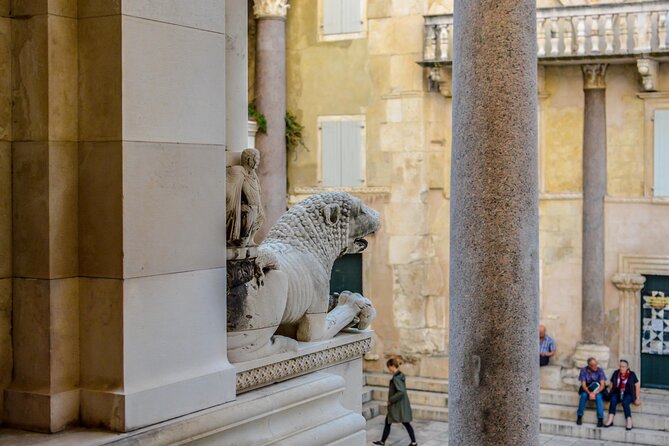
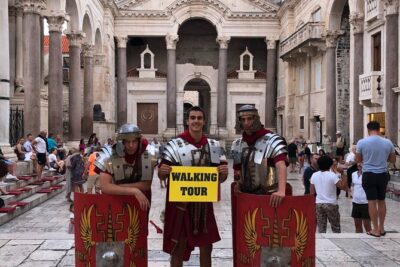
Then comes the Peristyle of Diocletian’s Palace. This wasn’t just a decorative courtyard. It was a sacral meeting place in Diocletian’s time—where he appeared to his subjects and connected himself to Jupiter.
What I like about this stop is that it makes the palace’s “center” feel intentional. You’re not just standing in a pretty rectangle. You’re reading the space. The guide’s job here is crucial: they connect the architecture to the idea of public authority.
3) St. Domnius Cathedral from the outside: pagan to Christian
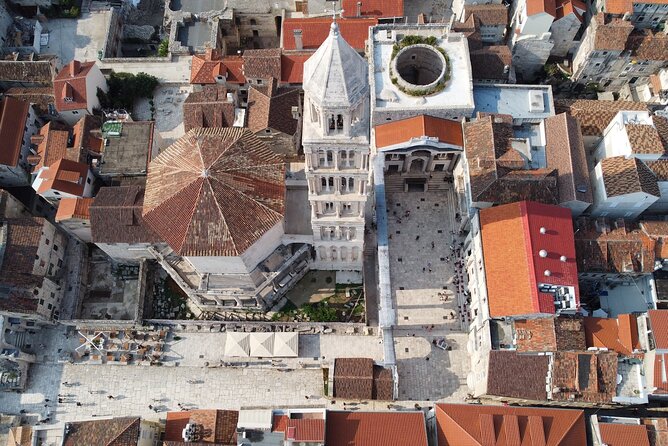
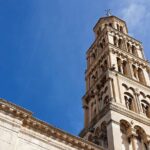
The Cathedral of Saint Domnius is next. Split’s cathedral story is one of those real-world cultural handoffs that happened across centuries. The palace was used as Diocletian’s mausoleum for a time, and later the area became a Christian cathedral—while Diocletian’s remains and coffin disappeared during the shift.
Here you’ll look from the outside, with no entrance fee. That works well for a short tour because the location alone tells the story. You don’t lose time waiting in line or buying tickets. You keep moving.
4) The Iron Gate / Silver Gate and the market pull
You then pass through gates that evolved with the centuries—specifically the Iron Gate that’s also described as the Silver Gate at one point, reopened in the 1940s after being walled up multiple times.
Today, that gate leads you into the market area where local products show up. This is one of those “ancient meets everyday” moments that makes Split feel alive, not staged. Even if you don’t buy anything, it’s helpful. Markets teach you how people actually use the old streets.
5) Triclinium: dining as a social statement
The route continues to the Triclinium, the dining room. The tour frames it in plain terms: this is where Diocletian dined with guests, and meals were often Mediterranean dishes with local wine and fish, plus honey as a popular ingredient.
It’s short (about 10 minutes), but it does something valuable: it reminds you the palace wasn’t only about rule and religion. It was also about hospitality and status. And when a guide explains that dining could mean up to 20 courses in one evening (as described), the palace stops feeling like stone and starts feeling like a place where real people ate, negotiated, and performed power.
6) Vestibulum and the private-chambers doorway idea
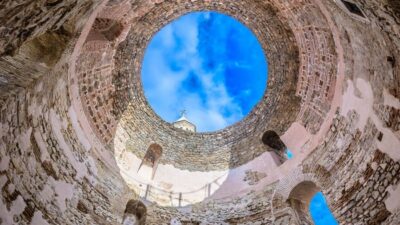
At the Vestibulum of Diocletian’s Palace, you’re in the entry area to Diocletian’s private chambers. This stop is only about 5 minutes, but it helps you understand that not all areas were public. Some spaces were designed for controlled movement and privacy.
It’s also a good moment for photos, because you can capture the contrast: grand ceremony zones nearby, and then the calmer, more restricted layers closer to the private side.
7) Temple of Jupiter as a baptistery: another repurpose
Then you get the Temple of Jupiter, now used as a baptistery. Again, you’ll see it from the outside with no entrance fee. But the repurpose matters. You’re seeing a pattern across Split: old Roman spaces becoming Christian spaces over time.
This stop works well if you’re the type who likes to connect the dots. The guide helps you see that the “site” isn’t frozen in time. It’s been reused, rebuilt, and reinterpreted.
8) West gate, the trap zone idea, and Pjaca square
You then move to the Iron Gate (west gate), part of a double-gate system called Propugnaculum. The idea here is that an enemy could get trapped in the area between gates and be hit with stones, arrows, or hot oil.
That’s intense imagery for a place that looks peaceful today, and that’s why it’s worth including. You start reading the gates as defense technology, not just passageways.
After leaving the gate, you enter the beautiful square called Pjaca. This gives you a visual and mental break: you’ve gone from tight corridors and ceremonial nodes back to a more open public square.
9) Golden Gate: the Roman road connection
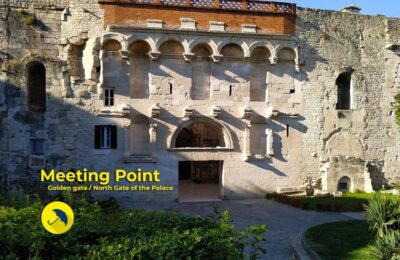
Next is the Golden Gate, the north gate and one of the most important gates in Roman times. From here the road led to Salona, the capital of the Roman province.
It’s short (about 5 minutes), but it’s a strong “history in motion” moment. You can stand there and imagine people arriving with goods, news, and power from the wider region—not just walking within the palace walls.
10) Green Market: everyday food routes
On the east side of the palace is the Green Market. It sells fresh fruits and vegetables and other traditional foods every day. This is the easiest stop to understand, because you can almost feel the local routine.
If you like to travel like a local—snacking and small grocery buys—this is the part that clicks. Even if you don’t stop to shop, it anchors the tour in normal life.
11) Ending back at the Riva
Finally, you reach the promenade again, following the walls toward Split Riva. That finish matters. After walking through stone corridors, squares, and markets, you get open air back. It’s a nice handoff to the rest of your day: drink something cold, plan your next walk, and use what you learned to navigate without stress.
Why the guide approach matters (especially in a short tour)
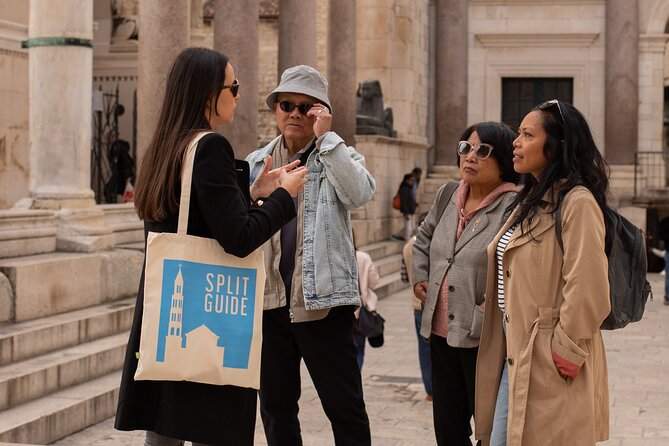
This tour’s rating is strong because the guide work is strong—storytelling, context, and the ability to answer the questions that pop up when you’re standing in front of ancient walls.
One name you might hear is Dana, described as exceptional for sharing history and stories. The best guides here don’t just recite dates. They help you interpret what you’re seeing: why a gate was where it was, why the ceremonial area mattered, why repurposing happened, and how daily life continued inside the palace footprint.
In a 90-minute format, a good guide can be the difference between seeing things and understanding them.
Price and value: $137.80 for a focused 90-minute win
At $137.80 per person, you’re paying for a private, English-language guide and a route that’s planned to reduce wasted time in Split Old Town.
Here’s why it can be good value:
- You’re not paying entry fees for the listed sights you’ll see.
- The route covers a wide set of key palace elements: gates, ceremony spaces, and market access.
- The group size stays small (designed for up to 6, with a maximum of 10), so you’re not stuck in a crowded line-and-wait situation.
- The included restaurant and leisure recommendations can save you decision fatigue after the tour.
Could it be pricey? Sure—if you only want a casual wander with no structure. But if you’re the type who wants to understand what you’re walking past, the per-person guide cost starts to look fair fast.
Who should book this tour
I think this works best for:
- First-time visitors who want a fast orientation to Split Old Town and Diocletian’s Palace
- People who prefer context and stories over reading plaques
- Travelers who want to keep the day easy on logistics (English guide, mobile ticket, free to view stops)
It may not be ideal if:
- You’re hoping for a long, interior-only museum style visit
- You want a slow pace with lots of downtime, because the itinerary is compact by design
Practical tips for your walk
A few things that will make your time smoother:
- Wear comfortable shoes. You’ll be moving through old-stone areas and squares.
- If you’re visiting during strong heat, plan to use the cafes and shade opportunities around the Riva before you hit the thicker stone areas.
- Bring a little patience for photos at the gates and squares. These spots are the “anchor images” of the palace.
Also, the tour depends on good weather, so plan to keep your schedule flexible if the day you pick looks questionable.
Should you book Split Diocletian Palace Highlights?
If you want a smart first pass at Split’s most important site, I’d book it. The route is designed to help you connect the dots between the palace’s ceremonial core, its defensive layout, and the living markets that still flow through it.
I’d especially choose it if you’re trying to do Old Town in one day and don’t want to burn half your time figuring out where to go next. The combo of no-entry-fee sightseeing, a compact 90-minute pace, and an English guide who focuses on story makes this a strong value play.
That said, if you want lots of interior time, long museum-style stops, or a very slow walk, you’ll probably feel rushed. For “get it and go” travelers, this hits the sweet spot.
FAQ
How long is the Split Diocletian Palace Highlights private walking tour?
It lasts about 1 hour 30 minutes.
Where does the tour start and end?
It starts at the Model of the historical core of the city of Split on Obala Hrvatskog narodnog preporoda 23, Split, and ends at Republic Square (Prokurative), Split.
What language is the tour offered in?
The tour is offered in English.
Is there an admission fee for the sights on this tour?
Admission is listed as free for the stops included. The tour also notes that sights are visited from the outside, and there are no entrance fees to pay.
What exactly does the itinerary cover?
You’ll walk the Split Riva promenade, see multiple key areas of Diocletian’s Palace (including the cellars and Peristyle), view sites like the Cathedral of Saint Domnius and Temple of Jupiter from the outside, and pass gates and markets such as Pjaca, the Green Market, and market areas near the gates.
Does the tour include recommendations for food and leisure?
Yes. Restaurant, bar, and leisure activity recommendations are included.
How big is the group for this private tour?
It’s designed for a maximum of 6 participants, and the experience states a maximum of 10 travelers.
Do I get a mobile ticket?
Yes, the tour includes a mobile ticket.
Is the tour suitable for most travelers?
It says most travelers can participate, and the tour can be adapted to special needs if you inform the provider in advance.
What if the weather is bad?
The tour requires good weather. If it’s canceled due to poor weather, you’ll be offered a different date or a full refund.
Deeper Into the Palace, Split
- Split: Old Town and Diocletian Palace Walking Tour
★ 4.9 · 4,727 reviews - Walking Tour of Split and Diocletian’s Palace
★ 5.0 · 2,588 reviews - Split & Diocletian’s Palace Walking Tour
★ 5.0 · 1,125 reviews - Split: Diocletian Palace & Old Town Guided Walking Tour
★ 4.7 · 882 reviews - Split Old Town and Diocletian’s Palace Tour
★ 4.8 · 716 reviews
Walk Split a Different Way
- Split: Old Town and Diocletian Palace Walking Tour
★ 4.9 · 4,727 reviews - Walking Tour of Split and Diocletian’s Palace
★ 5.0 · 2,588 reviews - Krka Waterfalls tour with Trogir Walking tour and Krka panoramic boat cruise
★ 5.0 · 1,659 reviews - Split & Diocletian’s Palace Walking Tour
★ 5.0 · 1,125 reviews - Walking Tour of Split with a ‘Magister’ of History
★ 5.0 · 1,122 reviews
Just Your Group in Split
- SPLIT-PRIVATE Walking Tour of Diocletian’s Palace & Old Town
★ 5.0 · 467 reviews - Private Krka Waterfalls tour with 30min Boat Cruse
★ 4.0 · 458 reviews - Split by Private Electric Rickshaw – Palace & Hidden Gems
★ 5.0 · 412 reviews - Private Blue cave, Mamma Mia and Hvar, 5 islands tour from Split
★ 5.0 · 387 reviews - The Best of Split Private Tour
★ 5.0 · 338 reviews
Still deciding? More Split trips we have been out and reviewed

Diocletian's Palace & Old Town, compared.
 ★ 4.9Old Town and Diocletian Palace Walking TourFrom $174,727 reviews
 ★ 5.0Walking Tour of Split and Diocletian’s PalaceFrom $482,588 reviews
 ★ 5.0Split & Diocletian’s Palace Walking TourFrom $211,125 reviews
 ★ 4.7Diocletian Palace & Old Town Guided Walking TourFrom $17882 reviews
 ★ 4.8Split Old Town and Diocletian’s Palace TourFrom $17716 reviews
 ★ 4.8Game of Thrones Tour with Diocletian’s Palace CellarFrom $41545 reviews
 ★ 5.0Diocletian’s Palace and Old Town SMALL GROUP Walking TourFrom $16502 reviews
 ★ 5.0SPLIT-PRIVATE Walking Tour of Diocletian’s Palace & Old TownFrom $240467 reviews
Browse the lists this tour appears in