
Reviewed · DIOCLETIAN'S PALACE & OLD TOWN
Split Old Town and Diocletian’s Palace Tour
Split’s palace walls tell stories on your feet. I love Diocletian’s Palace for how clearly it reads once someone explains it, and I love ending up by the Riva promenade with the sea in view. The one catch: the meeting spot is busy, so you’ll need to find that blue umbrella before the group starts moving.
This tour works because it doesn’t treat Split like a bunch of photo stops. It connects the Roman emperor’s plan to what you see today: the cathedral, the courtyard, the gates, and the squares. Guides such as Slavjko and Ivana are praised for storytelling that’s funny and easy to follow, even when the palace gets steep.
In This Review
- Key things I’d prioritize before you go
- Finding the Golden Gate and Gregory of Nin fast
- Diocletian’s Palace: why this place feels different once explained
- St. Domnius Cathedral and the bell tower viewpoint
- Peristyle courtyard and the Golden Gate moment
- People’s Square, Old Town Hall, and the clock vibe
- Riva promenade: your sea-view reward
- Optional Trogir add-on: a longer day with guided context
- Price and pacing: is $17 really good value?
- Who this tour suits best (and who should rethink it)
- Should you book this Split Old Town and Diocletian’s Palace tour?
- FAQ
- Where do I meet for the Split Old Town and Diocletian’s Palace tour?
- What’s the price for this experience?
- How long does the tour take?
- Is there an option to include Trogir?
- What’s included in the basic tour?
- What should I bring?
- Is the tour wheelchair accessible?
Key things I’d prioritize before you go
- Golden Gate start point (with the Gregory of Nin statue right there) so you don’t waste time searching.
- A Roman palace layout that becomes understandable fast, not just a walk through stones.
- Cathedral of Saint Domnius and its 12th-century bell tower for the medieval layer of the site.
- Peristyle courtyard and the Golden Gate details that explain how power moved in and out.
- Riva promenade timing that gives you Adriatic views instead of ending in a dead-end alley.
- Optional Trogir add-on with transfer and guided time, plus room to wander.
Inside the palace walls: more Old Town tours around Split
- Split: Old Town and Diocletian Palace Walking Tour★ 4.9 · 4,727 reviews
- Walking Tour of Split and Diocletian’s Palace★ 5.0 · 2,588 reviews
- Split & Diocletian’s Palace Walking Tour★ 5.0 · 1,125 reviews
- Split: Diocletian Palace & Old Town Guided Walking Tour★ 4.7 · 882 reviews
Finding the Golden Gate and Gregory of Nin fast

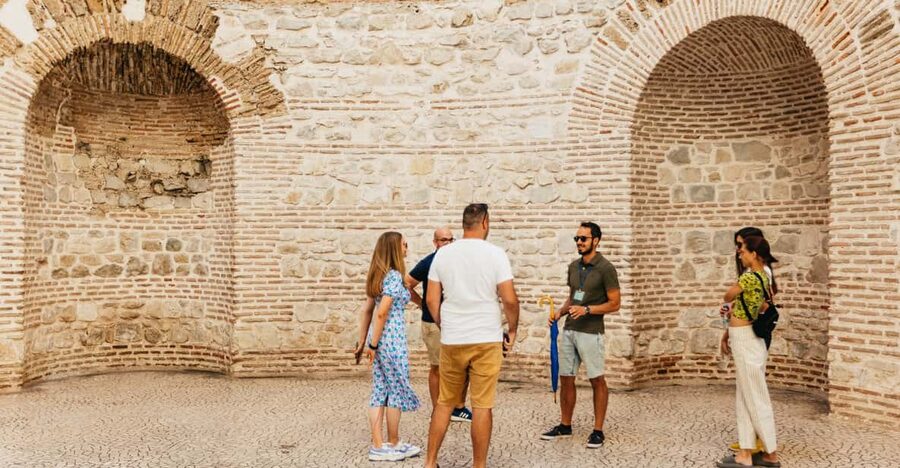
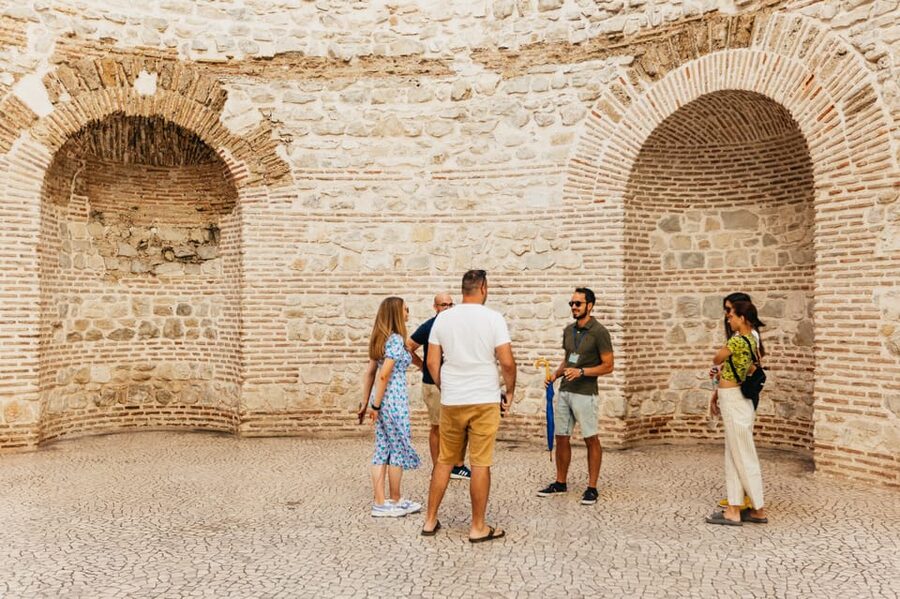
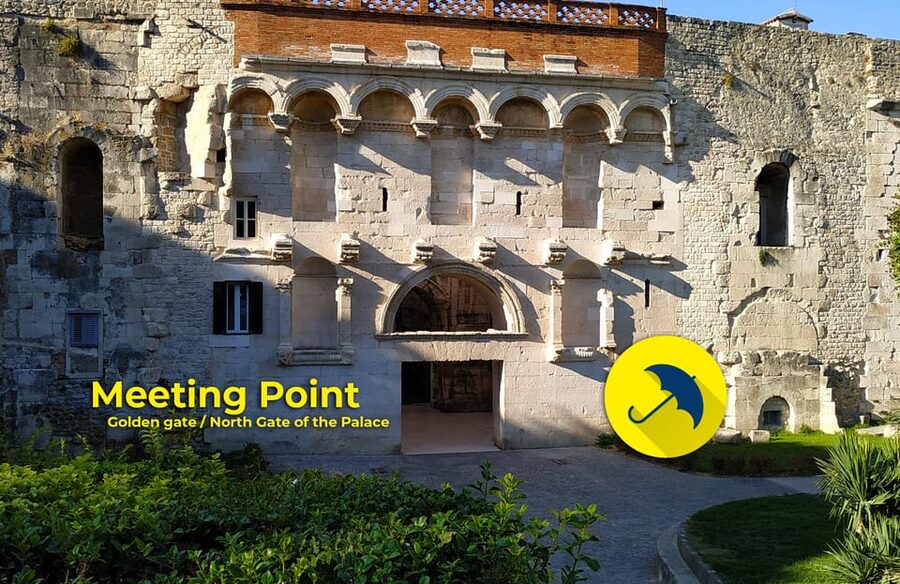
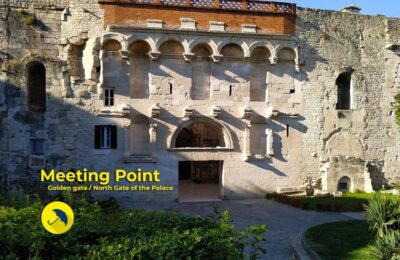
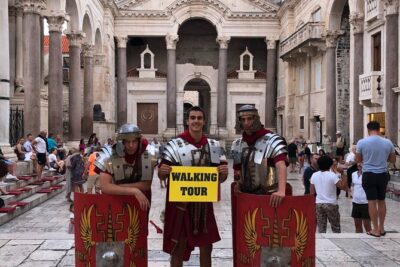
You meet at the Golden Gate, right below the big statue of Gregory of Nin. Look for the blue umbrella. That sounds simple, but Split’s Old Town can get packed around that area, so arriving a few minutes early helps you spot your guide without stress.
This start matters. When you begin at the gate, the whole tour makes more sense right away. It’s the kind of place where, left on your own, you might notice impressive ruins but miss the why behind them. With a guide leading the walk, you start learning the geography and the layout—so later, when you’re looking at walls and doorways, they stop feeling random.
Also, bring comfortable shoes. Several sites inside Diocletian’s Palace have slopes and uneven walking, and one of the best bits of advice is boring but true: if your feet are happy, you’ll enjoy the stories more. Add sunglasses too, because you’ll have bright open-air stretches between shaded passages.
Diocletian’s Palace: why this place feels different once explained
Diocletian’s Palace is the headliner, and the tour’s pacing is designed to make it readable. You spend about 1.5 hours on the guided palace walk, moving through the spaces people still live around and inside. The best part is that you stop thinking of it as ruins. You start seeing it as a complete city plan made by a Roman emperor for control, comfort, and power.
What I like most is how the guide connects what you’re standing next to with what that feature likely meant back then. You’ll hear the story of Diocletian’s palace built for the Roman emperor in 305 CE, and you’ll watch the present-day Old Town snap into place around that Roman skeleton.
The palace can be more surprising than people expect. It’s not just flat corridors and simple walls. It has a layout that can feel steep or tricky in spots, and guides often manage the route with a steady rhythm. In warmer weather, guides are praised for finding shade along the way, which is a big deal in Split when the sun is doing most of the work.
St. Domnius Cathedral and the bell tower viewpoint
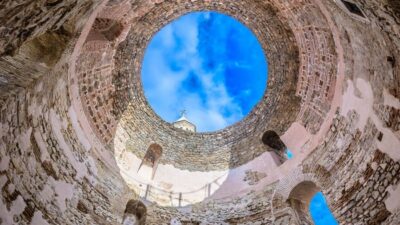
One of the most satisfying moments is when the tour shifts from Roman power to religious continuity. You’ll see the Cathedral of Saint Domnius, including its 12th-century bell tower. This is where Split stops being only an ancient site and becomes a layered one—Roman foundations with medieval changes built on top.
Even if you’ve seen cathedrals elsewhere in Europe, St. Domnius feels different because of its setting. It’s inside a space created by Diocletian, so you’re watching centuries overlap instead of separate. That’s what makes this stop valuable: it gives you a timeline you can point to, not just a list of facts.
If you like quick payoff views, the bell tower layer is the sort of feature that helps you orient yourself. You start noticing how the city’s streets and alleys relate to the palace boundaries. It’s also a nice mental reset during the walk: less “keep moving,” more “pause and look at what time did.”
Peristyle courtyard and the Golden Gate moment
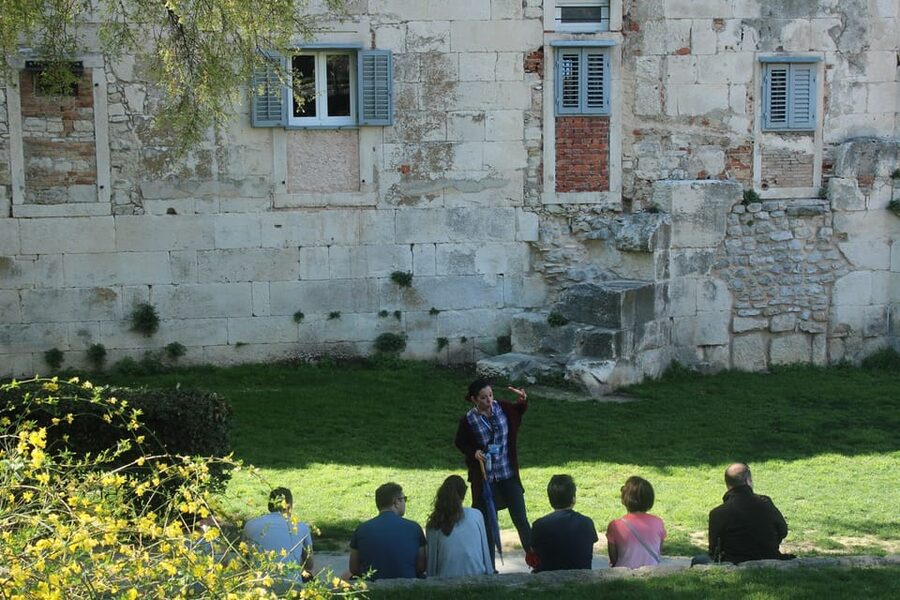
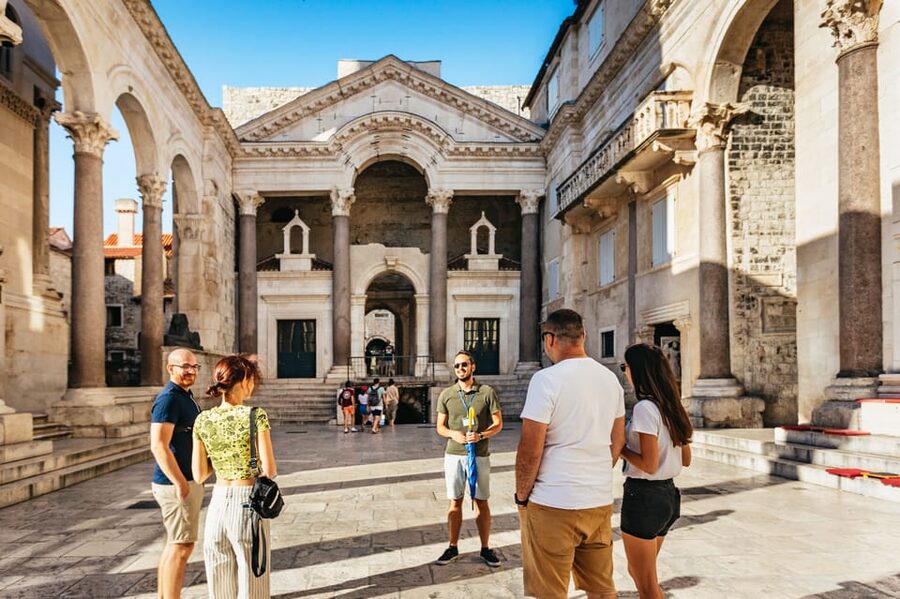
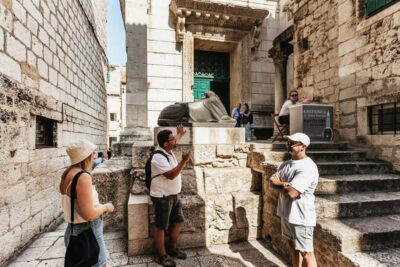
Next comes the courtyard and the gates—two parts that help you understand how people entered, moved, and gathered. You’ll visit the Peristyle courtyard of Diocletian’s Palace, and you’ll get a close look at the Golden Gate, which Diocletian used to walk through to enter his domain.
The Golden Gate is one of those details that changes your perspective fast. From the street, it’s easy to treat it like impressive architecture. With an explanation, it becomes a statement: control over access, ceremonial entry, and the emperor’s presence built into everyday movement.
The Peristyle courtyard also helps you “read” the palace. It’s not just a pretty open space. It’s a key part of the palace’s functioning—where the geometry and daily flow come together. In other words: you’re standing in a room-scale version of political planning.
You’ll also see the statue of Gregory of Nin by the modern sculptor Ivan Meštrović. That adds a totally different tone to the tour. It’s not ancient Roman; it’s a later layer of local identity. And because the statue is part of your starting point, it works like a visual bookmark for the route.


People’s Square, Old Town Hall, and the clock vibe
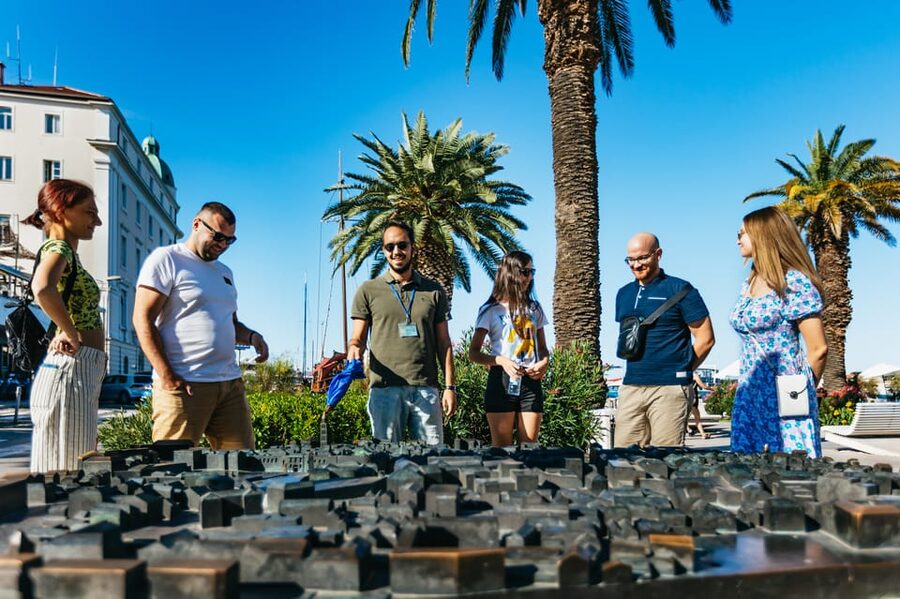
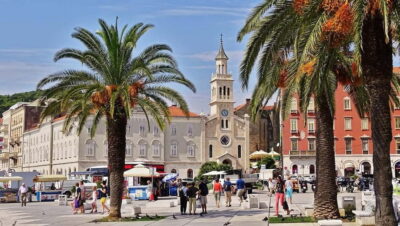
After the palace core, the tour takes you into Old Town space where everyday life and history share the same corners. You’ll see People’s Square, including the Old Town Hall and city clock.
This stop is small but useful. Palace tours can leave you thinking only in ancient terms. People’s Square reminds you that Split didn’t freeze after 305 CE. It kept evolving—administration, public meeting points, and the rhythms of a city that still uses its center.
For your experience, this is where you start making your own connections. Once you understand the palace boundaries, you can look at the streets and squares and see how they likely formed around the Roman plan. If you’ve ever walked through a historic center feeling like everything is impressive but disconnected, this is the part that fixes that.
Riva promenade: your sea-view reward
The tour finishes with a walk to the Riva promenade, down toward views of the Adriatic Sea. This is smart timing. You’ve already done the heavy thinking and the steep walking, so the sea view gives you a breather and helps the whole experience feel complete.
I like the Riva ending because it connects history to the setting that makes people stay in Split. You’ll be looking out over the water while the city around you keeps moving—boats, light, and the constant hum of a coastal town. It makes Diocletian’s palace feel less like a museum and more like the foundation under a living place.
If you’re the kind of person who likes photos, you’ll enjoy this section too. But the real value is orientation: after you walk it, you know which direction the city opens up, and where your next meal or drink will likely be easiest to reach.
Optional Trogir add-on: a longer day with guided context
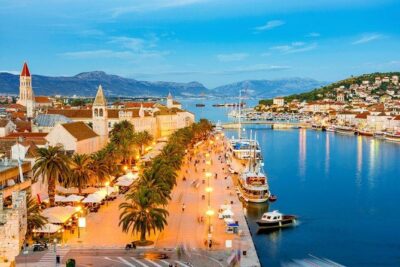
If you choose the option that includes Trogir, the experience expands from a palace-focused visit into a half-day outing. You get transfer to and from Trogir, a guided tour of Trogir, and about 60 minutes free time there.
This add-on is for you if you want more than one historic “slice” in the same day. Trogir is smaller than Split, so the guided time tends to feel tighter and easier to follow. One reason people enjoy it is practical: a short drive with an air-conditioned vehicle helps on hot days, and it means you’re not spending your limited time figuring out transport.
The free hour matters because you can turn guide facts into your own wandering. You can also pace yourself if you’re feeling palace-walked-out. Just remember that the total duration can stretch to up to 5 hours, so plan your day accordingly.
Price and pacing: is $17 really good value?

At about $17 per person, this tour sits in the “cheap enough to be worth it” category for what you get. You’re paying for a local guide, a structured walking route, and the kind of context that makes the site easier to understand on your own later.
The math gets even better if you add Trogir. You’re still paying roughly the same base rate for the Split portion, but the day includes transfer plus extra guided time and an hour to roam. For many people, that’s the difference between seeing ruins and actually learning how the city works.
The pacing also matters for value. Guides are praised for being humorous and engaging, and some are noted for managing crowds and even waiting for slower walkers. That kind of group handling can make a tour feel effortless, even if the terrain isn’t.
If you’re tight on time in Split, this is a smart first move. It helps you get oriented fast—so the rest of your self-guided hours feel less like aimless wandering.
Who this tour suits best (and who should rethink it)
This tour is ideal if you want a high-impact introduction to Split without spending your whole day decoding ruins. It’s a great fit for first-timers, history-curious travelers, and anyone who likes tours that explain what you’re seeing instead of only naming it.
It’s also good for families. Several guides are praised for being friendly with kids and keeping the stories entertaining.
The main reason to rethink it is physical access. It’s not suitable for wheelchair users. And because the palace walking can be steep and uneven, it’s best for people with comfortable walking stamina and steady footing.
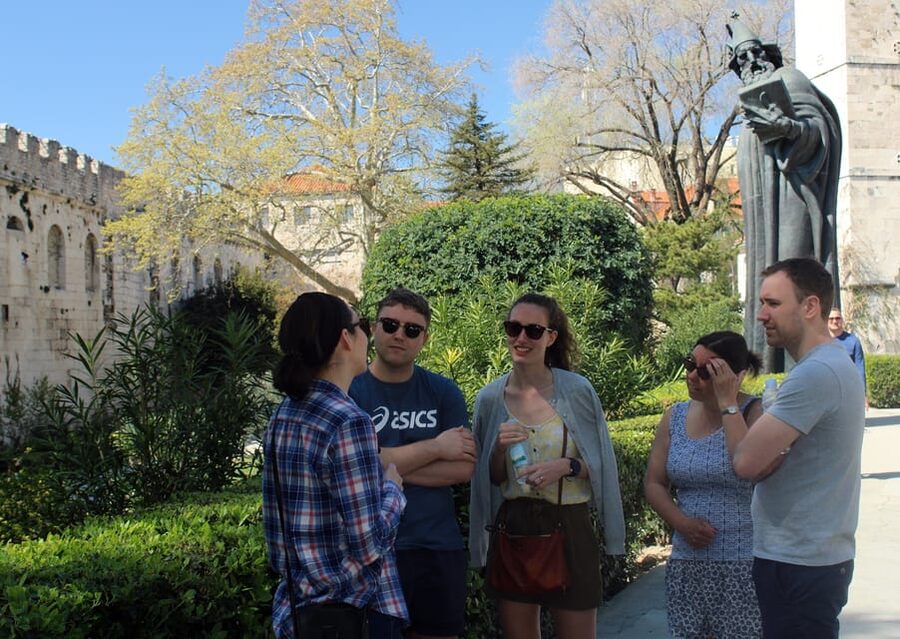
If you dislike crowds, plan to be patient around the meeting area. One practical note from real experiences: it can be hard to spot the right person when there are lots of people at the start, which is why the blue umbrella matters.
Should you book this Split Old Town and Diocletian’s Palace tour?
Yes, if you want your first hours in Split to be guided, understandable, and efficient. This tour’s value comes from the way it turns Diocletian’s Palace from impressive stones into a clear city layout—then connects that Roman spine to St. Domnius, People’s Square, and the Riva.
Book it especially if you’re the type who likes small, specific details: the Golden Gate, the Peristyle, and the Gregory of Nin statue all act like anchors for your memory. Guides such as Slavjko, Antonia, and Ivana are repeatedly praised for making stories fun and for adjusting to real conditions like heat and weather.
Skip it only if you hate walking on uneven ground or you need wheelchair access. Otherwise, this is a solid use of a half-day that gives you a better Split for the rest of your trip.
FAQ
Where do I meet for the Split Old Town and Diocletian’s Palace tour?
You meet at the Golden Gate, below the big statue of Gregory of Nin. Look for the blue umbrella.
What’s the price for this experience?
The price is listed as $17 per person.
How long does the tour take?
The duration ranges from 90 minutes to 5 hours, depending on the option you choose.
Is there an option to include Trogir?
Yes. If you select the option, the experience includes transfer to and from Trogir, a guided tour of Trogir, and 60 minutes of free time in Trogir.
What’s included in the basic tour?
A local licensed English-speaking guide is included, along with a Diocletian’s Palace walking tour.
What should I bring?
Bring comfortable shoes and sunglasses.
Is the tour wheelchair accessible?
No. It’s listed as not suitable for wheelchair users.
More Tours in Split
- From Split: Krka Waterfalls, Food & Wine Tasting Tour
★ 5.0 · 9,326 reviews - Blue cave, Mamma Mia and Hvar, 5 islands speedboat tour
★ 5.0 · 7,150 reviews - From Split: Krka Waterfalls, Food & Wine Tasting Tour
★ 4.9 · 6,598 reviews - Split/Trogir: Blue Cave, Mamma Mia, Hvar and 5 Island Tour
★ 4.6 · 6,320 reviews - Blue Cave and Hvar Tour – 5 Islands Tour from Split and Trogir
★ 5.0 · 4,815 reviews
More Tour Reviews in Split
- Split: Krka Waterfalls Trip with Boat Cruise and Swimming
★ 4.8 · 10,519 reviews - From Split: Krka Waterfalls, Food & Wine Tasting Tour
★ 5.0 · 9,326 reviews - Blue cave, Mamma Mia and Hvar, 5 islands speedboat tour
★ 5.0 · 7,150 reviews - From Split: Krka Waterfalls, Food & Wine Tasting Tour
★ 4.9 · 6,598 reviews - Split/Trogir: Blue Cave, Mamma Mia, Hvar and 5 Island Tour
★ 4.6 · 6,320 reviews
Deeper Into the Palace, Split
- Split: Old Town and Diocletian Palace Walking Tour
★ 4.9 · 4,727 reviews - Walking Tour of Split and Diocletian’s Palace
★ 5.0 · 2,588 reviews - Split & Diocletian’s Palace Walking Tour
★ 5.0 · 1,125 reviews - Split: Diocletian Palace & Old Town Guided Walking Tour
★ 4.7 · 882 reviews - Split: Game of Thrones Tour with Diocletian’s Palace Cellar
★ 4.8 · 545 reviews
Still deciding? More Split trips we have been out and reviewed

Diocletian's Palace & Old Town, compared.
 ★ 4.9Old Town and Diocletian Palace Walking TourFrom $174,727 reviews
 ★ 5.0Walking Tour of Split and Diocletian’s PalaceFrom $482,588 reviews
 ★ 5.0Split & Diocletian’s Palace Walking TourFrom $211,125 reviews
 ★ 4.7Diocletian Palace & Old Town Guided Walking TourFrom $17882 reviews
 ★ 4.8Game of Thrones Tour with Diocletian’s Palace CellarFrom $41545 reviews
 ★ 5.0Diocletian’s Palace and Old Town SMALL GROUP Walking TourFrom $16502 reviews
 ★ 5.0SPLIT-PRIVATE Walking Tour of Diocletian’s Palace & Old TownFrom $240467 reviews
 ★ 5.0Split by Private Electric Rickshaw – Palace & Hidden GemsFrom $48412 reviews
Browse the lists this tour appears in