
Reviewed · DIOCLETIAN'S PALACE & OLD TOWN
Split: Diocletian Palace & Old Town Guided Walking Tour
Ancient walls, live city life, in one tight walk. I love how this tour packs the main sights of Diocletian’s Palace into a smooth Peristyle courtyard loop, and I also love the payoff at St. Domnius bell tower for harbor views. One possible drawback: it’s short, so you have to keep moving over uneven cobblestones.
The biggest reason it works is the guiding. When you get a strong host like Ina, Natasa, Darko, or Tin, the stones stop being “old stuff” and start behaving like a story you can follow, with clear context and plenty of room for questions.
For $17, you’re not just ticking boxes. You’re getting a focused orientation to Split’s layers—Roman layout, medieval street life, and later influences—without spending your whole day on a single monument.
In This Review
- Key highlights you shouldn’t miss
- Diocletian’s Palace in 50 Minutes: Why This Short Walk Works
- Finding the Tour: The Red Open-Top Bus Near Apodos
- From the Riva Promenade to the Palace Walls: Starting With the Right Context
- The Bronze, Silver, Golden, and Iron Gates: Where Power Meets Entrances
- Peristyle Courtyard Access: The Palace’s Center of Gravity
- Emperor’s Private Chambers and the Palace Cellars: Learning How Life Fit Here
- St. Domnius Cathedral (Sv. Duje) and the Bell Tower Views
- Fruit Square, Town Hall, and the Old Town Maze: Seeing the Medieval Layers
- Guide Impact: What You Get When Ina, Natasa, Darko, and Tin Lead
- Price and Value: Is $17 Worth It?
- What to Bring, and How to Handle the Steps and Cobblestones
- After the Tour: How to Use Your 50 Minutes to Plan the Rest of Split
- Should You Book This Split Walk of Diocletian’s Palace and Old Town?
- FAQ
- How long is the Split guided walking tour?
- Where does the tour start?
- What languages are offered for the live guide?
- Is there a skip-the-ticket-line benefit?
- What’s included in the tour?
- What should I bring and wear?
- Is the tour wheelchair accessible?
Key highlights you shouldn’t miss

- Diocletian’s Palace gates: Bronze, Silver, Golden, and Iron entrances make the Roman system feel real
- Peristyle courtyard access: the palace’s ceremonial center, right where daily life evolved
- St. Domnius bell tower views: an easy win for panoramas over the harbor and Old Town
- Split’s living streets: Town Hall area and Fruit Square connect the palace to everyday history
- A guide who answers hard questions: multiple guides (including Ina, Natasa, Darko, and Tin) are praised for clear, funny explanations
Prefer to walk it? More guided strolls through Split
- Split: Old Town and Diocletian Palace Walking Tour★ 4.9 · 4,727 reviews
- Walking Tour of Split and Diocletian’s Palace★ 5.0 · 2,588 reviews
- Krka Waterfalls tour with Trogir Walking tour and Krka panoramic boat cruise★ 5.0 · 1,659 reviews
- Split & Diocletian’s Palace Walking Tour★ 5.0 · 1,125 reviews
Diocletian’s Palace in 50 Minutes: Why This Short Walk Works
If you only have a slice of time in Split, this is one of the smarter ways to use it. Diocletian’s Palace is huge, and doing it on your own usually means you wander, look up, and hope it all clicks. A guided loop forces the important connections: where the power was, where residents moved, and why the later city grew around Roman bones.
This tour is built around that idea. You start at Split’s Riva waterfront, then move straight into the palace core. From there, you hit the places that explain how the site shifted over time: courtyards, gates, and the church that grew out of the emperor’s presence.
The pacing is brisk by necessity. You’re looking at a guided walkthrough (plus photo stops) rather than a slow museum-style experience. If you tend to linger over details, bring patience or plan one or two extra hours afterward to explore at your own speed.
Finding the Tour: The Red Open-Top Bus Near Apodos
Meeting is simple, as long as you’re watching for the right signal. Head to Apodos Travel Agency and look for an open-top red bus. The team is wearing red or white shirts, and they’ll connect you with your guide.
A practical tip: arrive a few minutes early and stand where you can see the bus stop area clearly. One common snag with any bus-based meeting point is timing drift, especially in busy Old Town zones. You don’t want to spend your short 50-minute experience hunting.
Once you’re matched with your guide, the tour moves quickly into the palace area—so good shoes matter more than good guesses.
From the Riva Promenade to the Palace Walls: Starting With the Right Context

The tour begins on the Riva promenade, Split’s lively waterfront lined with palm trees, cafés, and sea-breeze energy. That matters because it gives you a modern reference point before you enter the Roman complex.
Then the experience switches tone. You step into Diocletian’s Palace, originally built for the Roman Emperor Diocletian in the 4th century AD. Today, the palace walls form the heart of Split’s UNESCO-listed Old Town. In other words: you’re not visiting a ruin off to the side—you’re walking inside the framework of a city that kept evolving.
This opening sequence is also a good “orientation reset.” The guide’s first job is to show you what you’re looking at, so the later gates and courtyards feel less random.
The Bronze, Silver, Golden, and Iron Gates: Where Power Meets Entrances
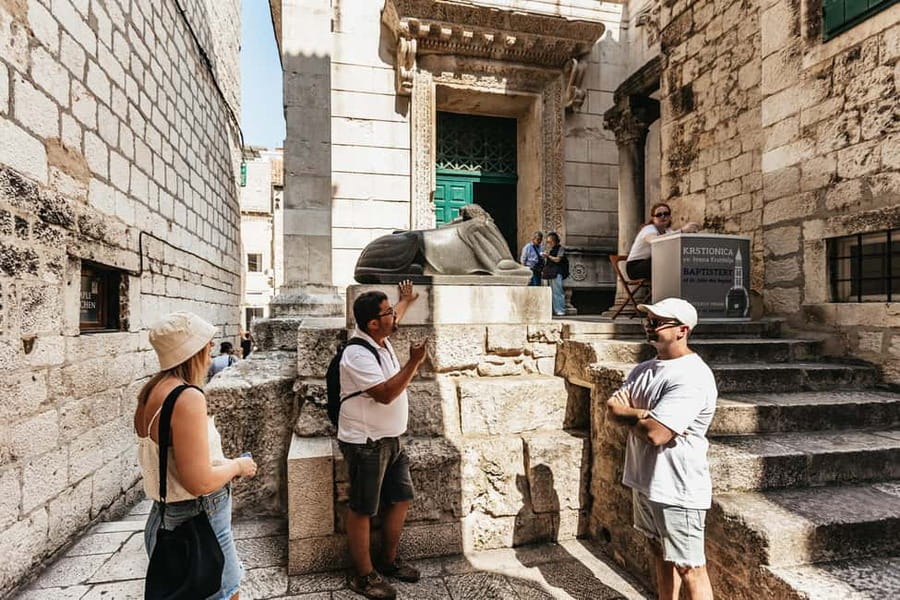
One of the most fun parts of this tour is that it doesn’t treat the gates like decorative trivia. You walk through the Bronze, Silver, Golden, and Iron Gates—the original entrances meant to protect and organize the imperial complex.
Why this is valuable: gates aren’t just “pretty doors.” In Roman planning, entrances control movement and communicate status. When you’re told what each gate suggests about flow, security, and hierarchy, you start noticing the palace as a system rather than a pile of stones.
It’s also a great photo moment, but more importantly, it’s a mental map moment. After the gates, you understand where you are in relation to the palace core, so the rest of the walk makes better sense.
Inside the palace walls: more Old Town tours around Split
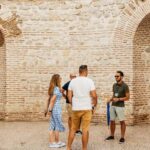
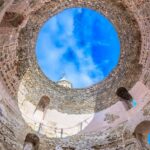
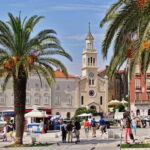

Peristyle Courtyard Access: The Palace’s Center of Gravity

Inside the complex, you get access to the Peristyle courtyard, described as the majestic heart of the palace. This is the kind of space where Roman architecture does its best work: strong lines, open light, and a layout that makes you feel how movement and gathering were designed.
If you only remember one “palace feeling,” make it this. The Peristyle is where ceremonies, daily routines, and later reuse all intersected. When your guide connects the architecture to how the area functioned after the Roman era, the courtyard becomes more than a backdrop for pictures.
One more practical note: you’ll be doing some walking on uneven surfaces. If your ankles are fragile, take it slow around the transitions from street to courtyard areas.
Emperor’s Private Chambers and the Palace Cellars: Learning How Life Fit Here
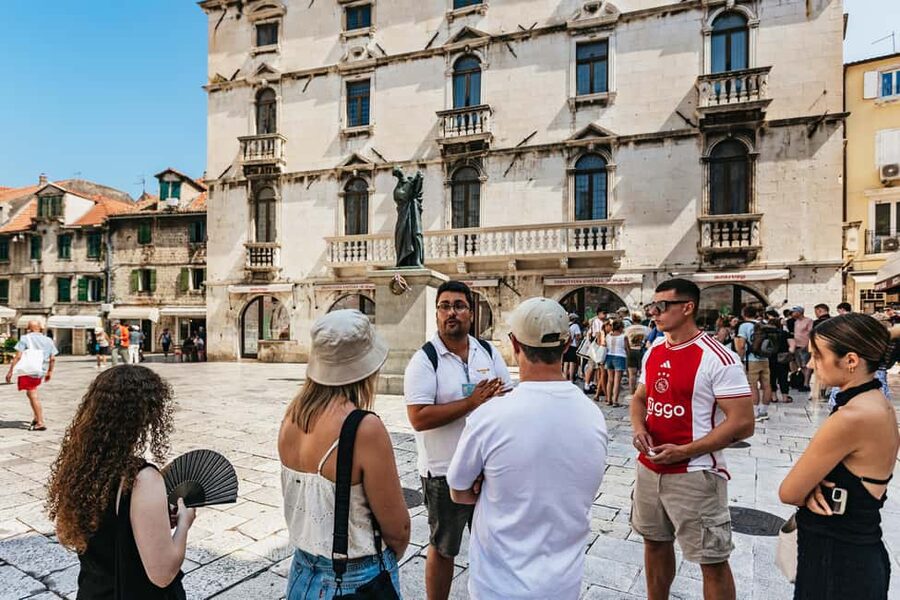
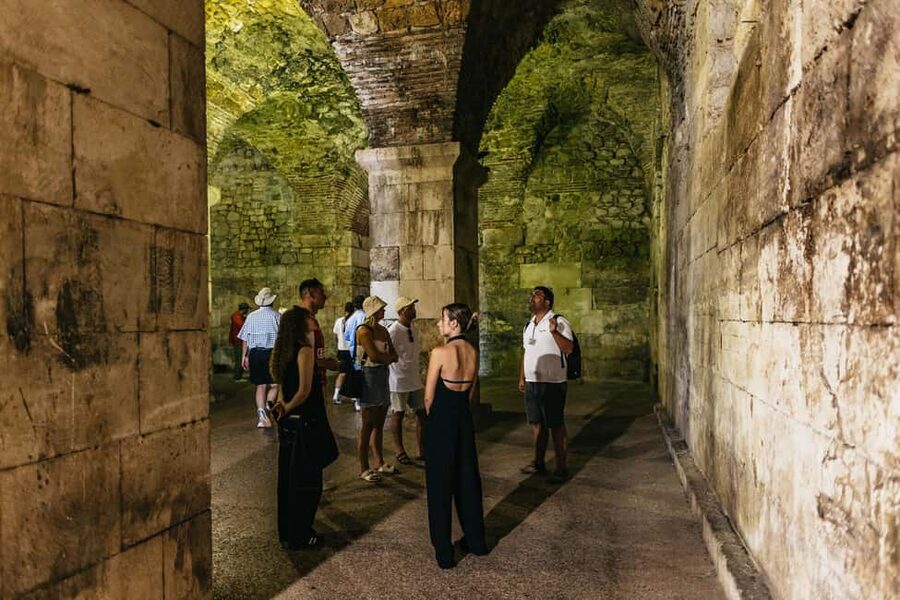
The tour doesn’t stay only in the public-facing areas. You also explore the palace cellars and Diocletian’s former private chambers, plus time at an emperor’s private observatory.
This is where the guided part pays off. The palace can look like a maze from outside. When you’re shown what rooms were for, and how the palace design shaped movement, you start to see how a complex imperial residence could turn into an actual neighborhood over time.
The cellar segment helps too. It reminds you that buildings like this weren’t just symbolic. They were engineered to support real living conditions—storage, structure, and the practical needs of a large compound.
St. Domnius Cathedral (Sv. Duje) and the Bell Tower Views
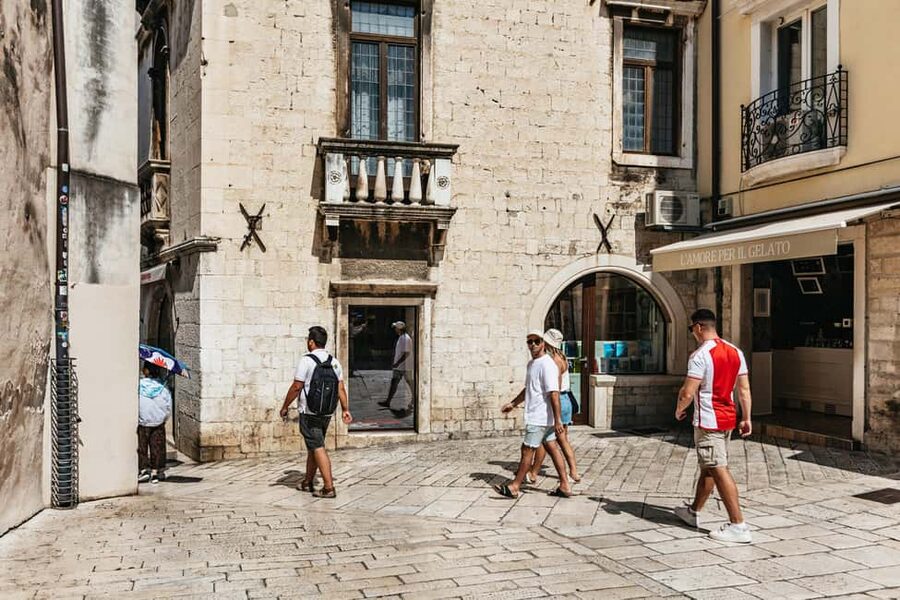
Next comes a big emotional and visual payoff: the Cathedral of St. Domnius (Sv. Duje). It was once the emperor’s mausoleum and is now one of the world’s oldest cathedrals.
Your guide also helps you connect the dots between Roman power and later religious significance. Then you climb the bell tower for panoramic views of the city and harbor.
This is the moment when the tour feels like more than architecture notes. You look out at Split as a layered city: Roman foundations under medieval street patterns, all with the Adriatic as the constant background.
Keep an eye on your time and your legs here. Tower climbs are short, but the steps are real. If you’re someone who gets winded easily, pace yourself and take quick breaths before you start snapping photos.
Fruit Square, Town Hall, and the Old Town Maze: Seeing the Medieval Layers
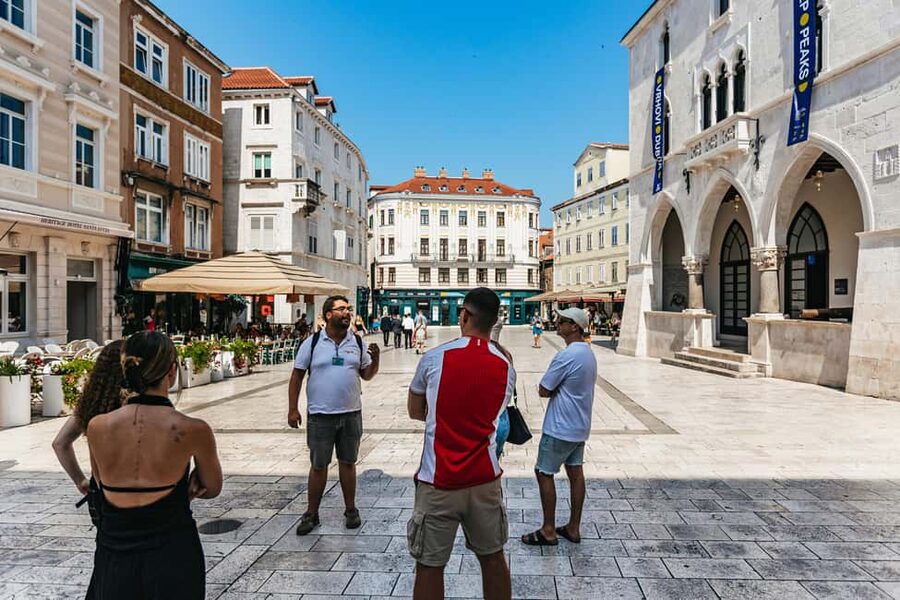
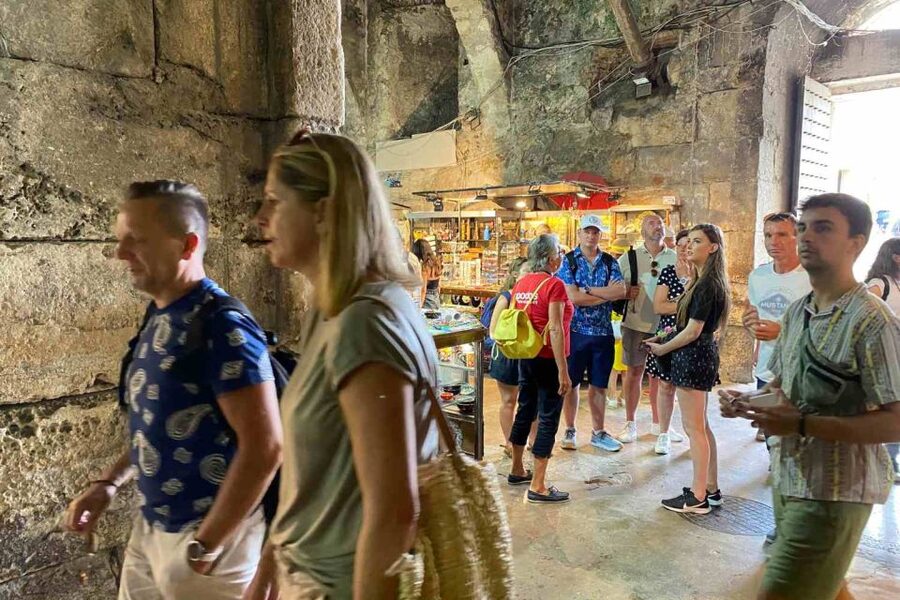
After the palace core, the walk moves into Split Old Town streets where later eras leave their marks.
You’ll hear about hidden gems like the Benedictine and the 15th-century Town Hall, then stroll through the baroque monuments of Fruit Square. Even if you’re not trying to become a baroque expert by the end of the day, this part matters because it shows how the palace didn’t freeze history.
Split’s Old Town evolved around the palace. The medieval and later city adapted Roman structure into streets and public life. When your guide connects that chain, you stop thinking of the palace as a sealed chapter and start seeing it as a foundation for everything that came after.
This section can also feel like a “guided choose-your-own-adventure.” Once you understand where Fruit Square fits relative to the palace, you’ll navigate the rest of Old Town with more confidence.
Guide Impact: What You Get When Ina, Natasa, Darko, and Tin Lead
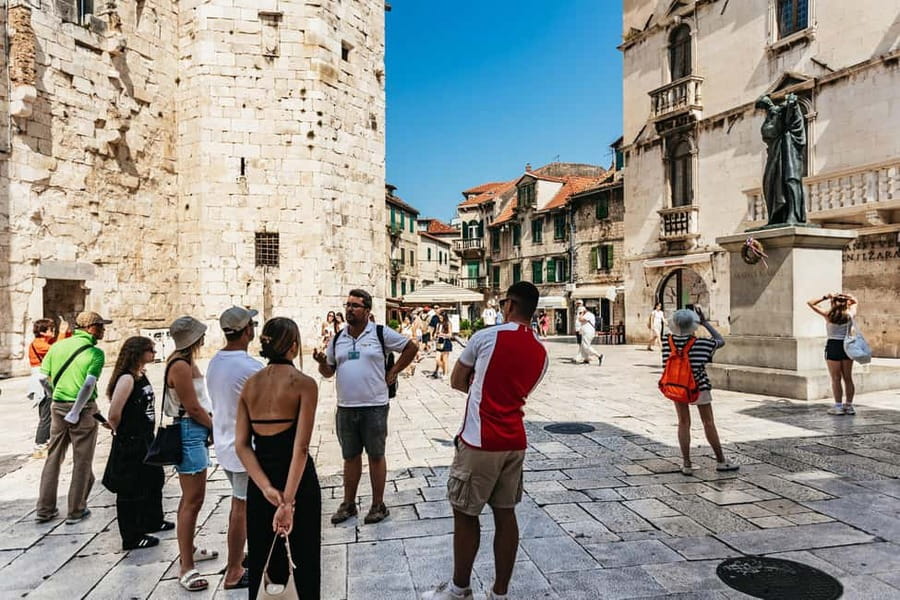
The tour lives or dies by the guide. The information quality is a major theme here, and it shows in the names that keep coming up.
- Ina is repeatedly praised for combining historical context with an engaging, question-friendly style.
- Natasa (sometimes written Nataša) gets credit for clear explanations that turn the palace into a story about change over centuries, plus a strong command of the art-history angle.
- Darko is noted for humor and a real passion for how Split has functioned over time, including daily-city context beyond the palace walls.
- Tin stands out for being funny and for keeping things moving even when people have questions.
You’ll likely hear a lot of “why” behind what you’re seeing: why an entrance matters, why a courtyard layout matters, and how later eras reused Roman structure. That’s the point. Even a short tour can feel full if the guide connects the dots.
One small practical note: a couple of people in the feedback mentioned a microphone would have helped. In real-life terms, that means if you’re near the back of the group, choose your spot early so you can hear clearly.
Price and Value: Is $17 Worth It?
At $17 per person, this tour is priced like an easy add-on, but it doesn’t feel cheap because it targets high-impact areas.
Here’s what your money buys in real terms:
- A guided walk through Diocletian’s Palace plus the Old Town connections
- Access to the Peristyle courtyard
- Structured stops at the gates and key interiors (including cellars and private chambers)
- A bell-tower climb at St. Domnius (Sv. Duje) for the harbor view
- Built-in context on how Roman, medieval, and later influences shaped Split
You also avoid extra hassle with the “skip the ticket line” detail. For a short 50-minute experience, saving time matters. A delayed start or a long queue can eat the value fast.
The only “cost” you’ll pay is effort: you’re walking, you’re listening, and you should plan for some steps over cobblestones.
If you want one guided experience that gives you a map in your head for the rest of Split, this price-to-value ratio is strong.
What to Bring, and How to Handle the Steps and Cobblestones
The basics are simple:
- Comfortable shoes
- Camera
- Water
The tour also gives you some common-sense clothing guidance. Wear long sleeves on windy days, and sunglasses plus a hat on sunny days. That’s not just comfort—it’s survival in an open-air waterfront-to-stone complex.
Know before you go: you must be able to walk over uneven, cobblestone surfaces with 15 to 30 steps to take part. That doesn’t sound like much until you realize the steps are uneven and the pacing is brisk. If you’re traveling with mobility limits, confirm that your needs match what the route requires.
Wheelchair accessibility is listed, which is encouraging. Still, the “uneven and cobblestone” note matters because many “accessible” Old Town routes depend on the exact path that day.
After the Tour: How to Use Your 50 Minutes to Plan the Rest of Split
Once you’ve got the palace layout in your head, Old Town feels easier. You’ll be able to spot how the streets relate to palace boundaries, and you’ll understand why certain squares feel like they’re “made” for public life.
Your best move afterward is to slow down for 30 minutes somewhere you liked most—Riva for sea-level energy, or Old Town streets for the medieval street pattern. If you choose a spot based on what your guide emphasized (for example, Fruit Square or a gate viewpoint), you’ll get a better sense of place with less wandering.
This is also a good time to look for small local stops nearby, since the tour emphasizes the city as a living place rather than a sealed monument.
Should You Book This Split Walk of Diocletian’s Palace and Old Town?
Yes—if you want a high-value orientation to Split and you like architecture explained in plain language. This tour is especially good for first-timers who feel overwhelmed by the scale of Diocletian’s Palace, but still want the big moments: gates, Peristyle courtyard, St. Domnius bell-tower views, and the Old Town links around Fruit Square and Town Hall.
Skip it only if you need a very slow pace or you struggle with uneven cobblestones and short stair climbs. With that in mind, it’s a strong pick for a tight schedule, a good starting point for the rest of your day, and an easy way to turn “I’ve heard of Diocletian” into “I can see how it worked.”
FAQ
How long is the Split guided walking tour?
The tour duration is listed as 50 minutes.
Where does the tour start?
The meeting point is Apodos Travel Agency. You look for an open-top red bus next to it and the team wears red or white shirts.
What languages are offered for the live guide?
The live tour guide is available in English, Spanish, and Italian.
Is there a skip-the-ticket-line benefit?
Yes, the tour lists skip the ticket line.
What’s included in the tour?
Included items cover a guided tour of Diocletian’s Palace and Split Old Town, access to the Peristyle courtyard, exploration of the emperor’s private observatory, visits to the Bronze, Silver, Golden, and Iron Gates, insights into the 15th-century Town Hall, a stroll through Fruit Square baroque monuments, and historical stories throughout.
What should I bring and wear?
Bring comfortable shoes, a camera, and water. On windy days, long sleeves are recommended. Sunglasses and a hat are recommended on sunny days.
Is the tour wheelchair accessible?
Wheelchair accessibility is listed, but you must be able to walk over uneven and cobblestone surfaces with 15 to 30 steps to take part.
More Tour Reviews in Split
- Split: Krka Waterfalls Trip with Boat Cruise and Swimming
★ 4.8 · 10,519 reviews - From Split: Krka Waterfalls, Food & Wine Tasting Tour
★ 5.0 · 9,326 reviews - Blue cave, Mamma Mia and Hvar, 5 islands speedboat tour
★ 5.0 · 7,150 reviews - From Split: Krka Waterfalls, Food & Wine Tasting Tour
★ 4.9 · 6,598 reviews - Split/Trogir: Blue Cave, Mamma Mia, Hvar and 5 Island Tour
★ 4.6 · 6,320 reviews
Deeper Into the Palace, Split
- Split: Old Town and Diocletian Palace Walking Tour
★ 4.9 · 4,727 reviews - Walking Tour of Split and Diocletian’s Palace
★ 5.0 · 2,588 reviews - Split & Diocletian’s Palace Walking Tour
★ 5.0 · 1,125 reviews - Split Old Town and Diocletian’s Palace Tour
★ 4.8 · 716 reviews - Split: Game of Thrones Tour with Diocletian’s Palace Cellar
★ 4.8 · 545 reviews
Walk Split a Different Way
- Split: Old Town and Diocletian Palace Walking Tour
★ 4.9 · 4,727 reviews - Walking Tour of Split and Diocletian’s Palace
★ 5.0 · 2,588 reviews - Krka Waterfalls tour with Trogir Walking tour and Krka panoramic boat cruise
★ 5.0 · 1,659 reviews - Split & Diocletian’s Palace Walking Tour
★ 5.0 · 1,125 reviews - Walking Tour of Split with a ‘Magister’ of History
★ 5.0 · 1,122 reviews
Still deciding? More Split trips we have been out and reviewed



Diocletian's Palace & Old Town, compared.
 ★ 4.9Old Town and Diocletian Palace Walking TourFrom $174,727 reviews
 ★ 5.0Walking Tour of Split and Diocletian’s PalaceFrom $482,588 reviews
 ★ 5.0Split & Diocletian’s Palace Walking TourFrom $211,125 reviews
 ★ 4.8Split Old Town and Diocletian’s Palace TourFrom $17716 reviews
 ★ 4.8Game of Thrones Tour with Diocletian’s Palace CellarFrom $41545 reviews
 ★ 5.0Diocletian’s Palace and Old Town SMALL GROUP Walking TourFrom $16502 reviews
 ★ 5.0SPLIT-PRIVATE Walking Tour of Diocletian’s Palace & Old TownFrom $240467 reviews
 ★ 5.0Split by Private Electric Rickshaw – Palace & Hidden GemsFrom $48412 reviews
Browse the lists this tour appears in