
Reviewed · SPLIT OLD TOWN WALKING TOURS
Private History Split Walking Tour in Spanish
Few places teach you power and religion faster than Split. This private History Split Walking Tour in Spanish guides you through Diocletian’s Palace and the surrounding old-town streets, so you don’t just look at stone—you learn why it matters. I especially like the way the tour works from the Peristyle outward, and the focus on how Diocletian went from outsider to ruler of huge influence. One drawback to plan for: the walk is not recommended if you struggle with high steps, and you’ll be outside for most of the 1 hour 30 minutes.
What really stands out is the guide style: the tour is led by someone well educated, and past guests noted clear explanations and solid Spanish (and good attention to questions). You also get real structure to your visit: the stops concentrate on the Palace core first, then connect it to Split’s waterfront and later layers of history. If you’re hoping for a full museum time-slot, note this doesn’t include the museum part of the substructures—but you can often add that later.
Because it’s private, you’ll move as a group only (so you’re not pacing with a big crowd), and the tour ends not far from where it starts. The overall value is strong at $63.05 per person for a tightly packed route that hits the big sights without turning your day into a marathon.
In This Review
- Key points at a glance
- Diocletian’s Palace: the best “90-minute history” classroom in Split
- Starting at the Peristyle: get oriented, then everything clicks
- Jupiter and the idea of divine legitimacy
- The Golden Gate and Gregory of Nin: where architecture meets language
- Under the palace: Diocletian’s substructures and how their jobs changed
- Riva Harbor and the Palace afterlife: how Split grew outward
- Fruit’s Square (Trg Brace Radic): Venetian layers and Marko Marulić
- Split Synagogue: a pass-by with real context
- Vestibulum of Diocletian’s Palace: a doorway moment
- How the second substructures visit changes what you notice
- Price and value: what you’re really paying for at $63.05
- Language factor: Spanish guidance you can actually use
- Who should book this private Spanish walk (and who should skip it)
- Should you book Private History Split Walking Tour in Spanish?
- FAQ
- Where does the tour start and end?
- How long is the Private History Split Walking Tour in Spanish?
- Is this tour private?
- What’s included in the tour price?
- Are admission tickets included for everything?
- Is the tour suitable for people with limited mobility?
Key points at a glance
- Peristyle orientation first: you get a quick map of the Palace layout before wandering farther.
- Jupiter and divine branding: learn how Diocletian linked himself to a “divine father” idea.
- Palace substructures, not just surfaces: you see the under-layer story and how functions changed over time.
- Golden Gate meets Gregory of Nin: the Palace entrance doubles as a language-and-identity lesson.
- Riva Harbor and a bronze model: you connect the Palace to Split’s later waterfront growth.
- Synagogue stop is a pass-by: you learn the context, but entry is not included.
On your own schedule: more private tours in Split
- SPLIT-PRIVATE Walking Tour of Diocletian’s Palace & Old Town★ 5.0 · 467 reviews
- Private Krka Waterfalls tour with 30min Boat Cruse★ 4.0 · 458 reviews
- Split by Private Electric Rickshaw – Palace & Hidden Gems★ 5.0 · 412 reviews
- Private Blue cave, Mamma Mia and Hvar, 5 islands tour from Split★ 5.0 · 387 reviews
Diocletian’s Palace: the best “90-minute history” classroom in Split
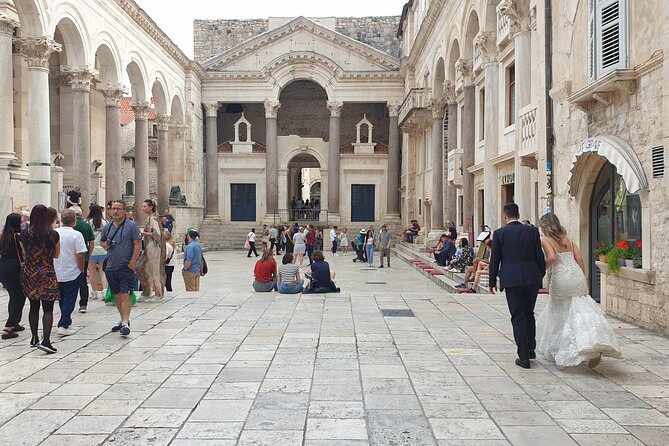
If you only have a morning or early afternoon, Diocletian’s Palace is the place to spend it. The walls and passageways are big enough to feel like a city inside a city, but you can still cover the highlights without draining your whole day. That’s exactly how this tour is built: it centers on the Palace spaces people actually notice when they’re walking around, then adds the “why” behind them.
I like that the route is efficient without feeling rushed. You start at the Peristyle, the central square that acts like the Palace’s navigation hub. From there, every other stop makes more sense, because you’ve already learned how the complex is laid out. It’s the kind of orientation that helps you keep your bearings once you leave the tour.
You should also know what this tour is designed to do—and what it isn’t. It’s a walking tour focused on the Palace highlights and the story threads that connect Diocletian to later Split. It’s not a museum deep dive. The good news: after the tour, you can choose whether you want to spend extra time in the museum areas on your own.
Starting at the Peristyle: get oriented, then everything clicks
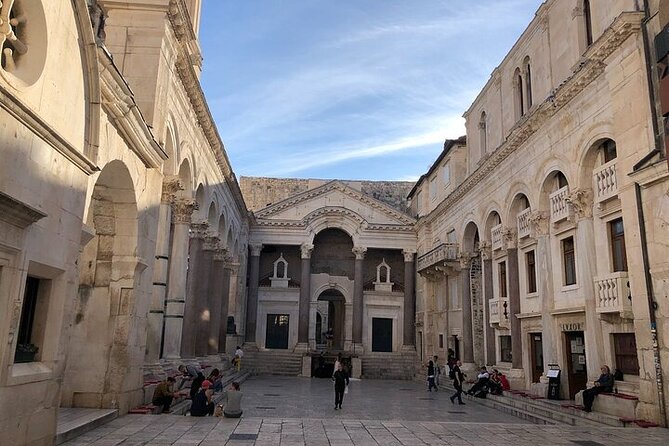
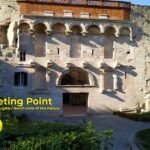
The tour begins at Peristil ulica (near the Peristyle area). You’ll start with the Peristyle of Diocletian’s Palace, the central square where you can reach many key parts of the complex. This first stop is short, but it does a lot of work: it gives you the big-picture layout before you start tracking smaller details.
Think of it like learning the compass rose before you start walking. Once you understand where you are in the Palace plan, you can read the architecture better—gate to gate, corridor to courtyard. If you’ve ever toured ancient sites where you feel like you’re just collecting photos, this avoids that. The Palaces’ geometry becomes a story, not a maze.
Jupiter and the idea of divine legitimacy
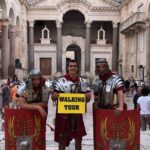
Right after the Peristyle, the tour includes time to learn about the Roman temple of Jupiter. The key point isn’t just who was worshipped—it’s why the message mattered. Diocletian considered Jupiter his divine father, and that belief helped him frame power as something sanctioned by the gods, not merely grabbed by force.
This is a smart stop because it changes how you look at the rest of the Palace. Instead of seeing isolated religious references, you start noticing how rulers used religion like a public relations tool. If you like “how power talks,” this piece will land well.
The Golden Gate and Gregory of Nin: where architecture meets language
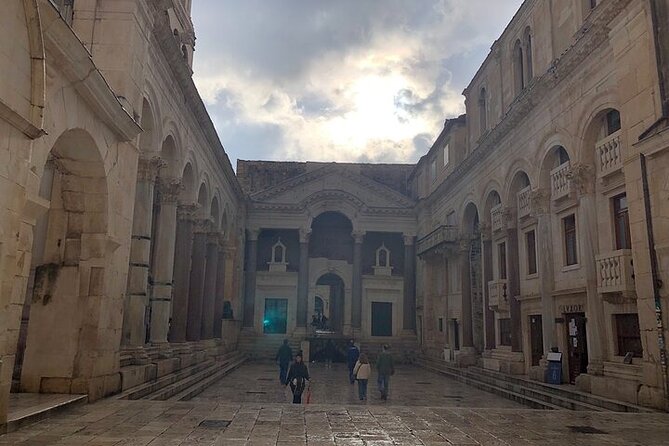
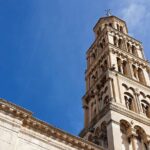
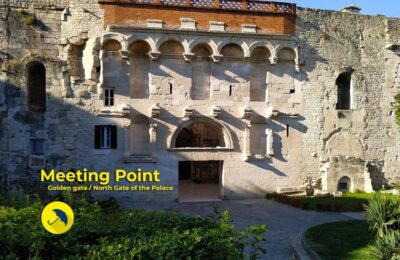
Next, you’ll reach the Golden Gate, the main entrance of Diocletian’s Palace. It’s a big visual moment—an entry point that feels ceremonial even now. But the tour doesn’t keep it purely architectural.
You’ll also see the statue of Gregory of Nin, and you’ll learn why he matters to Croatian history and even to language. That’s a good reminder that old places aren’t only preserved—they’re still connected to identity today. When you hear the explanation, the statue stops feeling like decoration and starts feeling like a historical signpost.
One practical note: gates and major entrances often mean more foot traffic in the area. The private format helps because your guide can shape the pacing around what you want to absorb without dragging you through crowds.
Prefer to walk it? More guided strolls through Split

Under the palace: Diocletian’s substructures and how their jobs changed
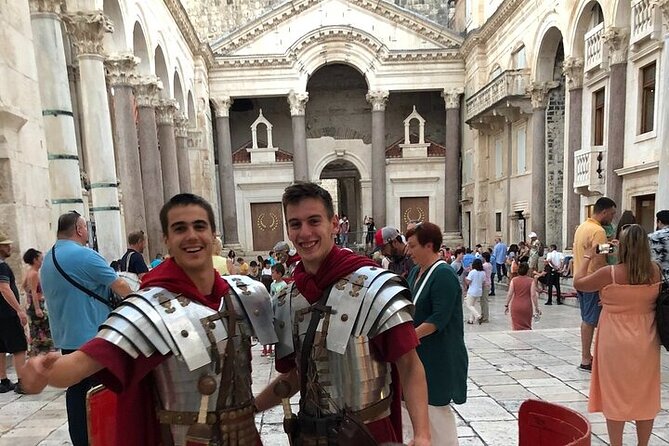
After the main surface highlights, the tour moves into Diocletian Palace substructures. This is one of the most valuable parts of the experience for anyone who likes “how things actually worked.” You’re not just seeing what looks impressive; you’re learning how the Palace was constructed and what the substructures were used for.
The tour mentions you’ll go through the substructures while learning their history and function over the ages, but you won’t visit the museum portion. That’s a thoughtful design choice. It keeps the walking tour moving and focused, while still giving you the core context needed to enjoy the museum later—if you want it.
You’ll even pass through the substructures again later in the tour, which can be helpful. After you learn more about the Palace story and nearby highlights, the second walk-through often makes details feel less random. It’s like hearing the plot once, then rewatching a scene with new context.
Riva Harbor and the Palace afterlife: how Split grew outward
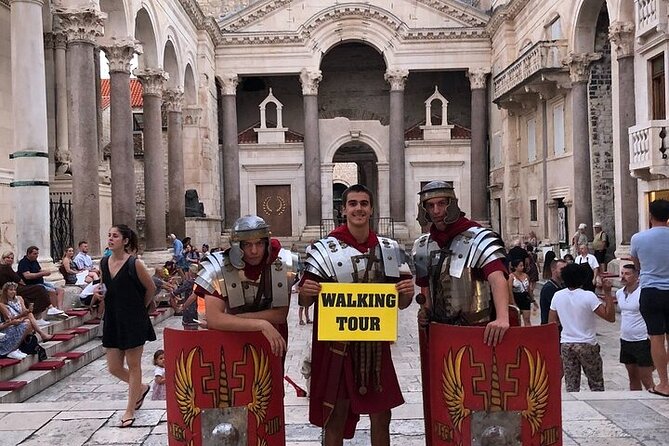
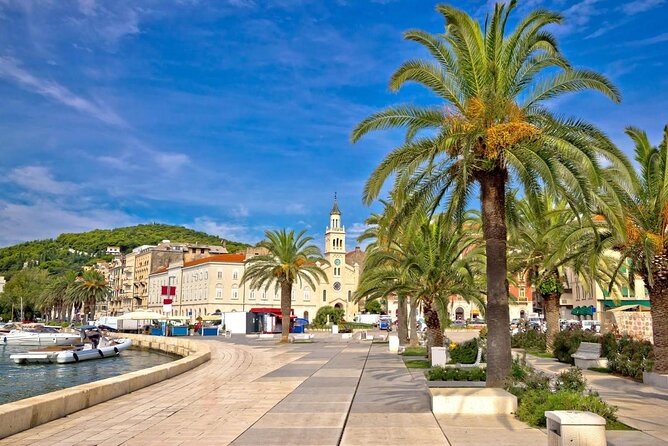
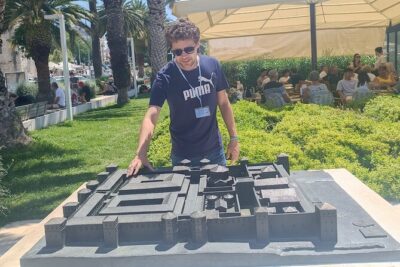
Then the tour shifts to Riva Harbor, a view that helps you connect the Palace to the waterfront life around it. You’ll see a bronze model of Diocletian’s Palace here—small enough to understand quickly, but clear enough to tie the big architecture back to what you’ve been walking through.
This stop matters because it shows the Palace isn’t a sealed-off artifact. It’s part of Split’s later story. Riva Harbor is also where you can feel the city’s rhythm: promenades, sea air, and the sense that Split lives around its harbor. Even if you’re not a “model” person, it’s worth it because it reinforces spatial understanding.
Fruit’s Square (Trg Brace Radic): Venetian layers and Marko Marulić
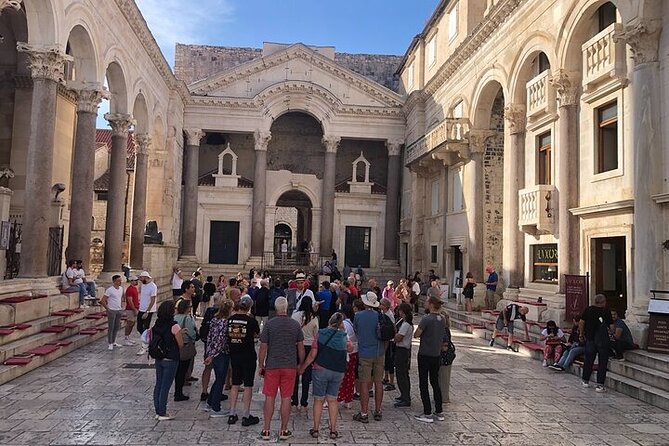
Next is Fruit’s Square (Trg Brace Radic), where you’ll learn about an important layer of later history: a 15th-century Venetian citadel. That’s the kind of detail that makes Split’s old streets feel like a timeline you can walk across, not just a preserved set.
You’ll also hear about Marko Marulić, described as the father of Croatian literature. This is a strong pairing—Venetian military presence next to a cultural legacy—because it shows how different kinds of influence shaped the city. Architecture brings power. Literature turns that power into meaning. Together, it gives you a fuller picture of what “history” means in everyday life.
If you’re the type who likes to understand why certain names keep showing up in plaques, street signs, or stories, you’ll likely enjoy this stop.
Split Synagogue: a pass-by with real context
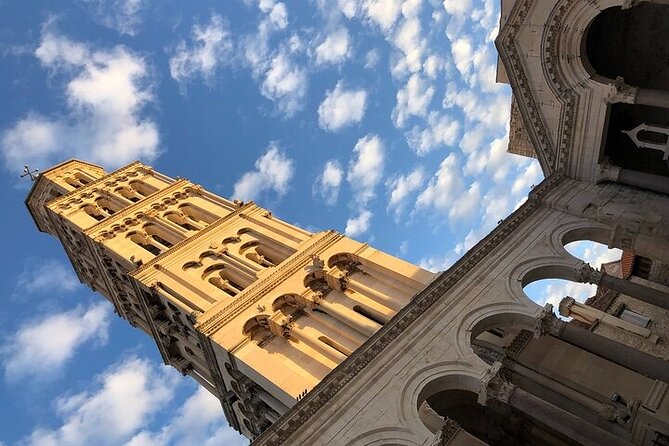
The tour passes by the 16th-century Split Synagogue. You’ll learn about the history of the Jewish people in Split, but the stop is clearly a “pass by” moment. Importantly, admission tickets for this are not included, so you’re not expected to enter as part of the tour.
This kind of stop works well when you want historical orientation without turning the walk into an extended detour. It’s also a gentle way to learn without feeling like you missed something, because you can decide later whether you want to do more on your own.
If you have a special interest in Jewish history and you enjoy visiting specific sites, you might want to plan extra time separately—since this tour doesn’t cover entry.
Vestibulum of Diocletian’s Palace: a doorway moment
Another short but memorable stop is the Vestibulum of Diocletian’s Palace. Here, you’ll see the vestibule of emperor Diocletian. The tour notes you might also hear traditional Dalmatian singing, which can add a nice local flavor to the ancient setting.
Even if you don’t hear singing that day, the vestibule stop still helps because it’s closer to the “threshold” feeling of the Palace. You’re not just looking at big open spaces—you’re learning how movement through spaces shaped the experience of living in or entering the Palace.
How the second substructures visit changes what you notice
The itinerary includes another round through the substructures (again, without the museum portion). Repetition sounds boring on paper, but in practice it can help you remember. After the Golden Gate, harbor story, and cultural stops, you come back with a wider set of connections.
This is where context pays off. You might start focusing on functional details and construction logic rather than treating the underground areas like a background feature. If you like architecture, you’ll likely find your attention sharpening the second time around.
And since the tour ends not far from where it starts, you aren’t stuck far away from your next plans. Your guide can take you back to the Peristyle if you ask.
Price and value: what you’re really paying for at $63.05
At $63.05 per person for about 1 hour 30 minutes, the price is basically buying you three things:
1) A structured route through the Palace highlights
2) A guide who explains the connections (power, religion, identity, and later layers of Split)
3) Private-group pacing so you can ask questions and move without the pressure of a large group schedule
The “private” piece matters more than it sounds. In places like Diocletian’s Palace, the architecture is complex and easy to misread. A good guide helps you avoid wandering with only vague impressions. And the route is built so most stops have admission ticket free included—so your day isn’t chopped up by extra ticket decisions.
What’s not included: gratuities, and some site-specific admission (notably, the synagogue). Also, the tour doesn’t include the museum part of the substructures. But that’s not necessarily a negative. You get the key orientation and storytelling, then you can decide if a longer museum visit is worth it for you.
One more small value point: the tour uses a mobile ticket, which is convenient. And since it’s near public transportation, it’s easier to slot into a day in Split.
Language factor: Spanish guidance you can actually use
This is a Spanish walking tour, and the feedback you’d hope for is consistent: guests noted the guide’s Spanish is quite good, explanations are clear, and the guide stays attentive to questions. That matters because the content is dense—Jupiter, Diocletian’s rise, Gregory of Nin, Venetian citadels, Marko Marulić, Jewish history in Split. If the language is shaky, the whole experience gets harder.
If you speak Spanish, great—you’ll get the full benefit. If your Spanish is at an intermediate level, you’ll still likely follow the story because the stops are visual and the guide can point and explain on-site.
Who should book this private Spanish walk (and who should skip it)
This tour fits best if you:
- want the highlights of Diocletian’s Palace without turning it into a multi-hour ordeal
- like clear explanations that connect people, power, and place
- prefer private-group pacing and question time
- want to understand Split’s layers, from Roman-era thinking to later cultural identity
It may not fit if you:
- struggle with high steps, since the tour is not recommended for that
- want a museum-only experience (the substructures museum isn’t part of the tour)
- need guaranteed indoor time or lots of seating (this is mostly walking and standing)
If you’re the type who plans to keep exploring afterward, this tour is a strong starting move. It gives you a framework, and then you can roam with less guesswork.
Should you book Private History Split Walking Tour in Spanish?
I’d book it if you want a focused, story-driven look at Diocletian’s Palace and the key Split landmarks around it, in a private setting and in Spanish. The price sits in a reasonable mid-range for a tailored walking tour, and the stop choices line up well with the kinds of questions people usually have when they wander the Palace on their own.
The rating data is also encouraging: it averages 4.9 with 97% recommended, which usually points to a consistent guide experience and a route that lands for most visitors. If you care about understanding what you’re looking at—especially the “how did Diocletian become so powerful” thread and the later cultural references—you’ll likely feel it was time well spent.
If you’re short on time in Split, this is one of those rare tours that uses your hours efficiently. You’ll leave with the layout in your head, names you can place, and a better sense of how Split grew from Roman power into a living modern city.
FAQ
Where does the tour start and end?
The tour starts at Peristil ulica (Peristil ul.), 21000, Split. It ends not far from where it started, near Diocletian’s Palace in Grad, Split. You can ask the guide to take you back to the Peristyle.
How long is the Private History Split Walking Tour in Spanish?
The duration is about 1 hour 30 minutes.
Is this tour private?
Yes. It’s a private tour/activity, so only your group participates.
What’s included in the tour price?
The tour includes the guided walking experience led by an educated guide, plus it uses a mobile ticket. Most stop locations mention admission ticket free for the included route segments.
Are admission tickets included for everything?
Most stops listed as part of the route are admission ticket free, but the Split Synagogue admission is not included. The museum part of the substructures also isn’t visited during the tour.
Is the tour suitable for people with limited mobility?
It’s not recommended for travelers who have issues with high steps. The tour is near public transportation and most travelers can participate, but steps are the main caution mentioned.
More Tour Reviews in Split
- Split: Krka Waterfalls Trip with Boat Cruise and Swimming
★ 4.8 · 10,519 reviews - From Split: Krka Waterfalls, Food & Wine Tasting Tour
★ 5.0 · 9,326 reviews - Blue cave, Mamma Mia and Hvar, 5 islands speedboat tour
★ 5.0 · 7,150 reviews - From Split: Krka Waterfalls, Food & Wine Tasting Tour
★ 4.9 · 6,598 reviews - Split/Trogir: Blue Cave, Mamma Mia, Hvar and 5 Island Tour
★ 4.6 · 6,320 reviews
Walk Split a Different Way
- Split: Old Town and Diocletian Palace Walking Tour
★ 4.9 · 4,727 reviews - Walking Tour of Split and Diocletian’s Palace
★ 5.0 · 2,588 reviews - Krka Waterfalls tour with Trogir Walking tour and Krka panoramic boat cruise
★ 5.0 · 1,659 reviews - Split & Diocletian’s Palace Walking Tour
★ 5.0 · 1,125 reviews - Walking Tour of Split with a ‘Magister’ of History
★ 5.0 · 1,122 reviews
Just Your Group in Split
- SPLIT-PRIVATE Walking Tour of Diocletian’s Palace & Old Town
★ 5.0 · 467 reviews - Private Krka Waterfalls tour with 30min Boat Cruse
★ 4.0 · 458 reviews - Split by Private Electric Rickshaw – Palace & Hidden Gems
★ 5.0 · 412 reviews - Private Blue cave, Mamma Mia and Hvar, 5 islands tour from Split
★ 5.0 · 387 reviews - The Best of Split Private Tour
★ 5.0 · 338 reviews
Still deciding? More Split trips we have been out and reviewed
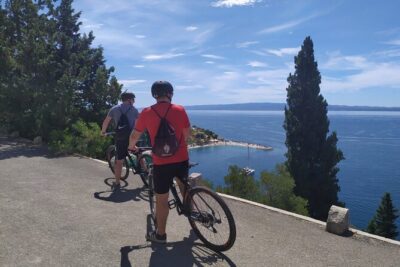
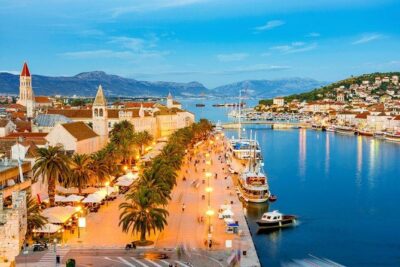
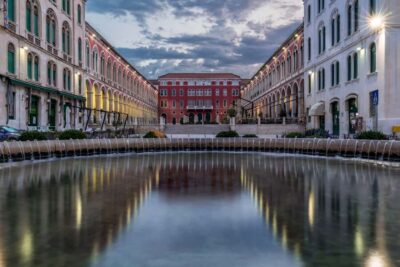


Split Old Town Walking Tours, compared.
 ★ 4.9Old Town and Diocletian Palace Walking TourFrom $174,727 reviews
 ★ 5.0Walking Tour of Split and Diocletian’s PalaceFrom $482,588 reviews
 ★ 5.0Krka Waterfalls tour with Trogir Walking tour and Krka panoramic boat cruiseFrom $481,659 reviews
 ★ 5.0Split & Diocletian’s Palace Walking TourFrom $211,125 reviews
 ★ 5.0Walking Tour of Split with a ‘Magister’ of HistoryFrom $341,122 reviews
 ★ 5.0Split Walking Tour with Professor of HistoryFrom $24926 reviews
 ★ 4.7Diocletian Palace & Old Town Guided Walking TourFrom $17882 reviews
 ★ 4.7Krka Waterfalls Cruise & Trogir Walking TourFrom $47681 reviews
Browse the lists this tour appears in