
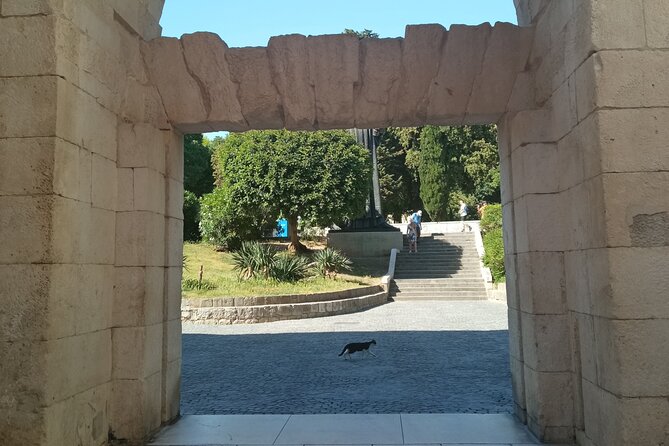
Reviewed · SPLIT OLD TOWN WALKING TOURS
Private History and Trivia Walking Tour by a Local Guide
Diocletian’s Palace, on foot and on schedule. This private history and trivia walk in Split is built for time-tight days, with a local guide leading you past the big icons and the little details that most people miss. I love how the route stays walkable and gets you into areas bigger bus tours usually skip, and I like that you focus on free-entry highlights instead of juggling ticket stops.
The main thing to watch is the pace. It’s a whistle-stop itinerary, so if you want to linger for photos or long museum-style reading, you’ll probably wish you had extra time.
In This Review
- Key Things You’ll Notice on This Tour
- Private History and Trivia in Split: What You’re Really Paying For
- Start at Riva Harbor: Setting the Scene by the Sea
- Enter Diocletian’s Palace Substructures Through the Bronze Gate
- Peristyle Square: The Palace’s Central “Stage”
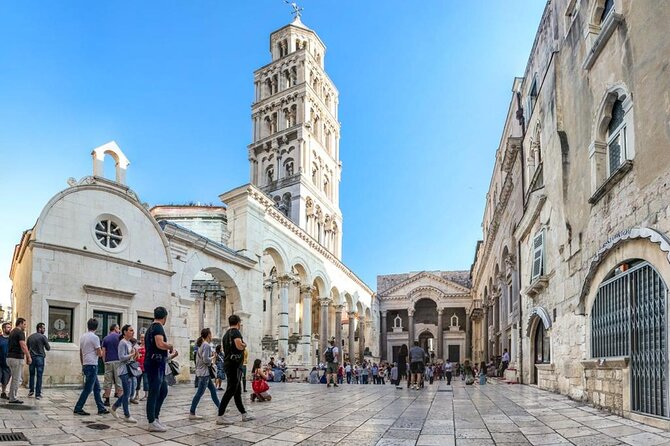
- Cathedral of St Domnius: When a Mausoleum Becomes a Cathedral
- Temple of Jupiter: A Roman Site Recast for Christian Worship
- Fruit Square, Marko Marulić, and the Narrow Streets of Old Split
- Narodni trg and the Palace-Lined Squares of Split
- Zeljezna Vrata (Iron Gate) and the Palace’s Eastern Logic
- City Museum of Split and the Papalić Palace Connection
- Golden Gate and the Art of Looking Up
- Bell Tower of St. Arnir: Early Christian Remnants in Plain Sight
- Finish on Marmontova Ulica: Views Over the Theater and Church Complex
- How Much Is It Really Worth? (And When to Choose It)
- Who This Tour Suits Best
- Should You Book This Private History Walk?
- FAQ
- How long is the Private History and Trivia Walking Tour in Split?
- Is this tour private, or do I join other groups?
- What languages are available for the guide?
- Do I need to pay extra admission fees at the stops?
- Where do I meet the guide?
- Will I get a mobile ticket?
- Can I cancel for a full refund?
- Is this tour suitable for most travelers, and are service animals allowed?
Key Things You’ll Notice on This Tour
- Private, small-group feel (up to 15): You stay together with only your group, so questions don’t get lost.
- Whistle-stop pace that still teaches: You cover major palace landmarks fast without turning it into a race.
- Diocletian’s Palace all the way through: From the southern Bronze Gate to the Golden Gate and the Iron Gate area.
- Stories that connect eras: Roman structures become Christian spaces, and old squares reflect later civic life.
- Guide personalities matter: Ivan is repeatedly described as fun, friendly, and willing to answer questions in depth.
On your own schedule: more private tours in Split
- SPLIT-PRIVATE Walking Tour of Diocletian’s Palace & Old Town★ 5.0 · 467 reviews
- Private Krka Waterfalls tour with 30min Boat Cruse★ 4.0 · 458 reviews
- Split by Private Electric Rickshaw – Palace & Hidden Gems★ 5.0 · 412 reviews
- Private Blue cave, Mamma Mia and Hvar, 5 islands tour from Split★ 5.0 · 387 reviews
Private History and Trivia in Split: What You’re Really Paying For
At $53.95 per person, this tour sits in the sweet spot between “fast overview” and “real guidance.” You’re not just buying a route—you’re buying someone’s time, their storytelling, and their ability to point out what matters as you walk. For Split, where you can burn an entire afternoon just wandering, that focus is value.
The big practical win is duration: about 1 hour 45 minutes. That’s long enough to feel like you learned the city, but short enough to still plan a second visit to your favorite spot afterward. And because it’s private (your group only), it doesn’t feel like you’re stuck behind strangers at every turn.
You’ll also appreciate the format: a mobile ticket and a clear starting point on the waterfront. Meeting at the promenade helps you orient quickly before you start walking into the palace complex.
Start at Riva Harbor: Setting the Scene by the Sea
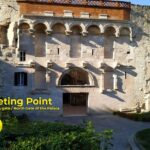
Your tour begins at Obala Hrvatskog narodnog preporoda 22, right on Split’s promenade. The first stretch matters because it frames what you’ll see next. From here, you get visual alignment with the harbor and the broader layout—especially the southern wall area of Diocletian’s Palace.
This is also where your guide can explain how the palace and the city’s coastline interacted. Even if Roman walls look “just walls” at first glance, you start to see them as part of a system: defense, access, and daily life packed into one footprint. You’ll get a quick orientation so you don’t feel lost when you step into the palace.
Tip: Wear shoes you’re happy walking in. Split’s old center is walkable, but you’ll be moving constantly for nearly two hours.
Enter Diocletian’s Palace Substructures Through the Bronze Gate
One of the smartest moves on this tour is that you don’t just look at palace exteriors. You pass into the palace via the southern entrance, the Bronze Gate, and then go into the substructures.
Why this is worth your time: it’s the opposite of “postcard history.” Substructures are where you understand function. You start seeing how the palace worked from the inside out—service corridors, practical spaces, and the hidden architecture that supports the big dramatic parts you’ll see later.
Your guide explains the specific role these areas played across different historical phases, so you’re not only admiring stone—you’re learning why it’s shaped the way it is. It’s also a good mental reset: the walk from the harbor into the palace creates a clear before-and-after feeling.
Peristyle Square: The Palace’s Central “Stage”
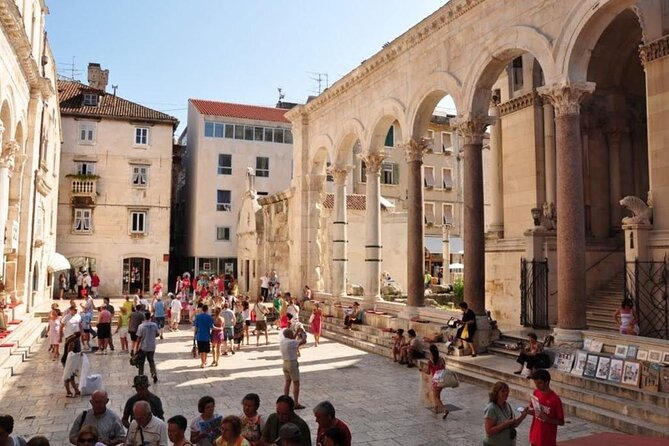
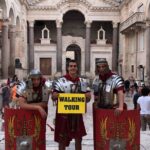
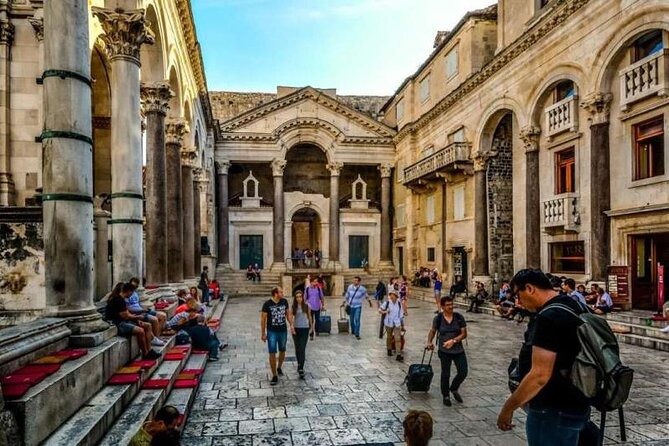
Next you stop at the Peristyle, the palace’s central ancient square. This is where the tour turns from “Roman structures” into “Roman culture.” In one place, you can grasp the palace as a living center rather than a ruin you pass through.
Your guide lays out the historical and cultural background of the site right here, which helps you connect later stops—cathedral conversion, repurposed temples, and the way later Split civic life grew around the palace footprint.
If you like guided context, this is one of the stops you’ll appreciate most. If you prefer quiet self-guided wandering, you may still benefit because the Peristyle is the best place for a 10-minute explanation to “click” in your head.
Prefer to walk it? More guided strolls through Split


Cathedral of St Domnius: When a Mausoleum Becomes a Cathedral
At the Cathedral of Saint Domnius, the story shifts from Roman palace life to Christian transformation. Your guide explains the role the Mausoleum of Emperor Diocletian played—and how it was turned into a cathedral as religion and power structures changed.
This stop also gives you architecture education in plain terms: you learn about construction style in both the cathedral and the adjacent bell tower area. It’s not just facts for a quiz. It’s the kind of explanation that helps you recognize patterns when you look up at stonework.
You’ll also get a strong sense of why Split became a place where layers of time stack without fully removing the earlier ones. Here, you can feel the city’s “reuse” mindset in the physical spaces.
Temple of Jupiter: A Roman Site Recast for Christian Worship
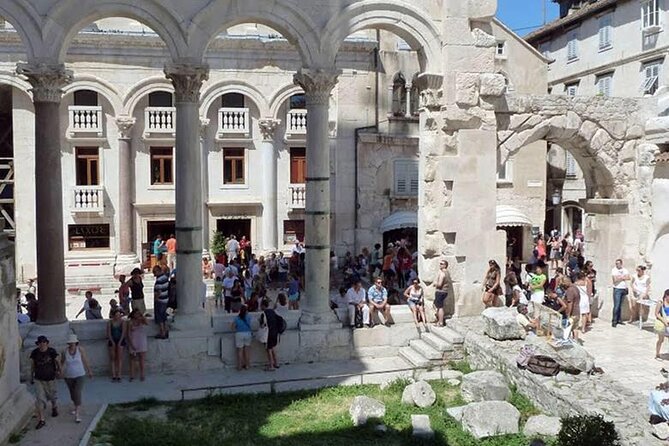
A short walk from the cathedral brings you to the Temple of Jupiter. Your guide explains how it was turned into a baptistery as Christianity spread within the palace walls.
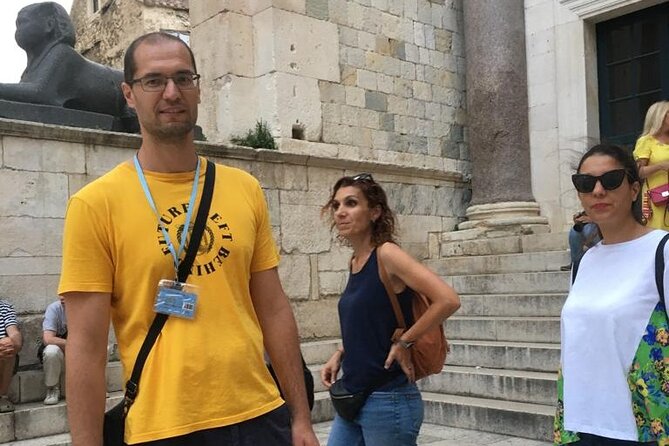
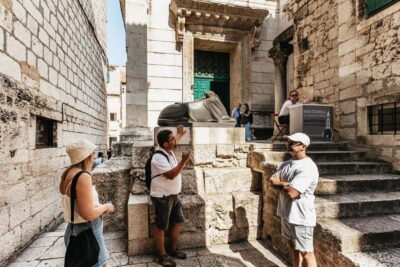
That detail changes how you look at the building. Instead of thinking of it as frozen Roman architecture, you see it as a structure that kept getting new meanings. The sphinx in front also gets mentioned as a visual reminder of the contrast between worlds—Roman-era artifacts and later Christian use.
This stop is a good example of why the “trivia” part matters. Small contrasts like this help your brain remember the big timeline, even if you only spend minutes at each spot.
Fruit Square, Marko Marulić, and the Narrow Streets of Old Split
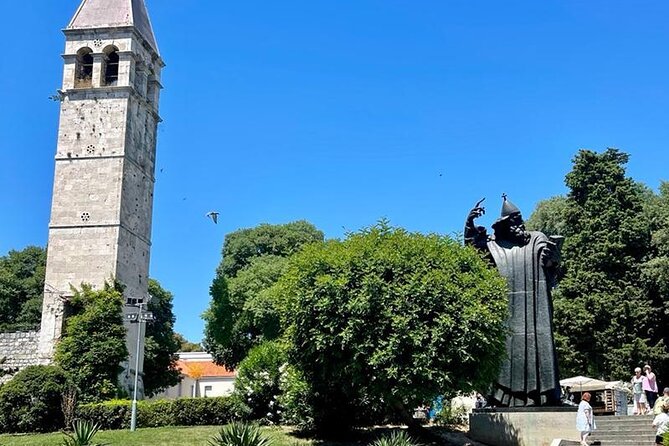
From the palace core, you head toward Fruit’s Square (Trg Brace Radic). The guide brings you through the narrow streets of Split and specifically references the famed Pusti me Proć—the kind of alley experience that feels like stepping into a film set.
Fruit Square is also where the tour starts mixing civic identity with palace history. Your guide talks about the town’s development—or lack of it—during the period when Split was under changing control. That’s the “why” behind what you see.
You’ll pass the statue of Marko Marulić, father of Croatian literature. Nearby, you’ll also see the palace of the Milesi Family from the 17th century. This is a nice rhythm change: after Roman stone and cathedral conversion, you get a human-scale anchor tied to Croatian culture.
Narodni trg and the Palace-Lined Squares of Split
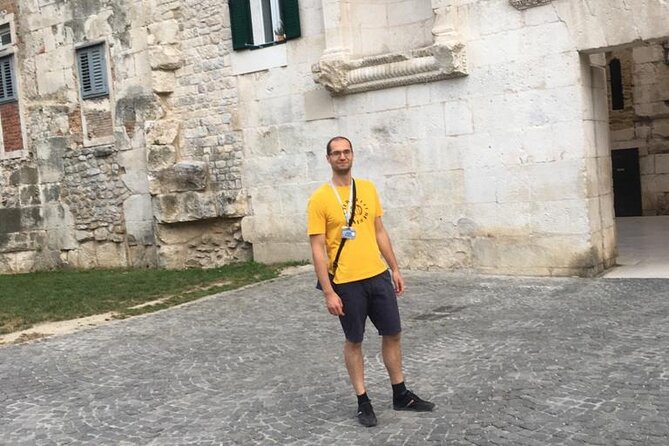
Next comes Narodni trg, the main square area (often treated like Split’s everyday center). Your guide explains how this square developed and how it became the main public space as the town expanded.
Along the way, you’ll pass several notable civic and noble palaces. The tour highlights buildings belonging to prominent Split families, including a recently renovated palace at the western end and additional noble family residences around the square. You’ll also see the old city hall area as part of the square’s story.
This section works well if you want more than “Roman ruins.” It shows how Split’s identity shifted after the palace ceased to dominate every view.
Zeljezna Vrata (Iron Gate) and the Palace’s Eastern Logic
Heading eastward, you reach Zeljezna Vrata, the Iron Gate, and the tour slows just enough to make the history feel concrete. Your guide explains that this gate has a rich history and ties it to different activities that happened there.
Gates in historic cities are never just entrances. They’re control points—where movement is regulated, where power shows up in stone. The guide connects that idea to what you see, including mention of the oldest element tied to this area (the stop description notes an oldest structure, though the exact label isn’t fully spelled out in the details provided).
You’ll also spot more noble residences nearby, including a 17th-century palace tied to the wealthy Cindro family and a 15th-century palace connected to the Italian family Augubio. These aren’t random storefronts. They’re visual clues to who held influence after the palace era.
City Museum of Split and the Papalić Palace Connection
Then you move to the City Museum of Split, located in Papalić Palace. Even if you don’t plan to go deep into the museum during this short tour, it’s a strong landmark stop. The palace itself has historical significance, and there’s an extra layer for pop-culture fans: the area in front is linked to a scene from Game of Thrones.
I like this kind of stop because it offers an “optional expansion.” You can accept the brief connection during the walk, then decide on your own later whether to spend more time inside.
Golden Gate and the Art of Looking Up
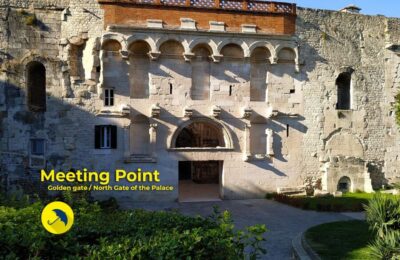
Back inside the palace footprint, you’ll see the Golden Gate—described as the northern entrance and the most decorated. This is one of those places where a short explanation makes your eyes work better. Your guide talks about the way it’s built and why the construction stands out as a Roman achievement.
Right opposite, you’ll also meet Grgur Ninski (Bishop Grgur of Nin), a statue by sculptor Ivan Meštrović. Your guide explains why Grgur is such an important figure in Croatian identity, turning a statue into a person with a story.
This stop is also a small lesson in how cities honor their values through monuments. You walk away remembering that these sculptures and arches aren’t just decoration—they’re signals.
Bell Tower of St. Arnir: Early Christian Remnants in Plain Sight
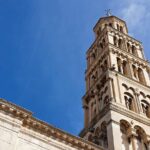
Next to Grgur’s statue, you reach the Bell Tower of Saint Arnir, plus the chapel of Saint Arnir. Your guide points out remnants of an early Christian church nearby and gives a few words to tie the architecture to the bigger story of religious shift.
This area is easy to miss if you’re only doing quick sightseeing. With guidance, it becomes a bridge between the dramatic Peristyle and the concluding waterfront views.
Finish on Marmontova Ulica: Views Over the Theater and Church Complex
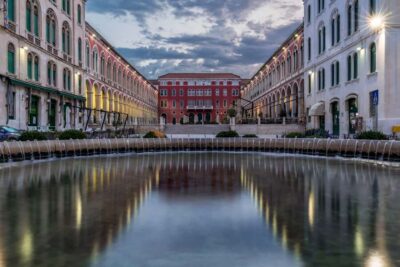
Your tour ends on the top of Marmontova street, with views over the Croatian National Theater and the nearby Monastery and Church of Our Lady of Health. This is a smart way to close the walk: you get height, you get perspective, and you leave with a sense of where the city flows next.
The guide covers the historical aspect of a short-lived period tied to this area (the detail is incomplete in the provided description), but the takeaway is clear: Split keeps changing, and the center keeps absorbing new chapters without losing the old ones.
The tour finishes back at the meeting point on the promenade, which makes it easy to continue on your own afterward—coffee, lunch, or a second visit to the one spot you liked most.
How Much Is It Really Worth? (And When to Choose It)
At $53.95 per person, you’re paying for a guided route that compresses multiple major landmarks into about two hours. If you’re paying for entry tickets separately, this kind of structure can feel expensive. But here, the listed stops show admission ticket free, and you’re not paying for a long, drawn-out day of logistics.
It also helps that the tour is private for your group and capped at 15 persons, which typically means you can actually ask questions and get answers without the guide racing the clock for a large crowd.
Compared to a basic group tour, this one is a better match if you care about details like:
- why Roman spaces became Christian spaces,
- how gates and squares connect to civic life,
- and what to look for when you revisit the palace later on your own.
Compared to a DIY walk, you’re paying to save time and to avoid missing the “why.” In a city where the stones can feel similar, that’s the difference between passing through and understanding.
Who This Tour Suits Best
This is ideal for:
- Time-tight visitors who want a strong orientation to Split without a full-day commitment.
- People who like history explained in a human way, including humor and room for questions.
- Families with kids old enough to handle short stops. One family described bringing children aged 5 and 7, and another mentioned a 12-year-old enjoying the tour when the guide kept things engaging.
It may not be ideal if:
- you want long pauses for reading, sketching, or slow museum time,
- you hate standing and walking for most of the 1h45,
- or you prefer audio-only self-guided exploration.
Should You Book This Private History Walk?
Yes—if you want to understand Split quickly and walk away with a mental map you can reuse. This tour gives you a guided path through Diocletian’s Palace, the cathedral conversion story, and the gate-and-square layout that shapes how the city feels today.
Book it especially if you’re the type who returns to a site later and wants to know what you’re seeing. The guide’s emphasis on answering questions in depth (including in different languages) also makes it a smart first stop.
If you have only one morning or you’re tired from travel, this is the kind of tour that can set you up for the rest of your day—then you can go back at your own pace to whatever grabbed you most.
FAQ
How long is the Private History and Trivia Walking Tour in Split?
It lasts about 1 hour 45 minutes.
Is this tour private, or do I join other groups?
It’s private. Only your group participates, and it has a maximum of 15 persons.
What languages are available for the guide?
The tour includes a local licensed guide speaking English, French, German, Spanish, or Italian.
Do I need to pay extra admission fees at the stops?
The listed stops show admission ticket free, and personal expenses are not included. No extra admission fees are specifically indicated for these stops.
Where do I meet the guide?
You start at Obala Hrvatskog narodnog preporoda 22, 21000 Split, Croatia, and the tour ends back at the same meeting point.
Will I get a mobile ticket?
Yes, the tour includes a mobile ticket.
Can I cancel for a full refund?
Yes. You can cancel up to 24 hours in advance for a full refund.
Is this tour suitable for most travelers, and are service animals allowed?
Most travelers can participate. Service animals are allowed, and the meeting area is near public transportation.
More Tour Reviews in Split
- Split: Krka Waterfalls Trip with Boat Cruise and Swimming
★ 4.8 · 10,519 reviews - From Split: Krka Waterfalls, Food & Wine Tasting Tour
★ 5.0 · 9,326 reviews - Blue cave, Mamma Mia and Hvar, 5 islands speedboat tour
★ 5.0 · 7,150 reviews - From Split: Krka Waterfalls, Food & Wine Tasting Tour
★ 4.9 · 6,598 reviews - Split/Trogir: Blue Cave, Mamma Mia, Hvar and 5 Island Tour
★ 4.6 · 6,320 reviews
Walk Split a Different Way
- Split: Old Town and Diocletian Palace Walking Tour
★ 4.9 · 4,727 reviews - Walking Tour of Split and Diocletian’s Palace
★ 5.0 · 2,588 reviews - Krka Waterfalls tour with Trogir Walking tour and Krka panoramic boat cruise
★ 5.0 · 1,659 reviews - Split & Diocletian’s Palace Walking Tour
★ 5.0 · 1,125 reviews - Walking Tour of Split with a ‘Magister’ of History
★ 5.0 · 1,122 reviews
Just Your Group in Split
- SPLIT-PRIVATE Walking Tour of Diocletian’s Palace & Old Town
★ 5.0 · 467 reviews - Private Krka Waterfalls tour with 30min Boat Cruse
★ 4.0 · 458 reviews - Split by Private Electric Rickshaw – Palace & Hidden Gems
★ 5.0 · 412 reviews - Private Blue cave, Mamma Mia and Hvar, 5 islands tour from Split
★ 5.0 · 387 reviews - The Best of Split Private Tour
★ 5.0 · 338 reviews
Still deciding? More Split trips we have been out and reviewed


Split Old Town Walking Tours, compared.
 ★ 4.9Old Town and Diocletian Palace Walking TourFrom $174,727 reviews
 ★ 5.0Walking Tour of Split and Diocletian’s PalaceFrom $482,588 reviews
 ★ 5.0Krka Waterfalls tour with Trogir Walking tour and Krka panoramic boat cruiseFrom $481,659 reviews
 ★ 5.0Split & Diocletian’s Palace Walking TourFrom $211,125 reviews
 ★ 5.0Walking Tour of Split with a ‘Magister’ of HistoryFrom $341,122 reviews
 ★ 5.0Split Walking Tour with Professor of HistoryFrom $24926 reviews
 ★ 4.7Diocletian Palace & Old Town Guided Walking TourFrom $17882 reviews
 ★ 4.7Krka Waterfalls Cruise & Trogir Walking TourFrom $47681 reviews
Browse the lists this tour appears in