
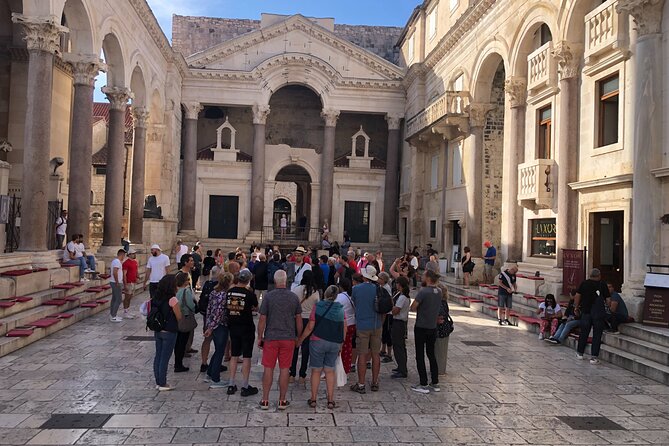
Reviewed · SPLIT OLD TOWN WALKING TOURS
History Split Walking Tour in German – Small group
Diocletian’s Palace makes more sense with a guide. This German-language walking tour is built to help you “read” the site fast, from the Peristyle to the Golden Gate, then out into Split’s streets and waterfront. You’ll learn how Diocletian went from an unknown man to the most powerful one, while the palace’s spaces explain why it was built the way it was.
I really like two things about this tour: the guides bring the story to life, and the pacing keeps it focused. When I saw guides such as Antonella and Josip at work, it was clear they can answer questions without getting lost in trivia, and their humor makes the history easier to swallow.
One thing to consider: this walk is not recommended if you struggle with high steps. Also, you won’t go into the museum part of the substructures, and the synagogue stop is pass-by only with admission not included.
In This Review
- Key highlights in plain terms
- Entering Diocletian’s Palace with a German guide
- The group size and timing that keep it worth your time
- Where you meet and how the route flows
- Stop-by-stop: the highlights you’ll actually remember
- 1) Peristyle of Diocletian’s Palace: your orientation point
- 2) Vestibulum: the emperor’s entry space (and maybe a Dalmatian song)
- 3) Substructures: what the palace used beneath the palace
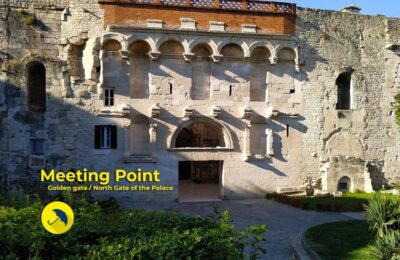
- 4) The Golden Gate: the statue of Gregory of Nin
- 5) Riva Harbor: scale, stories, and a bronze palace model
- 6) Fruit’s Square (Trg Brace Radic): Venetian layers and Marulić
- 7) Split Synagogue: Jewish history, with a pass-by only
- What you’ll learn beyond the photos
- Practical tips so the walk feels easy
- Is this good value for Split’s Diocletian’s Palace?
- Who should book this tour
- Should you book this German Split history walk?
- FAQ
- FAQ
- Is the tour offered in German?
- How long is the tour?
- What does the tour cost?
- How big is the group?
- Where does the tour start and end?
- Are entrance tickets included for all stops?
- Do you visit the substructures museum during the tour?
- Is it suitable if I have trouble with steps?
- What is the cancellation policy?
Key highlights in plain terms
- Small group size (max 20) makes it easy to ask questions at the palace’s tight corners.
- Peristyle first gives you instant orientation, so later stops feel connected instead of random.
- Golden Gate + Gregory of Nin ties the palace to Split’s later identity and language.
- Riva Harbor + bronze palace model helps you visualize the palace scale from outside viewpoints.
- Fruit’s Square and Marko Marulić bring 15th-century Venetian layers and Croatian literature into the mix.
- Synagogue pass-by only means you’ll learn context, but you’ll need a separate ticket if you want to go inside.
Prefer to walk it? More guided strolls through Split
- Split: Old Town and Diocletian Palace Walking Tour★ 4.9 · 4,727 reviews
- Walking Tour of Split and Diocletian’s Palace★ 5.0 · 2,588 reviews
- Krka Waterfalls tour with Trogir Walking tour and Krka panoramic boat cruise★ 5.0 · 1,659 reviews
- Split & Diocletian’s Palace Walking Tour★ 5.0 · 1,125 reviews
Entering Diocletian’s Palace with a German guide

If you’ve only got a day or two in Split, you can easily wander around Diocletian’s Palace and still feel like you missed the point. This tour is designed to fix that. It starts where it should: the Peristyle, the central hub that connects most important parts of the palace. Once you understand that “center,” the rest of the palace stops feeling like a maze.
Because it’s in German, it’s also a good option for German speakers who don’t want to rely on English explanations—or for anyone who wants the history presented clearly, with the guide’s full attention. The story thread is simple and strong: the palace isn’t just impressive stone. It’s a statement of power, and the guide helps you connect spaces to that power.
The group size and timing that keep it worth your time
This is a 1 hour 30 minutes walking tour with a maximum of 20 people. For a site as dense as Diocletian’s Palace, that group size matters. Smaller groups move with fewer bottlenecks, and you get enough time at each stop to actually understand what you’re looking at.
The tour also uses a mobile ticket, which is the practical modern touch you want while traveling. You’re not spending your energy figuring out paperwork. Total walking time feels tight but not rushed, and the itinerary is arranged so you cover the big “must-see” landmarks without trying to squeeze in everything.
Price-wise, it’s $165.08 per person. For some people, that sounds steep for a 90-minute walk. But here’s how I’d judge value: you’re paying for a guide who can connect multiple palace features and nearby old-town landmarks into one story, in German, for a small group size, plus most stops have free admission. If you like guided learning (especially when you want more than a quick photo stop), the math tends to work.
Where you meet and how the route flows
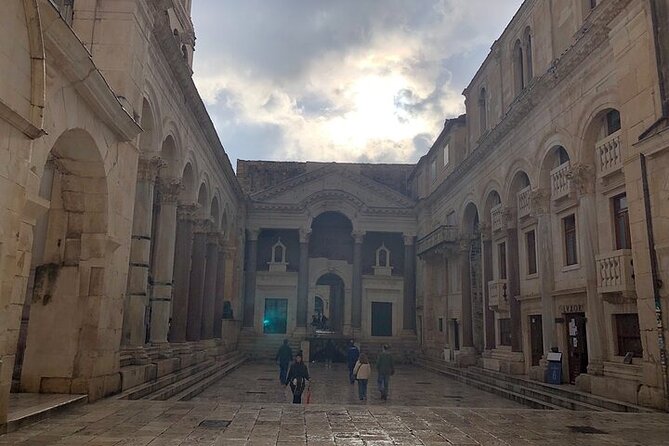
You start at Peristil ul., 21000, Split. The tour ends not far from the starting area, at Diocletian’s Palace. If you want to get back to the Peristyle, you can ask the guide and they can help you find your way there.
That “start and finish near each other” setup is underrated. It means you can plan the rest of your day without stress. You’re not locked into a long one-way route that leaves you far from where you’ll want to grab lunch or return to your hotel.
Stop-by-stop: the highlights you’ll actually remember
A few more Split boat days and tours worth a second look



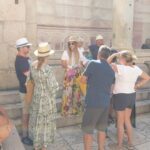
1) Peristyle of Diocletian’s Palace: your orientation point
The Peristyle is the tour’s anchor. This central square is where you can reach many other locations within the palace. The guide uses it to set the mental map.
I like this approach because it reduces that common first-time-palace problem: you see walls and arches, but you can’t connect them. Starting here helps you later when you move through smaller passageways and entrances. You’re not just looking; you’re understanding.
2) Vestibulum: the emperor’s entry space (and maybe a Dalmatian song)
Next is the Vestibulum of Diocletian’s Palace. This is where you’ll learn about Diocletian’s vestibule and its history. The tour may also include the chance to hear traditional Dalmatian singing.
Even if you don’t hear singing on your day, the payoff is still the same: the guide helps you treat this as more than a doorway. It’s a space that fits the palace’s political purpose, and the explanation makes the architecture feel intentional.
Time is short here, about 5 minutes. So if you tend to ask lots of questions, plan to save your biggest ones for later stops too, not only this one.
3) Substructures: what the palace used beneath the palace
Then you move into the Diocletian Palace substructures. This is where the guide focuses on how the substructures were constructed and what they did over time.
One important note: you won’t visit the museum part of the substructures during this tour. The guide keeps it focused on the storyline and the spaces themselves. If you want more after the walk, you can visit the museum section later on your own.
This is a smart compromise. A guided history walk should give you structure first. The museum can be a slower, self-paced follow-up once you know what you’re looking for.
4) The Golden Gate: the statue of Gregory of Nin
The Golden Gate is the palace’s main entrance. Here the guide connects two layers: the palace itself, and what happened later in Split’s history. You’ll also see the statue of Gregory of Nin and learn his importance to history and language.
This stop is one of the reasons I think the tour is more than “Roman ruins.” You leave with a sense that Diocletian’s Palace isn’t sealed off from later identity. The guide shows how later figures and traditions shape how the city reads its own past.
Time is around 10 minutes, so it stays efficient. Still, it’s long enough to understand why Gregory of Nin is repeatedly mentioned in Split conversations.
5) Riva Harbor: scale, stories, and a bronze palace model
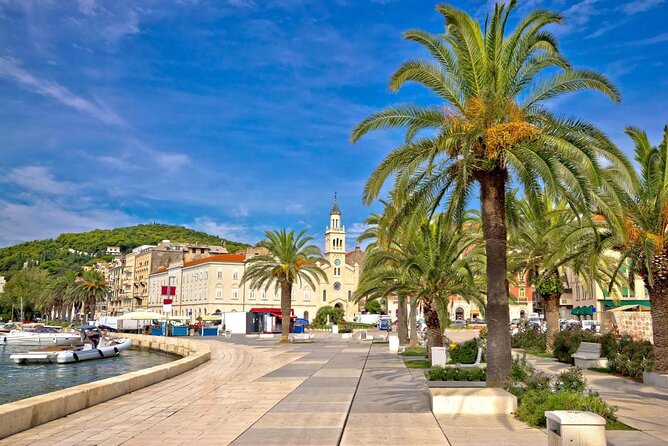
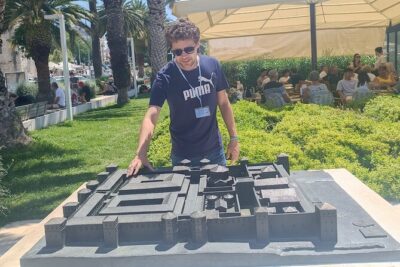
After the palace interior/exterior transitions, the tour moves toward the Riva Harbor area. You’ll see a bronze model of Diocletian’s Palace here, and the guide explains the history of Split’s Riva promenade.
For me, the bronze model is key. It helps you visualize what the palace looked like as a whole, especially if you keep getting turned around by streets and walls. It also turns “waterfront sightseeing” into something educational.
This stop is about 15 minutes. That extra time works well because you can compare what you saw inside the palace to what you see from the harbor direction.
6) Fruit’s Square (Trg Brace Radic): Venetian layers and Marulić
Next is Fruit’s Square, also known as Trg Brace Radic. The guide discusses a 15th-century Venetian citadel and the importance of Marko Marulić, described here as the father of Croatian literature.
This stop widens your lens from Roman power to later cultural identity. You’re not only tracking buildings; you’re tracking ideas. Marulić’s name is a useful anchor because it gives you a sense of what Croatian literature values and why certain historical figures get remembered.
Time is about 10 minutes. It’s enough for context, not enough for an all-day literature lecture. If that’s your thing, you’ll still have plenty of time to explore after the tour.
7) Split Synagogue: Jewish history, with a pass-by only
The tour then passes by the Split Synagogue, a 16th-century synagogue. You’ll learn about the history of the Jewish people in Split. Admission here is not included, and the tour is a pass-by rather than a full visit.
This matters for your expectations. If you want to go inside, plan to do it separately. Since the tour spends most of its time on the palace core, the synagogue stop gives you context without turning the walk into a longer, ticket-heavy day.
What you’ll learn beyond the photos

This tour is built around one big outcome: understanding how the palace’s spaces relate to the people and power behind them. You’ll hear the story of Diocletian rising from nobody to the most powerful man in the world. You’ll also get explanations of how parts of the palace were made for specific functions, and how those functions shifted over time.
Guides like Antonella and Josip are highlighted in the experience as being well educated and liked by guests, with a strong sense of humor. That combination matters. If you’re the kind of person who wants to ask why something is where it is, or how one area connects to another, you’ll feel supported.
And if you prefer history that’s told with clarity instead of a pile of dates, you’ll likely enjoy how the stops are short, focused, and tied together.
Practical tips so the walk feels easy
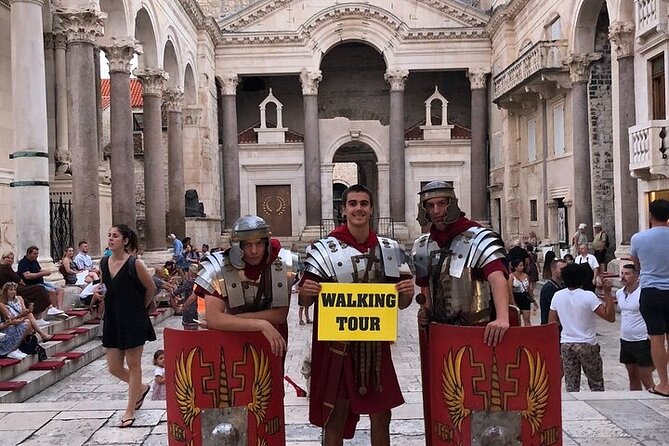
- Wear shoes that work on uneven old-stone streets. Even if the pace is steady, the ground in this area can be a challenge.
- If you have mobility issues, treat this tour’s note about high steps seriously.
- Bring your curiosity. The format is short stops, so your best questions are the ones you ask at the exact point you’re standing in front of.
- If you want to add the substructures museum later, plan your schedule right after the tour so you can take advantage of that momentum.
Is this good value for Split’s Diocletian’s Palace?
For $165.08 per person, this is not a budget tour. But it can be good value if you match the vibe: you want German guidance, you want a tight route through the key palace landmarks, and you like learning in a small group rather than reading plaques alone.
The biggest value win is efficiency. You hit orientation (Peristyle), power symbols (Golden Gate and Gregory of Nin), and visualization (Riva Harbor’s bronze model), then you expand to later cultural layers (Fruit’s Square and Marulić) and Jewish history context via the synagogue pass-by.
The main value limiter is also clear: you’re not going into everything. The substructures museum isn’t included, and synagogue admission isn’t included. So if your priority is purely interior ticketed attractions, you may want to pair this tour with separate time blocks.
Who should book this tour
You’ll be happiest booking if:
- You want a German-language guide for Diocletian’s Palace and the surrounding old town.
- You like short stops that still come with real explanations, not just wandering.
- You’re visiting in limited time and want the highlights tied into one story.
You should think twice if:
- Steps are hard for you. This tour isn’t recommended for travelers with issues with high steps.
- You want synagogue entry or the substructures museum during the tour itself. Those require separate planning.
Should you book this German Split history walk?
Yes, I’d book it if your goal is to understand Diocletian’s Palace quickly and you want it guided in German. The small group size, the clear stop sequence, and the focus on major palace highlights plus meaningful nearby context (Riva, Fruit’s Square, Gregory of Nin, and synagogue history) make it a practical way to get your bearings fast.
If you prefer purely self-guided exploring, or if you need fully accessible routes without steps, then skip this specific format and plan a different approach.
Either way, this is one of the more “start here and think differently about what you’re seeing” options in Split.
FAQ
FAQ
Is the tour offered in German?
Yes. The tour is a History Split Walking Tour in German.
How long is the tour?
It runs about 1 hour 30 minutes.
What does the tour cost?
The price is $165.08 per person.
How big is the group?
The tour has a maximum of 20 travelers.
Where does the tour start and end?
It starts at Peristil ul., 21000, Split. It ends at Diocletian’s Palace (and it’s not far from where it started).
Are entrance tickets included for all stops?
Admission tickets are free for the stops at the Peristyle, Vestibulum, substructures, Golden Gate, Riva Harbor, and Fruit’s Square. The Split Synagogue pass-by does not include admission.
Do you visit the substructures museum during the tour?
No. The tour does not visit the museum part of the substructures, though you can visit it after the tour.
Is it suitable if I have trouble with steps?
It is not recommended for travelers who have issues with high steps.
What is the cancellation policy?
Free cancellation is available up to 24 hours in advance for a full refund. If you cancel less than 24 hours before the experience’s start time, there is no refund.
More Tours in Split
- From Split: Krka Waterfalls, Food & Wine Tasting Tour
★ 5.0 · 9,326 reviews - Blue cave, Mamma Mia and Hvar, 5 islands speedboat tour
★ 5.0 · 7,150 reviews - From Split: Krka Waterfalls, Food & Wine Tasting Tour
★ 4.9 · 6,598 reviews - Split/Trogir: Blue Cave, Mamma Mia, Hvar and 5 Island Tour
★ 4.6 · 6,320 reviews - Blue Cave and Hvar Tour – 5 Islands Tour from Split and Trogir
★ 5.0 · 4,815 reviews
More Tour Reviews in Split
- Split: Krka Waterfalls Trip with Boat Cruise and Swimming
★ 4.8 · 10,519 reviews - From Split: Krka Waterfalls, Food & Wine Tasting Tour
★ 5.0 · 9,326 reviews - Blue cave, Mamma Mia and Hvar, 5 islands speedboat tour
★ 5.0 · 7,150 reviews - From Split: Krka Waterfalls, Food & Wine Tasting Tour
★ 4.9 · 6,598 reviews - Split/Trogir: Blue Cave, Mamma Mia, Hvar and 5 Island Tour
★ 4.6 · 6,320 reviews
Walk Split a Different Way
- Split: Old Town and Diocletian Palace Walking Tour
★ 4.9 · 4,727 reviews - Walking Tour of Split and Diocletian’s Palace
★ 5.0 · 2,588 reviews - Krka Waterfalls tour with Trogir Walking tour and Krka panoramic boat cruise
★ 5.0 · 1,659 reviews - Split & Diocletian’s Palace Walking Tour
★ 5.0 · 1,125 reviews - Walking Tour of Split with a ‘Magister’ of History
★ 5.0 · 1,122 reviews
Still deciding? More Split trips we have been out and reviewed


Split Old Town Walking Tours, compared.
 ★ 4.9Old Town and Diocletian Palace Walking TourFrom $174,727 reviews
 ★ 5.0Walking Tour of Split and Diocletian’s PalaceFrom $482,588 reviews
 ★ 5.0Krka Waterfalls tour with Trogir Walking tour and Krka panoramic boat cruiseFrom $481,659 reviews
 ★ 5.0Split & Diocletian’s Palace Walking TourFrom $211,125 reviews
 ★ 5.0Walking Tour of Split with a ‘Magister’ of HistoryFrom $341,122 reviews
 ★ 5.0Split Walking Tour with Professor of HistoryFrom $24926 reviews
 ★ 4.7Diocletian Palace & Old Town Guided Walking TourFrom $17882 reviews
 ★ 4.7Krka Waterfalls Cruise & Trogir Walking TourFrom $47681 reviews
Browse the lists this tour appears in