
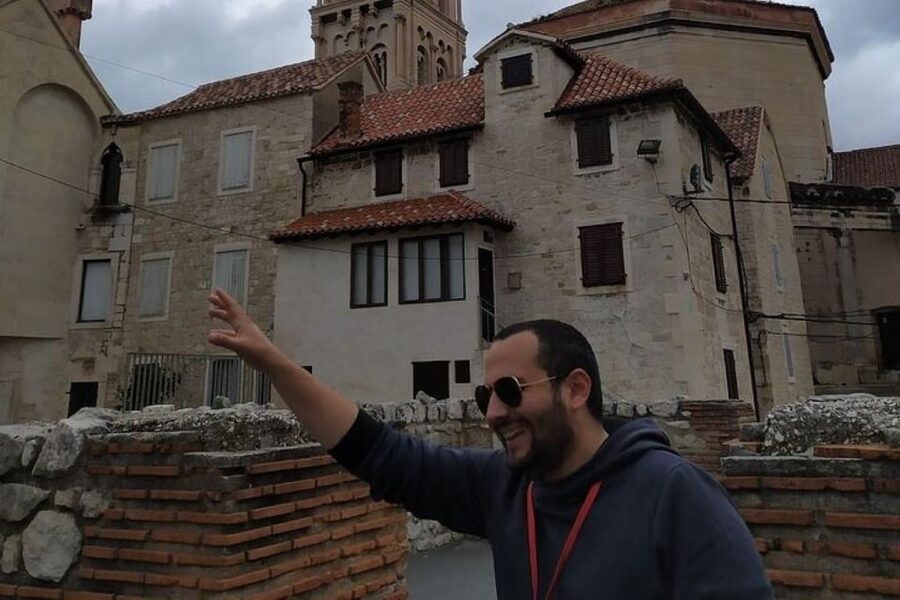
Reviewed · SPLIT OLD TOWN WALKING TOURS
Experience Split History Walking Tour With Local Historian
Split feels Roman long after sunset. This 2-hour walk with a local historian turns Diocletian’s Palace into a living map with the See, Hear and Feel approach. You start at the Golden Gate and quickly learn how the palace shaped everyday life in Split, then connects to what came later.
I love that the group stays small, with a maximum of 12 people, so you can actually ask questions and get clear answers without feeling rushed. I also like the practical storytelling style, which includes 3D reconstructions and pictures that help you picture what you are seeing.
The main drawback is simple: this is a lot of walking on old stone, and it is not suitable for wheelchair users or people with mobility impairments. On sunny days, bring comfortable shoes plus water or a hat, and plan your pace.
In This Review
- Key highlights that make this tour work
- Golden Gate to Narodni trg: how the route tells Split’s story
- Golden Gate: the Roman entrance and your fast orientation to Split
- Gregory of Nin: the statue you’ll remember while walking
- Entering Diocletian’s Palace: see it as lived-in space
- Peristil and the palace square you can almost hear
- Jupiter’s Temple and the palace’s “power rooms”
- Cathedral of Saint Domnius: when Roman stone becomes medieval identity
- Diocletian’s Cellars and the cool, practical side of the palace
- Riva promenade: the Roman-medieval connection you can feel walking
- Fruit Square and People’s Square: medieval stages in modern clothes
- Narrow church, narrow street, lost sphinx head, secret garden
- 3D reconstructions: using pictures to make ruined spaces understandable
- Price and value: is $37 a fair deal for a 2-hour historian walk?
- Who this Split tour suits best
- Should you book it? My honest take
- FAQ
- How long is the Split History Walking Tour?
- Where does the tour start, and where does it end?
- How big is the group?
- What is included in the price?
- What is not included?
- What languages are available?
- Is the tour suitable for wheelchair users or people with mobility impairments?
- Can I skip the ticket line?
Key highlights that make this tour work
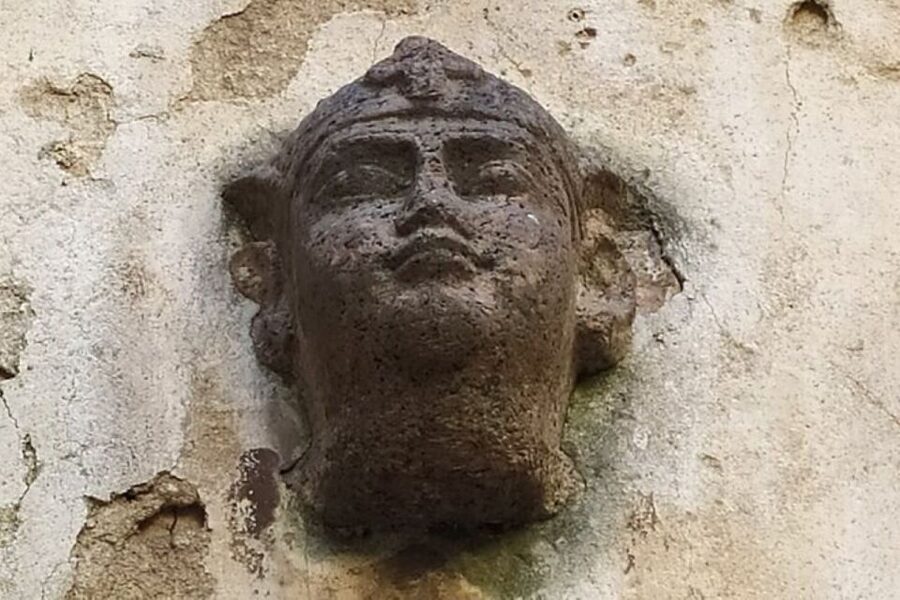
- Golden Gate orientation: start where Roman visitors would have entered, then place Split’s story in context
- Gregory of Nin right on the doorstep: you’ll meet the 8-meter statue early, before stepping into the palace
- Peristil, the palace’s main square: you’ll understand the space, not just spot it
- Emperor Diocletian, in and out: how his world connects to what people did in the city afterward
- Two medieval squares: Fruit Square and People’s Square, explained through architecture and daily life
- 3D reconstructions: pictures help you “see” what the palace looked like in earlier times
Prefer to walk it? More guided strolls through Split
- Split: Old Town and Diocletian Palace Walking Tour★ 4.9 · 4,727 reviews
- Walking Tour of Split and Diocletian’s Palace★ 5.0 · 2,588 reviews
- Krka Waterfalls tour with Trogir Walking tour and Krka panoramic boat cruise★ 5.0 · 1,659 reviews
- Split & Diocletian’s Palace Walking Tour★ 5.0 · 1,125 reviews
Golden Gate to Narodni trg: how the route tells Split’s story

This is a focused 2-hour history walk in Split, built around the idea that you learn best by moving through the city’s real spaces. The route starts at the Golden Gate, then threads through Diocletian’s Palace, before finishing around Narodni trg. It is not just monument spotting; it is a sequence that shows how Roman power became local life, and how later centuries layered onto the same walls.
The pace is designed for a walking tour, but it stays human. With a maximum of 12 people, the guide can slow down when a question comes up, or give extra context when you look confused (which is normal in a palace that has been reused for centuries). You’ll also get a “skip the ticket line” setup, so you can spend more time looking and less time standing around.
English and Croatian are available, and the tour is led by a local licensed guide and professional historian. If you like history told with scenes and details you can picture, this format fits well.
Golden Gate: the Roman entrance and your fast orientation to Split
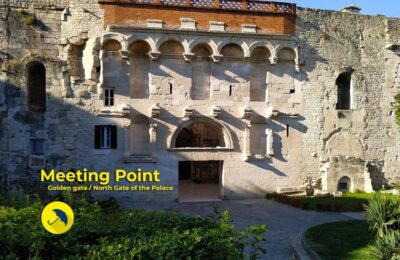
The meeting point is the Golden Gate, the northern gate of Diocletian’s Palace. It is opposite the 8-meter-high statue of Gregory of Nin, which is helpful because it gives you an obvious landmark before you even begin walking.
At the start, you learn what the Golden Gate was for and why it mattered. You also get an early sense of the palace as a whole system: an entrance that signals status, controlled movement, and a world that was meant to feel important right from the first step. It is the kind of orientation that makes the rest of the tour click, because you stop seeing isolated buildings and start seeing a layout.
One smart bonus: the guide uses this area to explain what you will see after you enter. Instead of walking into the palace blind, you get the names and roles of spaces ahead of time, so you can connect what the guide says to what your eyes catch.
Gregory of Nin: the statue you’ll remember while walking
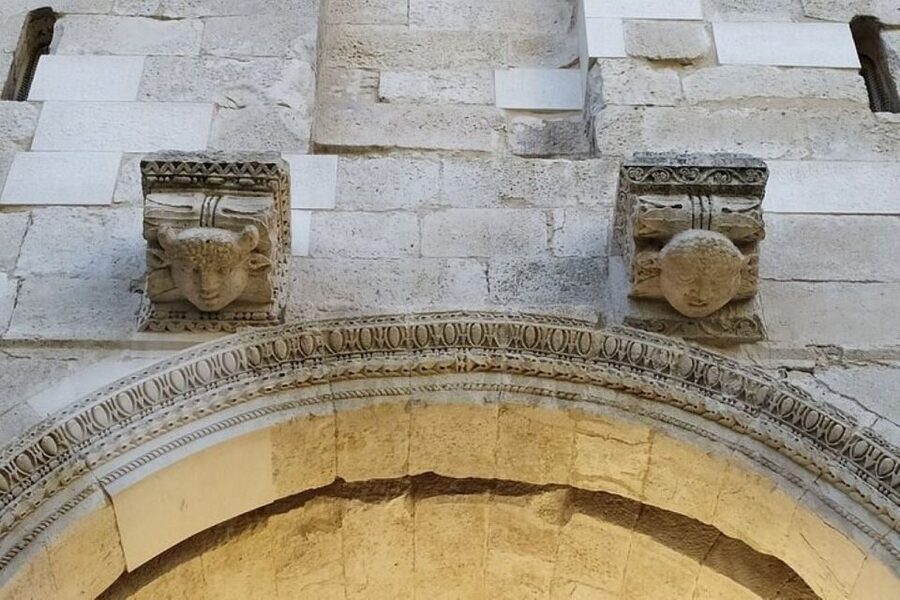
Gregory of Nin is not a random photo spot here. Because the statue sits right at the start, it becomes a reference point for how Split remembers its religious and cultural identity over time.
You’ll learn who Gregory of Nin is, and you’ll also hear why this statue is such a strong symbol for the city. Then, as you walk into Diocletian’s Palace, it helps you notice how the city’s identity has shifted, while still reusing the same physical ground.
This kind of “start with a symbol, then walk into the setting” approach is one of the reasons this tour feels more like a guided narrative than a checklist.
Entering Diocletian’s Palace: see it as lived-in space
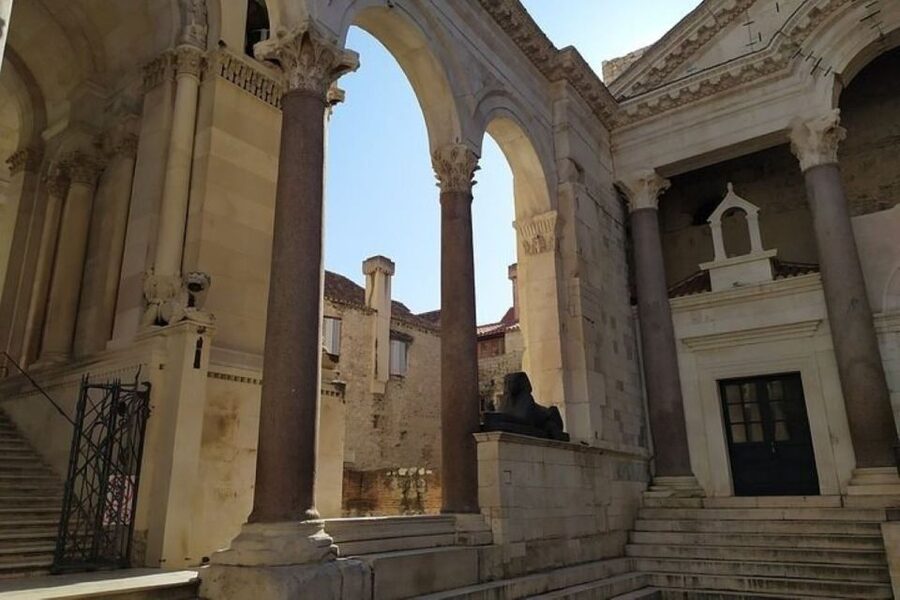
Once you step inside, the tour changes tone from orientation to interpretation. Diocletian’s Palace is a UNESCO World Heritage site, but the guide’s goal is to make it feel less like a distant artifact and more like a place people used and adapted.
You’ll move through key spaces and the guide explains what makes each one distinctive—through stories, facts, legends, and the kind of small details that help you understand purpose. Instead of just naming a room, the guide frames it so you can imagine how movement and power worked inside the complex.
Expect stop-and-look moments at places that matter to the palace’s layout, including the main palace square Peristil and other architectural areas you would normally rush past. You’ll also hear how the Roman foundation connects to medieval Split, which is the thread that ties the whole experience together.
If you have never been inside the palace, the effect is immediate: you realize you are walking through a structure that has been repurposed again and again. That is why this tour feels practical—your brain gets a timeline, even if you are standing inside ruins.
A few more Split boat days and tours worth a second look




Peristil and the palace square you can almost hear
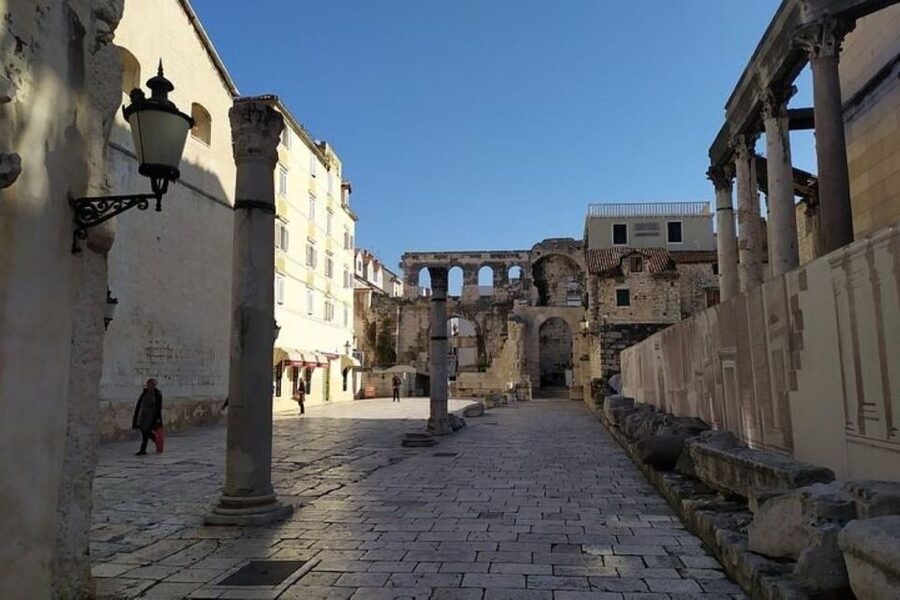
Peristil is one of the tour’s anchor points, and it makes sense. This is the main palace square, and it functions like a stage: a monumental open space surrounded by significant structures. When the guide explains it, the square stops being “just big” and starts being meaningful.
You’ll get stories and context about why this space was central, what kinds of movement it supported, and how it related to authority inside the palace. Even if you only stay for a short visit, you’ll leave with a mental map of what Peristil meant, and that makes every later stop easier to place.
A nice thing here is the guide’s “see, hear, feel” approach. You’re not only looking at stone and columns. You are listening for how the architecture guided behavior, and that helps you understand why certain areas feel ceremonial.
Jupiter’s Temple and the palace’s “power rooms”
After Peristil, you continue through other standout areas linked to the palace’s internal logic. Jupiter’s Temple is one of these stops, and it’s discussed as part of Emperor Diocletian’s world. The guide connects what you see with the idea of how religion, governance, and public space were intertwined in Roman life.
You’ll also pass through additional palace structures that the guide breaks down for you, including the Vestibul and Triclinium. These names can feel intimidating if you are sightseeing on your own, but on a tour like this, you get guidance on what each space likely supported and how people would have used it.
You are not being asked to memorize details. You are being taught how to read the palace with your eyes. Once you understand the relationship between these spaces, Diocletian’s Palace stops being random Roman leftovers and starts looking like a system.
Cathedral of Saint Domnius: when Roman stone becomes medieval identity
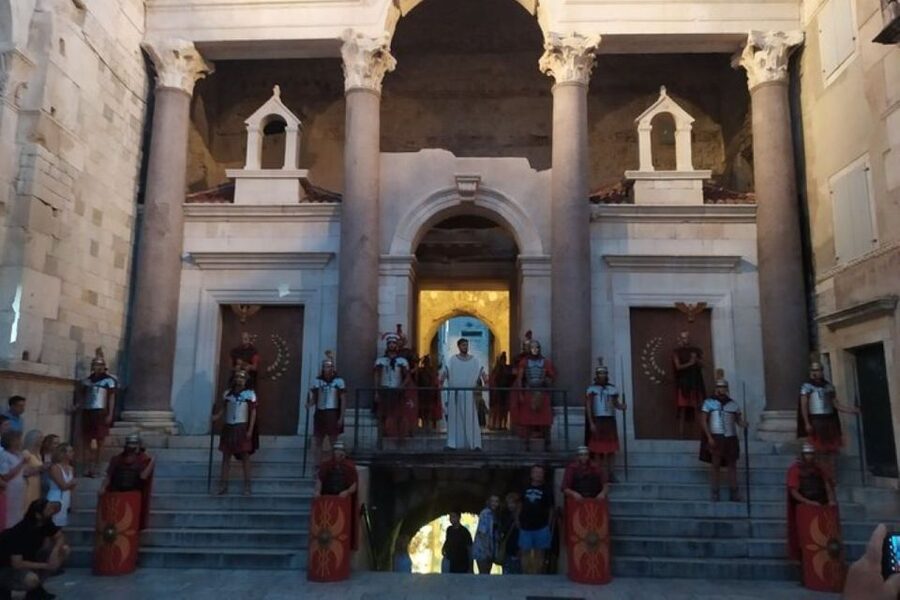
One of the most compelling transitions on this walk happens at the Cathedral of Saint Domnius (also connected to the Mausoleum-Cathedral concept in the tour flow). This is where the Roman era story meets later centuries in a visible way.
The guide explains Diocletian’s legacy and how the palace spaces were adapted by local Croat people over the centuries. That’s a key point for anyone trying to understand why Split feels the way it does today: the city’s identity did not erase the Roman foundation. It absorbed it, re-used it, and gave it new meaning.
As you stand in and around this area, you’ll also hear how the palace’s original grandeur lived on, sometimes through continuity, sometimes through reinvention. It’s the kind of stop that makes you slow down, because the architecture has layers you can actually sense.
Diocletian’s Cellars and the cool, practical side of the palace
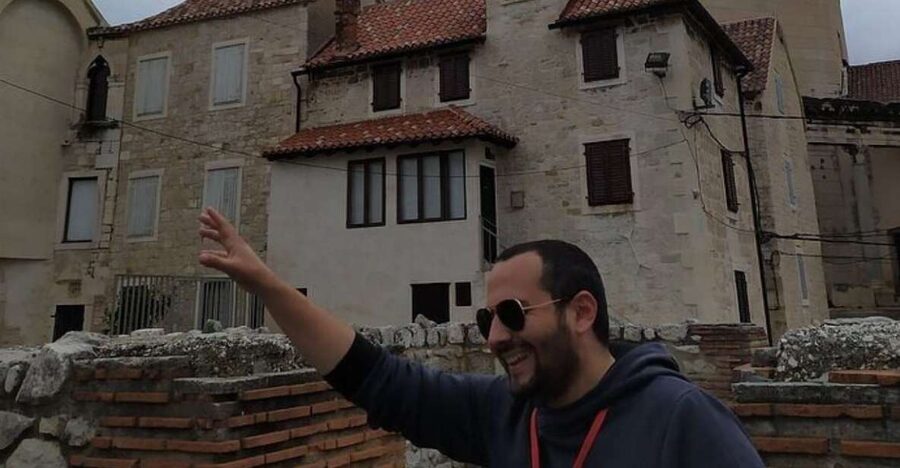
The tour includes Diocletian’s Cellars / central substructures, another place that rewards a guide. Underground and semi-internal spaces are harder to interpret on your own, because your brain wants an easy “this was a room for X” answer.
Here, the guide offers context so you can picture what these areas were for in the palace system, and how they fit into everyday life in and around the complex. You’ll also get told enough to understand that these aren’t just leftovers; they are functional components of the larger whole.
This stop also gives you a helpful break from bright sun. Even if you are not expecting a big temperature change, you’ll feel the shift in space and acoustics, and that helps your attention stay fresh.
Riva promenade: the Roman-medieval connection you can feel walking
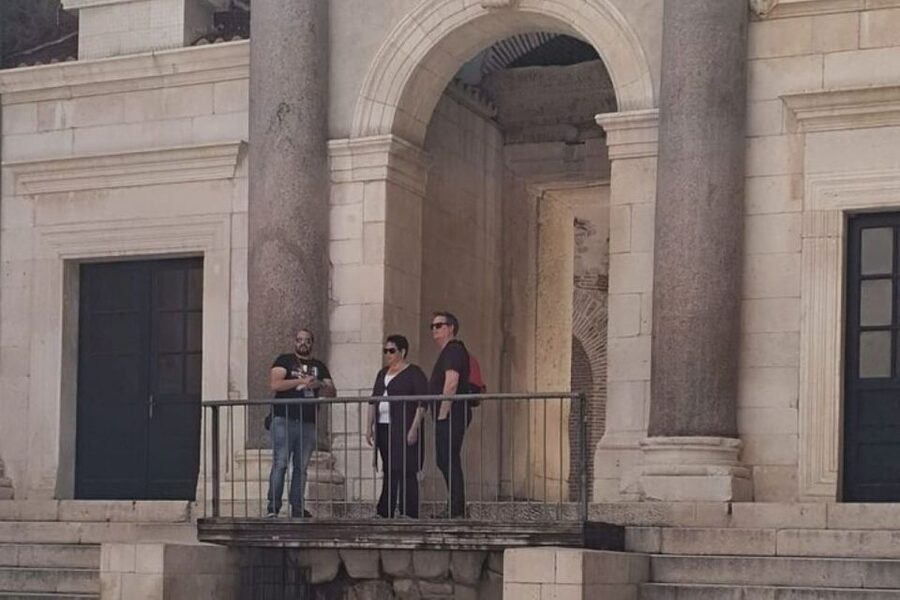
After the deeper palace spaces, you return to the city’s rhythm at the Riva promenade. This part of the tour connects Roman and medieval Split, explaining how the city’s center evolved from imperial architecture into a public, living waterfront zone.
You’ll get introduced to the “pomalo” way of life, which is less about a single historical fact and more about the pace and attitude you notice in daily routines. For me, that matters because it turns history into something you can experience while you are in town, not something you just learn and forget on the next street.
This segment is short, but it is valuable. It helps you balance the heavy stone story with the lived city vibe, so the tour feels like it belongs to modern Split rather than floating above it.
Fruit Square and People’s Square: medieval stages in modern clothes
Two medieval squares are included: Fruit Square and People’s Square. This is where the tour expands beyond the palace walls and shows you how public life played out in street-level spaces.
At Fruit Square and People’s Square, you will learn the secrets these squares are hiding in their architecture and in centuries of happenings. The guide ties the physical layout to what people likely did there and why the spaces stayed important.
What I like about this part is that it teaches you how to read a city block the same way you read a building. A square is not just an open patch. It is where communities gather, trade, celebrate, argue, and organize daily life.
By the time you reach these squares, you’ll understand how “Roman infrastructure” could become “local stage,” and how medieval city life reused the same kind of spatial logic.
Narrow church, narrow street, lost sphinx head, secret garden
There is a stop designed for small surprises and tight spaces. It’s built around things like the narrowest church and narrowest street, plus the lost sphinx head and a secret garden you get the chance to hear about.
This is where the tour becomes more than famous-sights shopping. Those tiny details are exactly what make a city feel specific, because they do not exist in tourist postcards as easily as big names do.
The guide’s job here is to help you see why these objects and spaces matter. You might not know what you are looking at from the outside, but once someone connects it to the palace story and Split’s changing identity, it becomes part of your mental map.
If you enjoy off-beat scale and small oddities, this portion is one of the most memorable.
3D reconstructions: using pictures to make ruined spaces understandable
One of the included features is 3D reconstruction images and pictures, shown via a display book. This matters because Diocletian’s Palace is complex, and some areas are not obvious in terms of earlier appearance.
The guide uses these visual aids to help you picture what the spaces were like and how they functioned in different time periods. Even if you think you are good at reading ruins on your own, having support like this can save you from guessing.
I also like that this approach supports different learning styles. If your mind needs visuals, the reconstructions help. If you learn best by hearing stories, the guide’s explanation ties directly to what you can look at nearby.
Price and value: is $37 a fair deal for a 2-hour historian walk?
At $37 per person for a 2-hour tour, the price is reasonable for three big reasons.
First, you are paying for a licensed local guide with a master’s degree in history, not just a casual storyteller. Second, you get included visual support through 3D reconstructions and a structured walk through major palace and square areas. Third, the group size stays capped at 12, which often means more time for questions and less time waiting.
You also avoid extra stress by having a guide to lead you from stop to stop inside the palace complex, and there is skip-the-ticket-line included. That saves energy, which matters when you are walking through busy areas.
Food and drinks are not included, so plan to grab a snack after. The upside is you can choose what fits your budget and preferences.
Who this Split tour suits best
This tour fits well if you are:
- Visiting Split for the first time and want a clear, walkable orientation to Diocletian’s Palace
- Curious about how Roman architecture shaped medieval and modern life
- The type who likes questions mid-walk rather than receiving information at a single stop
- Comfortable with walking and standing in historic areas
It is not a great fit if you use a wheelchair or have mobility impairments. The pace and the old-stone setting likely won’t work.
Should you book it? My honest take
If you want a 2-hour Split experience that ties together Diocletian’s Palace, major interior spaces, and medieval squares into one coherent story, this tour is a strong choice. The guide format, small group size, and the included 3D reconstructions make it feel more like guided learning than sightseeing homework.
I would book it if you like history told with practical context: who people were, how spaces were used, and why modern Split still echoes those choices. I would skip it if you want total freedom to wander without stopping for explanations, or if your mobility is limited and you need step-free routes.
FAQ
How long is the Split History Walking Tour?
The tour lasts 2 hours.
Where does the tour start, and where does it end?
You start at the Golden Gate (northern gate) of Diocletian’s Palace, and the tour finishes at Narodni trg.
How big is the group?
The experience is limited to a maximum of 12 participants.
What is included in the price?
A local professional guide with a master’s degree in history is included, along with 3D reconstruction images and pictures.
What is not included?
Food and drinks are not included, and there is no hotel pickup or drop-off.
What languages are available?
The tour is offered in English and Croatian.
Is the tour suitable for wheelchair users or people with mobility impairments?
No, it is not suitable for people with mobility impairments or wheelchair users.
Can I skip the ticket line?
Yes, skip the ticket line is included.
More Tours in Split
- From Split: Krka Waterfalls, Food & Wine Tasting Tour
★ 5.0 · 9,326 reviews - Blue cave, Mamma Mia and Hvar, 5 islands speedboat tour
★ 5.0 · 7,150 reviews - From Split: Krka Waterfalls, Food & Wine Tasting Tour
★ 4.9 · 6,598 reviews - Split/Trogir: Blue Cave, Mamma Mia, Hvar and 5 Island Tour
★ 4.6 · 6,320 reviews - Blue Cave and Hvar Tour – 5 Islands Tour from Split and Trogir
★ 5.0 · 4,815 reviews
More Tour Reviews in Split
- Split: Krka Waterfalls Trip with Boat Cruise and Swimming
★ 4.8 · 10,519 reviews - From Split: Krka Waterfalls, Food & Wine Tasting Tour
★ 5.0 · 9,326 reviews - Blue cave, Mamma Mia and Hvar, 5 islands speedboat tour
★ 5.0 · 7,150 reviews - From Split: Krka Waterfalls, Food & Wine Tasting Tour
★ 4.9 · 6,598 reviews - Split/Trogir: Blue Cave, Mamma Mia, Hvar and 5 Island Tour
★ 4.6 · 6,320 reviews
Walk Split a Different Way
- Split: Old Town and Diocletian Palace Walking Tour
★ 4.9 · 4,727 reviews - Walking Tour of Split and Diocletian’s Palace
★ 5.0 · 2,588 reviews - Krka Waterfalls tour with Trogir Walking tour and Krka panoramic boat cruise
★ 5.0 · 1,659 reviews - Split & Diocletian’s Palace Walking Tour
★ 5.0 · 1,125 reviews - Walking Tour of Split with a ‘Magister’ of History
★ 5.0 · 1,122 reviews
Still deciding? More Split trips we have been out and reviewed


Split Old Town Walking Tours, compared.
 ★ 4.9Old Town and Diocletian Palace Walking TourFrom $174,727 reviews
 ★ 5.0Walking Tour of Split and Diocletian’s PalaceFrom $482,588 reviews
 ★ 5.0Krka Waterfalls tour with Trogir Walking tour and Krka panoramic boat cruiseFrom $481,659 reviews
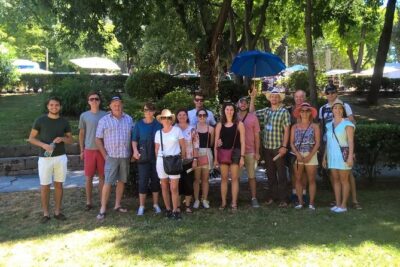 ★ 5.0Split & Diocletian’s Palace Walking TourFrom $211,125 reviews
 ★ 5.0Walking Tour of Split with a ‘Magister’ of HistoryFrom $341,122 reviews
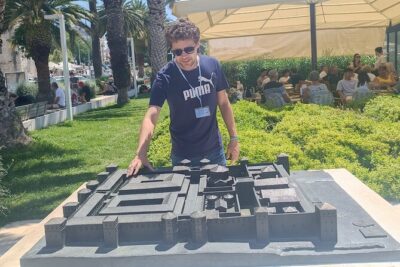 ★ 5.0Split Walking Tour with Professor of HistoryFrom $24926 reviews
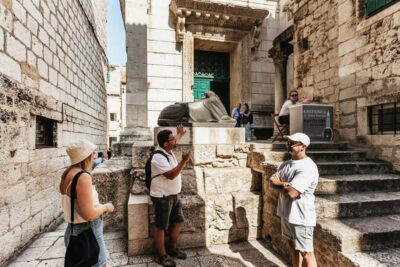 ★ 4.7Diocletian Palace & Old Town Guided Walking TourFrom $17882 reviews
 ★ 4.7Krka Waterfalls Cruise & Trogir Walking TourFrom $47681 reviews
Browse the lists this tour appears in