
Reviewed · DIOCLETIAN'S PALACE & OLD TOWN
Essential Diocletian’s Palace Tour for First-Time Visitors
Split makes sense fast. This 90-minute walk through Diocletian’s Palace is built for first-timers, turning big stone landmarks into a clear story of how Split formed and how people live here now, with a small-group pace and story-driven guiding.
I especially liked the way Jelena Tanjić (originally from Bosnia and Herzegovina, living in Split for years) connects the palace layout to the wider Balkans. You also get a fun keepsake moment with a group Vestibule Dome selfie, plus a set of recommendations after the tour, including voucher access for select restaurants and bars.
One thing to think about: this tour isn’t set up for wheelchair users, and the focus stays on key sights and talking points rather than entering every possible palace area (for example, it’s not about going into the Bell Tower/Substructures).
In This Review
- Key reasons this tour works so well
- Why Diocletian’s Palace feels easier with a guide
- Meeting at Gregory of Nin and the Golden Gate entrance
- Golden Gate and People’s Square: the palace as a city front door
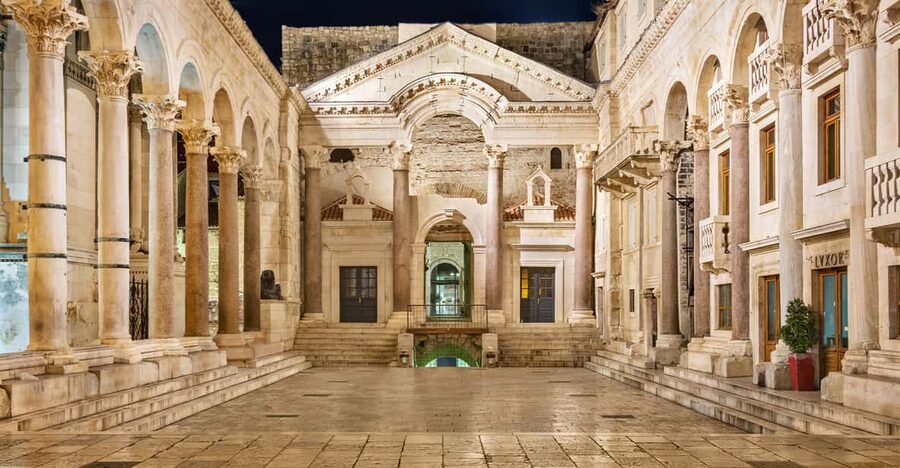
- Jupiter’s Temple and the Peristyle: how power looked up close
- Cathedral of Saint Domnius: when one site keeps changing roles
- Vestibule area and the Dome selfie moment
- Diocletian’s Cellars and the Egyptian Sphinx: weird, real, and memorable
- Pjaca and the Riva finish: going from ruins to real city life
- What you actually get for $41 in value terms
- The guide style: Jelena’s humor and question-friendly pacing
- Who this tour suits best (and who might want a different plan)
- Should you book this Diocletian’s Palace tour?
- FAQ
- How long is the Diocletian’s Palace tour?
- How big is the group?
- Where do I meet the guide?
- What is the tour language?
- What sights are included?
- Is the tour wheelchair accessible?
- Does the price include anything besides the guide?
- Can I cancel or pay later?
Key reasons this tour works so well

- A first-timer route that actually adds up: the palace stops build toward understanding how Split grew around Diocletian’s walls.
- Jelena’s regional perspective: you get context that goes beyond one empire chapter.
- Good pacing for real questions: limited to 10 people, so you’re not shouting into a crowd.
- Stop-and-smile memory moment: a planned selfie in the Vestibule area.
- Practical after-tour help: tailored dining and sightseeing recommendations, plus vouchers for discounts.
Inside the palace walls: more Old Town tours around Split
- Split: Old Town and Diocletian Palace Walking Tour★ 4.9 · 4,727 reviews
- Walking Tour of Split and Diocletian’s Palace★ 5.0 · 2,588 reviews
- Split & Diocletian’s Palace Walking Tour★ 5.0 · 1,125 reviews
- Split: Diocletian Palace & Old Town Guided Walking Tour★ 4.7 · 882 reviews
Why Diocletian’s Palace feels easier with a guide
Diocletian’s Palace can look like a maze on day one. You see columns, arches, temples, gates, and old streets, but without context it’s just impressive shapes.
This tour is designed to help you read the place fast. In 90 minutes, you get the meaning behind major stops, plus a sense of how the palace didn’t stay frozen in time. You’ll also notice how Split’s daily life still uses these spaces, not just for museum photos, but as part of the city’s rhythms.
And because the group is capped at 10, the walking pace stays human. That matters in Split’s old town, where you’re often dodging crowds, tour groups, and the occasional dramatic traffic of people heading for gelato.
Meeting at Gregory of Nin and the Golden Gate entrance
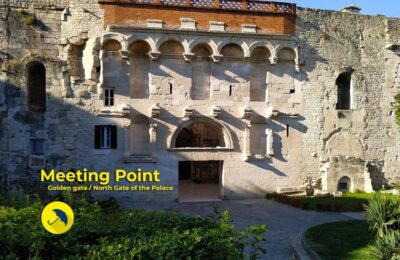
You meet in front of the big statue of bishop Gregory of Nin, at the north entrance called the Golden Gate. It’s easy to spot once you know the trick: look for a black umbrella.
This matters more than it sounds. Split’s palace streets are narrow and the signage can be confusing if you’re just getting oriented. Starting at Gregory of Nin gives you a clean “jumping-off point” because it’s a recognizable modern landmark right next to the palace’s main gateway zone.
If you’re the type who likes to know where you’re standing, you’ll enjoy the start. You’ll get an immediate sense of how the palace connects to the city’s public spaces.
Golden Gate and People’s Square: the palace as a city front door
After the meeting point, the tour heads into the palace area through the Golden Gate. This is where you learn how Diocletian’s complex functioned as something like an organized world inside walls, not just a single monument.
Then you move toward People’s Square. Even if you only know Split from the waterfront, this stop helps you connect the modern city’s gathering places to the palace’s older framework. You begin to see why the old town feels practical, not decorative. People still use these areas, and the palace walls shaped where movement and commerce went.
A guide can also help you avoid a common mistake: walking past major sites without understanding why they’re there. Here, you get the “why” as you go, so each next stop lands better.
Jupiter’s Temple and the Peristyle: how power looked up close
Jupiter’s Temple is one of those places where the architecture hits you first. With a guide, it doesn’t stop at wow. You learn what the setting signaled—imperial authority in stone—and how the space fits into the palace’s internal logic.
Next comes the Peristyle. This is the grand central courtyard space people picture when they think of palace ruins. It’s also where the tour’s storytelling really helps: you’re not just hearing names and dates. You’re being taught how the layout guided movement, control, and daily functions.
This is also one of the best stretches for photography, but with a warning. It’s popular. Go into it expecting people in your frame, and don’t let it ruin your shot. The upside is you’ll be in the most iconic “okay, now I get it” zone of the tour.


Cathedral of Saint Domnius: when one site keeps changing roles
The Cathedral of Saint Domnius is a big moment, because it’s not just about Diocletian’s palace anymore. It’s about how later eras layered their own meaning onto the site.
The tour’s approach keeps it grounded. You’ll understand how the cathedral connects to the palace world and why it became a long-term anchor for the city. Even if you’re not a cathedral person, it’s hard to miss the sense that this is a place people returned to again and again for centuries.
One practical note: depending on what’s covered, you may not be entering every part of the cathedral complex. The tour keeps the focus on key viewpoints and explanations, not on extra internal areas. If you want a hands-on museum-style visit inside every building, you may need a separate ticket or add-on later.
Vestibule area and the Dome selfie moment
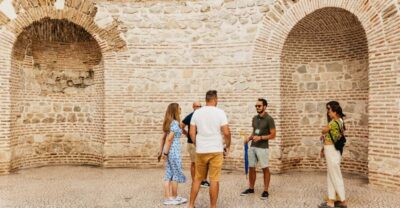
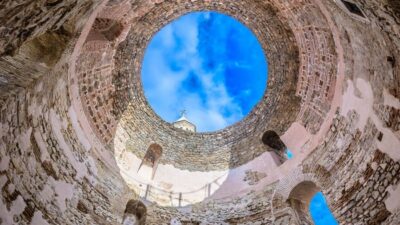
Now for the fun part. You’ll reach the Vestibule area, and this is where the tour sets up a group selfie in the Vestibule Dome area for a memory.
This is a small thing, but it adds value. At the end of a walking tour through stone corridors, a photo stop gives you an easy anchor to remember where the “most palace-looking” part happened. It also breaks up the history rhythm with something light.
More importantly, the guide uses this stop to talk about how impressive structures were repurposed and re-used over time. You’ll start to feel the palace wasn’t built to be admired from a distance—it was built to work.
If you’re traveling with friends or family, this is also a nice shared moment that doesn’t require you to keep hunting for a stranger with a phone.
Diocletian’s Cellars and the Egyptian Sphinx: weird, real, and memorable
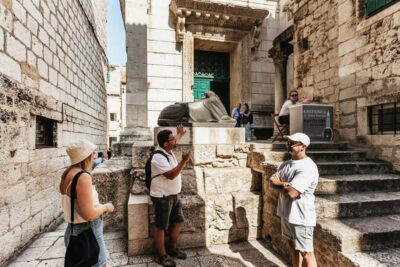
You’ll then head into Diocletian’s Cellars. In a palace context, “cellars” can sound like storage. On the tour, it becomes a lens for understanding how the palace supported daily life: food, supply, and the hidden infrastructure behind the grand public spaces.
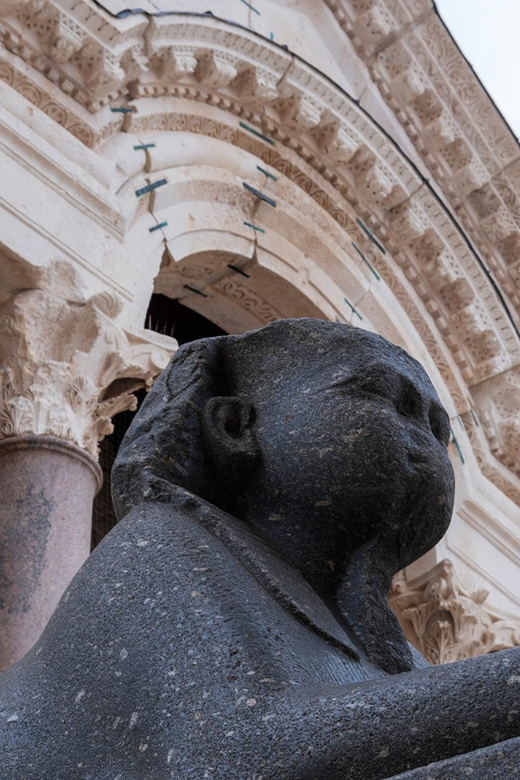
From there, the Egyptian Sphinx makes its way into the story. This is the kind of detail that sticks because it feels slightly out of place—yet it’s part of the palace world. It’s one of those objects that helps you understand how history can travel, move, and end up in unexpected corners.
If you’re a person who likes weird facts without getting lost in them, this stop is a good payoff. It gives you a concrete image you can later point to when you tell someone why Split is more than a beach town.
Pjaca and the Riva finish: going from ruins to real city life
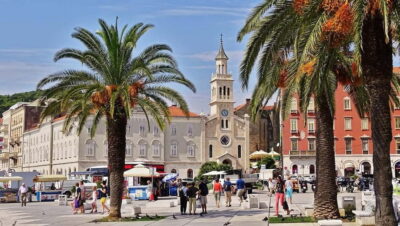
The tour continues toward Pjaca, the main square of Split, and then finishes at the Riva promenade. This is a smart flow. It prevents the tour from ending in a “just ruins” feeling.
Pjaca helps you see the old-town civic space where people still gather. The Riva gives you the classic payoff: after learning about palace structure and ancient institutions, you step into a lively modern waterfront where locals and visitors mix.
This ending is also practical for planning your next hour. Once you’re finished, you’re already positioned for a meal, a coffee, and an easy wandering loop without having to backtrack.
What you actually get for $41 in value terms
At $41 per person for 90 minutes, the price lands in the fair range if you care about more than just seeing stone. What justifies it isn’t only access to a guide—it’s the way the tour bundles guidance with decisions for after.
Here’s what you’re paying for, in real terms:
- Licensed, interactive storytelling that helps you understand the palace layout instead of memorizing facts.
- A small-group cap of 10, which keeps the tour conversational.
- The Vestibule selfie as a planned memory moment.
- Voucher access to discounted dining at select well-regarded restaurant and bar spots.
- A curated set of recommendations so you leave with a short list, not a blank screen.
If you’re visiting Split for the first time, that last piece is underrated. A good meal in the right neighborhood beats a second round of museum tickets when you only have a day or two.
The guide style: Jelena’s humor and question-friendly pacing
Jelena Tanjić’s style—part historical explanation, part storytelling, with humor—shows up repeatedly in how the tour feels. You don’t just hear a lecture while walking. You get moments where she answers questions and adjusts what she emphasizes.
That matters because Diocletian’s Palace can overwhelm you with details fast. When your guide can explain complex layouts in plain language and still keep people laughing, you retain more. You also feel comfortable asking things like which direction to go next or what to prioritize if you only have one afternoon.
Another plus: the tour keeps an eye on comfort. People note things like water, shade, and sensible breaks. On a hot day in an old stone maze, that’s not fluff. It’s part of the quality.
Who this tour suits best (and who might want a different plan)
This tour is ideal if:
- you’re a first-time visitor to Split and want instant orientation
- you like history that connects to today, not history that stays stuck in the past
- you want small-group interaction instead of being swallowed by a crowd
- you’ll appreciate help with what to eat and what to see after you finish
It may not be ideal if:
- you rely on wheelchair access (the tour isn’t suitable for wheelchair users)
- you want a strictly ticketed, museum-only experience inside every structure
- you’re expecting access to every extra palace zone like the Bell Tower/Substructures
Should you book this Diocletian’s Palace tour?
If you’re short on time and want to stop guessing what you’re looking at, I’d book it. The 90 minutes give you a meaningful framework: gates, squares, central courtyard, the cathedral connection, the cellar world, and then the shift into real Split life on the Riva.
You’ll also like it if you want more than “ancient stones.” The vouchers and post-tour recommendations can turn your guided walk into a better day overall, not just a nicer morning.
If you’re able-bodied and okay with a paced walking route, this is one of the smartest ways to get your bearings fast in Split’s old town.
FAQ
How long is the Diocletian’s Palace tour?
The tour lasts 90 minutes.
How big is the group?
The small group is limited to 10 participants.
Where do I meet the guide?
Meet in front of the statue of bishop Gregory of Nin and the north entrance to the Palace called Golden Gate. Look for a black umbrella.
What is the tour language?
The tour is offered in English.
What sights are included?
You’ll visit major highlights such as the Golden Gate, People’s Square, Jupiter’s Temple, Peristyle, the Cathedral of Saint Domnius, the Vestibule area, Diocletian’s Cellars, the Egyptian Sphinx, Pjaca (main square), and you finish at the Riva promenade.
Is the tour wheelchair accessible?
No. It is not suitable for wheelchair users.
Does the price include anything besides the guide?
Yes. You get interactive storytelling, a Vestibule dome selfie, and access to vouchers for some recommended restaurants and bars.
Can I cancel or pay later?
You can cancel up to 24 hours in advance for a full refund, and you can reserve now and pay later.
More Tours in Split
- From Split: Krka Waterfalls, Food & Wine Tasting Tour
★ 5.0 · 9,326 reviews - Blue cave, Mamma Mia and Hvar, 5 islands speedboat tour
★ 5.0 · 7,150 reviews - From Split: Krka Waterfalls, Food & Wine Tasting Tour
★ 4.9 · 6,598 reviews - Split/Trogir: Blue Cave, Mamma Mia, Hvar and 5 Island Tour
★ 4.6 · 6,320 reviews - Blue Cave and Hvar Tour – 5 Islands Tour from Split and Trogir
★ 5.0 · 4,815 reviews
More Tour Reviews in Split
- Split: Krka Waterfalls Trip with Boat Cruise and Swimming
★ 4.8 · 10,519 reviews - From Split: Krka Waterfalls, Food & Wine Tasting Tour
★ 5.0 · 9,326 reviews - Blue cave, Mamma Mia and Hvar, 5 islands speedboat tour
★ 5.0 · 7,150 reviews - From Split: Krka Waterfalls, Food & Wine Tasting Tour
★ 4.9 · 6,598 reviews - Split/Trogir: Blue Cave, Mamma Mia, Hvar and 5 Island Tour
★ 4.6 · 6,320 reviews
Deeper Into the Palace, Split
- Split: Old Town and Diocletian Palace Walking Tour
★ 4.9 · 4,727 reviews - Walking Tour of Split and Diocletian’s Palace
★ 5.0 · 2,588 reviews - Split & Diocletian’s Palace Walking Tour
★ 5.0 · 1,125 reviews - Split: Diocletian Palace & Old Town Guided Walking Tour
★ 4.7 · 882 reviews - Split Old Town and Diocletian’s Palace Tour
★ 4.8 · 716 reviews
Still deciding? More Split trips we have been out and reviewed




Diocletian's Palace & Old Town, compared.
 ★ 4.9Old Town and Diocletian Palace Walking TourFrom $174,727 reviews
 ★ 5.0Walking Tour of Split and Diocletian’s PalaceFrom $482,588 reviews
 ★ 5.0Split & Diocletian’s Palace Walking TourFrom $211,125 reviews
 ★ 4.7Diocletian Palace & Old Town Guided Walking TourFrom $17882 reviews
 ★ 4.8Split Old Town and Diocletian’s Palace TourFrom $17716 reviews
 ★ 4.8Game of Thrones Tour with Diocletian’s Palace CellarFrom $41545 reviews
 ★ 5.0Diocletian’s Palace and Old Town SMALL GROUP Walking TourFrom $16502 reviews
 ★ 5.0SPLIT-PRIVATE Walking Tour of Diocletian’s Palace & Old TownFrom $240467 reviews
Browse the lists this tour appears in