
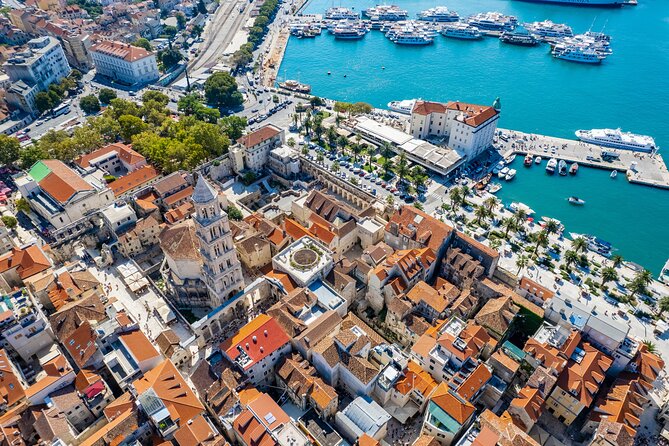
Reviewed · DIOCLETIAN'S PALACE & OLD TOWN
Diocletian’s Palace Small Group Tour in Split
Roman walls still power Split’s street plan.
This small-group tour takes you into the UNESCO-listed core of Diocletian’s Palace, where Roman stone has been repurposed into today’s old town. You’ll move at a walking pace through major palace spaces while your guide connects the buildings to how Split lives now.
What I love most is the guide-led storytelling that turns the palace from a pile of ruins into a map you can actually use. I especially like the way guides such as Luka, Sandra, and Jelena tend to mix clear history with practical street-level context, plus helpful local tips you can use beyond the tour.
One consideration: the tour is about 2 hours, so you’ll see the big anchors of the palace—but you won’t have time to linger everywhere in the maze on this one stop.
In This Review
- Key highlights at a glance
- Entering Diocletian’s Palace: Why This Walk Feels Like a Shortcut
- Diocletian’s Palace Main Area: Getting Oriented in the Maze-Like Core
- Peristyle Square: The One Stop That Teaches You What Romans Made for Public Life
- Vestibulum Geometry: Rectangular Outside, Circular Inside
- Diocletian’s Cellars: UNESCO’s Real Reason, Not Just a Slogan
- Golden Gate (Porta Septemtrionalis): The Palace’s Entrance Story in Stone
- The 2-Hour Pace: How to Fit This Into a Full Day in Split
- What You Gain from the Guide: Local Tips and Names You Might Hear
- Price and Value: $60.21 for a Guided Palace Orientation
- Quick Practical Notes Before You Go
- Should You Book the Diocletian’s Palace Small Group Tour?
- FAQ
- How long is the Diocletian’s Palace small group tour in Split?
- Is the tour offered in English?
- Do I get a mobile ticket?
- Where do I meet the tour guide?
- What’s included at the stops, and is the cathedral ticket included?
- What fitness level do I need?
- How big is the group?
- Can I cancel for free if my plans change?
Key highlights at a glance
- Multiple departures during the day, so you can choose a time that fits your schedule in Split
- Walking inside the palace complex, including the peristyle square and the golden gate area
- Stop-by-stop context that explains what you’re looking at, not just what it is
- Entry to the palace sections covered on the walk, with cathedral tickets kept separate
- Small-group feel with guides who make questions easy and the pace comfortable
Inside the palace walls: more Old Town tours around Split
- Split: Old Town and Diocletian Palace Walking Tour★ 4.9 · 4,727 reviews
- Walking Tour of Split and Diocletian’s Palace★ 5.0 · 2,588 reviews
- Split & Diocletian’s Palace Walking Tour★ 5.0 · 1,125 reviews
- Split: Diocletian Palace & Old Town Guided Walking Tour★ 4.7 · 882 reviews
Entering Diocletian’s Palace: Why This Walk Feels Like a Shortcut
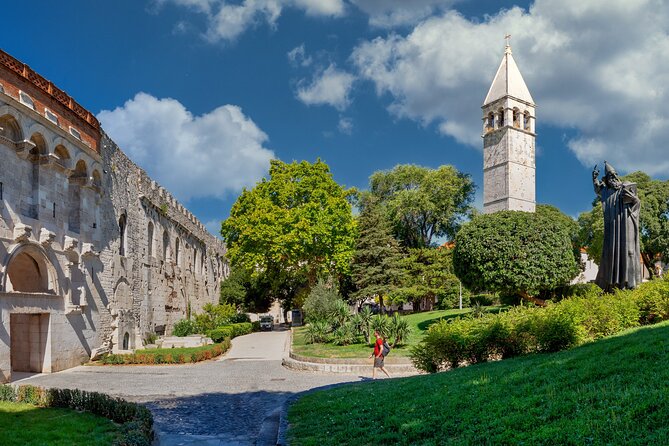
Split’s old town can be a little disorienting at first. That’s exactly why this tour works: it gives you a guided route through the parts of Diocletian’s Palace that shape the city center. Instead of staring up at stone and hoping it will make sense, you get the “where you are” explanation as you walk.
Diocletian’s Palace was built by the Roman emperor around the turn of the 4th century AD. People call it a palace because Diocletian planned to retire there, but the structure is massive—more like a fortress. About half the complex served his personal use, while the rest was geared for the military garrison. On this tour, you don’t just hear that in abstract terms; you see how the palace’s scale and layout influence the street plan you’re walking through now.
You’ll also get a sense of how medieval and modern life coexists with Roman remains. Even when your eyes catch dramatic stone details, your guide keeps tying it back to daily movement through the old town. That helps you stop feeling like you’re lost in a museum and start feeling like you’re learning the city.
Expect a walking tour format. There’s a moderate fitness requirement, so it’s best for people who can comfortably walk through city streets and stay upright for the duration. If you’re hoping for a totally low-effort tour with minimal walking, this probably won’t match your expectations.
Diocletian’s Palace Main Area: Getting Oriented in the Maze-Like Core
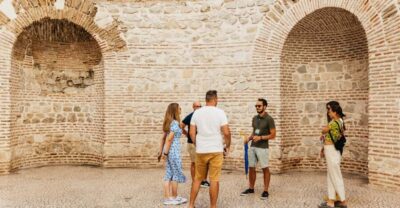
The first stop is the heart of it: the palace area that today forms roughly half of Split’s old town and city center. This is the part where you can easily wander in circles if you’re exploring solo. With a guide, you start to recognize patterns—arches, openings, transitions between rooms and courtyards, and the way spaces feel designed for movement and control.
One of the best reasons to do this early—if your schedule allows—is that it reduces confusion fast. The palace doesn’t read like a simple sightseeing circuit. It’s layered: Roman structure plus later additions and uses, meaning your eyes have plenty to process. A guided walk turns that into a sequence you can remember.
You’ll also learn how the “palace” label can mislead. Because the complex was built for both personal residence and military presence, it feels defensive and structured rather than a cozy residence. That mindset helps when you step into spaces that might otherwise look strangely utilitarian.
And yes, you’ll get local street atmosphere along the way. A guide doesn’t just point at buildings. They help you understand what the area feels like when it’s not only tourist time.
Peristyle Square: The One Stop That Teaches You What Romans Made for Public Life
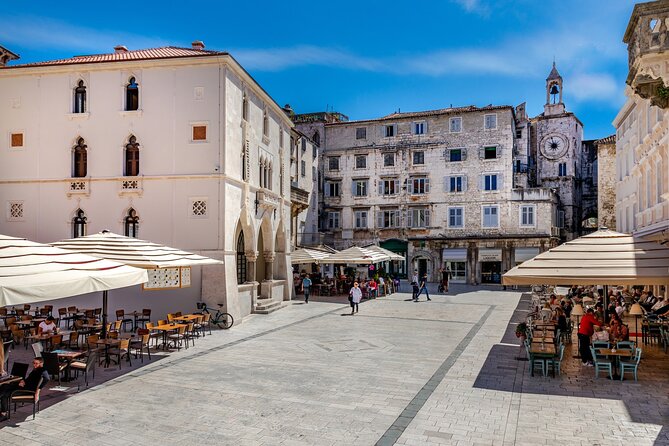
Next up is the Peristyle, the central square of Diocletian’s Palace. This isn’t just a pretty plaza. It was intended as a ceremonial center for Diocletian, presented as the living son of Jupiter, and it sits among many temples.
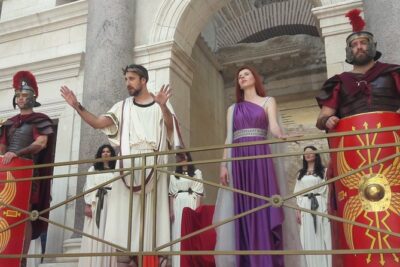
What makes this stop click for a visitor is the way the space is described: beauty, yes, but also unusual acoustics. That detail matters. It explains why the Peristyle has served as an outdoor stage setting for opera classics and ancient literature works. You start looking at the square not only as architecture but as a kind of performance shell.
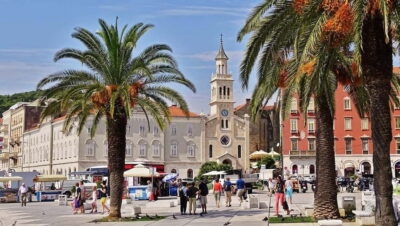
Then your guide ties it to the present: even with all the ancient symbolism, the Peristyle remains a place where urban life continues. That mix—ceremony and everyday activity—is one of Split’s defining traits. If you’re hoping to understand how heritage sites still work as real neighborhoods, this stop is where that idea becomes concrete.
The time here is short (around 10 minutes), so treat it like an orientation moment. Stand where your guide asks you to stand, listen to the explanation, then take a quick look around yourself. This is one of those spaces where a short pause can make the next steps easier to follow.
Vestibulum Geometry: Rectangular Outside, Circular Inside
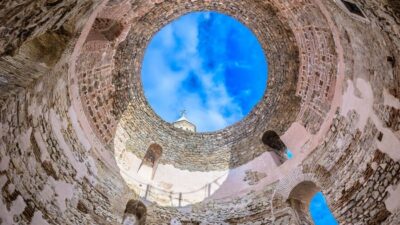
The Vestibulum (the palace entry court/space) is the kind of stop that makes you realize how intentional Roman design could be. From the outside, it has a rectangular plan. Inside, it shifts into a circular ground plan.
That contrast is the attraction. You’ll likely feel it immediately when you change perspective and notice how the space behaves differently as you move. It’s a reminder that Romans weren’t only building for power—they were engineering movement and perception.
This stop is also brief (about 10 minutes), so don’t expect a long sit-down experience. Instead, use it as a “visual lesson.” If the palace felt confusing earlier, the Vestibulum’s shape change can act like a mental checkpoint: it signals that you’ve moved into a different type of space within the complex.


Diocletian’s Cellars: UNESCO’s Real Reason, Not Just a Slogan
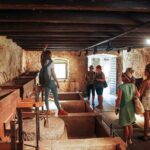
The palace substructures—often described as the cellars—are one of the best-preserved complexes of their kind. That preservation is tied directly to why Split’s historical core was included as a UNESCO World Heritage site.
You’ll hear this link explained in plain terms: the palace substructures are not background scenery. They’re part of what made the site qualify in the first place. When you see the scale and continuity of the substructures, you understand why they matter.
This stop is also about 10 minutes, so you won’t spend hours underground. The value is in the framing. Instead of treating the cellars like a quick photo stop, you learn why they’re considered central to the palace’s survival as a coherent site.
If you’re the kind of traveler who likes to understand why a place got protected, this is the moment where the UNESCO label stops feeling like marketing and starts feeling like logic.
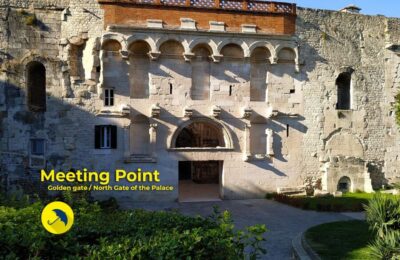
Golden Gate (Porta Septemtrionalis): The Palace’s Entrance Story in Stone

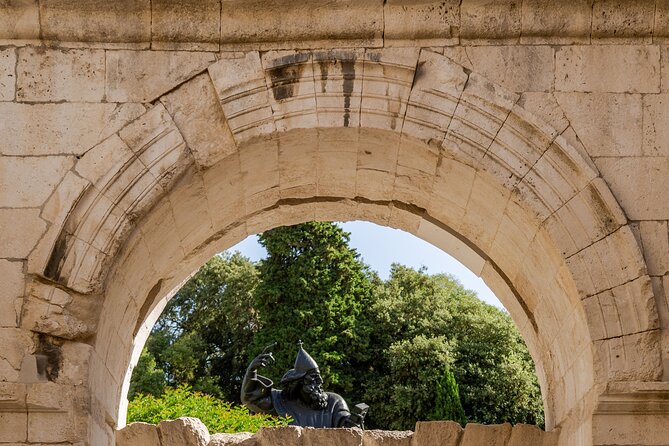
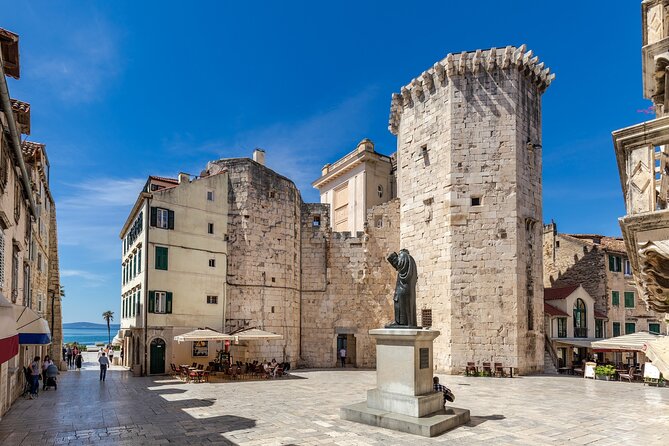
The final major stop on the walk is the Golden Gate, also known by its Roman name, Porta septemtrionalis. This isn’t a random decorative feature. It’s tied to Diocletian’s entry into the palace.
You’ll learn that Emperor Diocletian walked through these gates on June 1, 305. That date detail is the kind of anchor your brain remembers, and it helps you connect what you’re seeing to a moment in time rather than just a structure.
The gate itself was built with a rectangular shape and double doors as part of defensive military tactics, described as propugnaculum. In other words: this gate was designed for controlled access, not grand entrance for parade days.
This is a 10-minute stop, but it tends to leave a lasting impression because it ties history to cause-and-effect: defensive design, major entry point, then the way that entry point shapes how people move through the complex today.
The 2-Hour Pace: How to Fit This Into a Full Day in Split
The whole tour runs about 2 hours, with a choice of departures throughout the day. That scheduling flexibility is a real advantage. Split’s center can feel crowded at certain times, so picking a departure that avoids your worst timing can make a huge difference in comfort.
A short tour like this is also smart value if you’re using Split as more than one attraction. You’re not committing an entire half-day just to read a guidebook out loud. In those two hours you get:
- the “main places” inside the palace
- a sequence you can follow when you explore on your own afterward
- a set of mental cues so you stop feeling stuck behind big crowds
Because you’re moving between several stops (each around 10 minutes), the tour is best if you’re comfortable making quick observations. If you like to linger in one area for 30 to 45 minutes, you might end up wanting more time after the walk ends.
What You Gain from the Guide: Local Tips and Names You Might Hear
This tour includes a local guide and a professional guide, and that combination shows up in how the walk feels: practical, friendly, and focused on helping you see what’s important. People tend to notice the guides’ confidence and time generosity, which matters on a walking tour.
I also like that the guide experience isn’t generic. You may be with a guide such as Luka, who’s known for turning the palace into a story you can follow. Or you might get Sandra, described as extremely knowledgeable and very friendly. Jelena is another name that comes up when people talk about fun, history, and useful shop or area tips.
Even if the exact guide varies by departure, the goal stays the same: help you get your bearings fast, then give you enough context that the palace doesn’t blur together.
If you like asking questions, this is the kind of tour where your questions don’t feel like a disruption. The pacing and structure make it easy to get answers as you go.
Price and Value: $60.21 for a Guided Palace Orientation
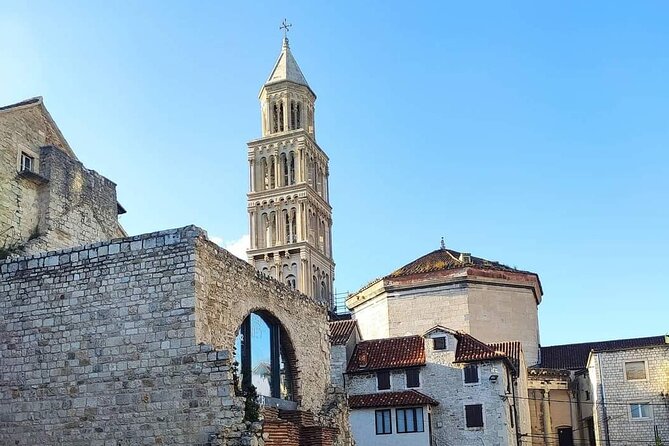
At $60.21 per person, this isn’t a bargain-basement walking tour. But the price starts to look fair when you break down what you’re actually buying.
You get:
- about 2 hours of structured guidance through the key palace spaces
- an English-language tour
- mobile ticket convenience
- inclusion of the palace areas covered on the walk, with separate handling for cathedral tickets
- both a local guide and a professional guide
And the big value is orientation. If you’ve ever wandered around an enormous UNESCO core without a plan, you know how quickly time disappears. A guide-led route is often the difference between paying for a few photos and understanding what you’re seeing.
So, I’d frame the cost as paying for clarity. In a compact center like Split, clarity is what lets you enjoy the city after the tour ends.
Quick Practical Notes Before You Go
- Language: offered in English
- Ticket type: mobile ticket
- Meeting point: South Tours Travel Agency, Mrčelina 1, 21000 Split
- End point: returns back to the meeting point
- Fitness level: moderate physical fitness is expected
- Cathedral tickets: not included in the tour package for cathedral entry
Also keep in mind that the tour has a maximum group size of 99. In practice, it’s often experienced as a small group on the ground, but you should still choose your departure time wisely if you’re sensitive to crowds.
Should You Book the Diocletian’s Palace Small Group Tour?
Book it if you want to understand Split quickly. This is especially good for first-timers who don’t want to spend half a day trying to decode Roman ruins while figuring out where you are.
Skip it (or add extra time on your own) if you prefer very slow touring or want to spend lots of time in one specific chamber or square. Because the tour is designed to cover multiple highlights in about 2 hours, it’s more of a smart orientation than a deep, linger-for-hours experience.
If your goal is to leave with a workable mental map of Diocletian’s Palace and a better feel for the old town around it, this is a strong choice.
FAQ
How long is the Diocletian’s Palace small group tour in Split?
It’s approximately 2 hours.
Is the tour offered in English?
Yes, it’s offered in English.
Do I get a mobile ticket?
Yes, the tour includes a mobile ticket.
Where do I meet the tour guide?
You meet at South Tours Travel Agency, Mrčelina 1, 21000 Split, Croatia.
What’s included at the stops, and is the cathedral ticket included?
The tour includes a local guide and a professional guide. Tickets for the cathedral are not included, but the listed palace areas on the walk are indicated as ticket free.
What fitness level do I need?
You should have a moderate physical fitness level.
How big is the group?
The maximum group size is 99 travelers.
Can I cancel for free if my plans change?
Yes. You can cancel up to 24 hours in advance for a full refund. If you cancel less than 24 hours before the start time, the amount paid won’t be refunded.
More Tours in Split
- From Split: Krka Waterfalls, Food & Wine Tasting Tour
★ 5.0 · 9,326 reviews - Blue cave, Mamma Mia and Hvar, 5 islands speedboat tour
★ 5.0 · 7,150 reviews - From Split: Krka Waterfalls, Food & Wine Tasting Tour
★ 4.9 · 6,598 reviews - Split/Trogir: Blue Cave, Mamma Mia, Hvar and 5 Island Tour
★ 4.6 · 6,320 reviews - Blue Cave and Hvar Tour – 5 Islands Tour from Split and Trogir
★ 5.0 · 4,815 reviews
More Tour Reviews in Split
- Split: Krka Waterfalls Trip with Boat Cruise and Swimming
★ 4.8 · 10,519 reviews - From Split: Krka Waterfalls, Food & Wine Tasting Tour
★ 5.0 · 9,326 reviews - Blue cave, Mamma Mia and Hvar, 5 islands speedboat tour
★ 5.0 · 7,150 reviews - From Split: Krka Waterfalls, Food & Wine Tasting Tour
★ 4.9 · 6,598 reviews - Split/Trogir: Blue Cave, Mamma Mia, Hvar and 5 Island Tour
★ 4.6 · 6,320 reviews
Deeper Into the Palace, Split
- Split: Old Town and Diocletian Palace Walking Tour
★ 4.9 · 4,727 reviews - Walking Tour of Split and Diocletian’s Palace
★ 5.0 · 2,588 reviews - Split & Diocletian’s Palace Walking Tour
★ 5.0 · 1,125 reviews - Split: Diocletian Palace & Old Town Guided Walking Tour
★ 4.7 · 882 reviews - Split Old Town and Diocletian’s Palace Tour
★ 4.8 · 716 reviews
Still deciding? More Split trips we have been out and reviewed


Diocletian's Palace & Old Town, compared.
 ★ 4.9Old Town and Diocletian Palace Walking TourFrom $174,727 reviews
 ★ 5.0Walking Tour of Split and Diocletian’s PalaceFrom $482,588 reviews
 ★ 5.0Split & Diocletian’s Palace Walking TourFrom $211,125 reviews
 ★ 4.7Diocletian Palace & Old Town Guided Walking TourFrom $17882 reviews
 ★ 4.8Split Old Town and Diocletian’s Palace TourFrom $17716 reviews
 ★ 4.8Game of Thrones Tour with Diocletian’s Palace CellarFrom $41545 reviews
 ★ 5.0Diocletian’s Palace and Old Town SMALL GROUP Walking TourFrom $16502 reviews
 ★ 5.0SPLIT-PRIVATE Walking Tour of Diocletian’s Palace & Old TownFrom $240467 reviews
Browse the lists this tour appears in