
Reviewed · SPLIT PRIVATE TOURS
Private History tour – small group
One of the fastest ways to understand Split is on foot. This private history walk takes you through the key bones of the city—Diocletian’s Palace and the old-town squares—while a local historian explains what you’re seeing in plain language. The whole thing is built for short stops with context, so the stones make sense right away.
What I like most is the guide’s approach: the stories connect buildings to real life, not just dates. I also like the mix of “big-name” sights—like the Golden Gate and Peristyle—plus the less obvious details around the palace’s layout and how Christianity reshaped the space. One thing to consider: parts of the walk are outdoors and it helps if the weather is good, since the tour is designed as a continuous walking experience.
In This Review
- Why This Private History Walk Works in Split
- Key Highlights at a Glance
- Price and Value for a Group Up to 10
- Meeting Point Ease: Start Central, Stay Efficient
- Golden Gate: The Roman Entry That Sets the Tone
- The Peristyle of Diocletian’s Palace: Where the Palace Feels Like a Stage
- Cathedral of Saint Domnius: Look Closely Without Needing to Enter
- Temple of Jupiter: How a Roman Temple Became a Christian Baptistery
- Vestibulum and the Private Chambers: The Palace’s Doorway to Power
- Riva Harbor: The City’s Main Promenade, Explained
- Fruit’s Square (Trg Brace Radic): Fort Remains Inside a Pretty Setting
- Pjaca (People’s Square): The Old Town Hall Area and Medieval Energy
- Grgur Ninski Statue: Landmark, Story, and a Small Tradition
- What the Mobile Ticket and Short Duration Mean for You
- Weather, Walking, and Footwear: Small Tips That Matter
- Who This Tour Is Best For
- Should You Book This Private History Tour?
- FAQ
- FAQ
- How long is the Private History tour in Split?
- Where does the tour start?
- Is this tour private or shared?
- What ticket or admissions are included?
- Does the tour enter the Cathedral of Saint Domnius?
- Is this tour dependent on weather?
Why This Private History Walk Works in Split
This tour gives you a city orientation without wasting time. You start at a central address on Ul. kralja Tomislava 15, then work your way toward the most recognizable palace structures and public spaces. If you’re only in Split for a short visit, this format helps you build a mental map fast.
Two things stand out in a very practical way. First, the guide has a Master’s Degree in History, so the explanations stay focused and credible. Second, the itinerary is mostly free to view from the street, with only a couple of spots where you may need to plan for admission if you want to go inside elsewhere on your own time.
The main drawback is simple: it’s a walking tour with limited “sit down and rest” time, so if you’re trying to minimize time on your feet, you’ll want comfortable shoes and realistic expectations.
On your own schedule: more private tours in Split
- SPLIT-PRIVATE Walking Tour of Diocletian’s Palace & Old Town★ 5.0 · 467 reviews
- Private Krka Waterfalls tour with 30min Boat Cruse★ 4.0 · 458 reviews
- Split by Private Electric Rickshaw – Palace & Hidden Gems★ 5.0 · 412 reviews
- Private Blue cave, Mamma Mia and Hvar, 5 islands tour from Split★ 5.0 · 387 reviews
Key Highlights at a Glance
- Master’s-level storytelling from Ivan Fistanić, grounded in what you can actually see on the street
- Diocletian’s Palace in order, starting with the Golden Gate and moving through the core spaces
- Peristyle and imperial architecture, including the colonnaded square and how life shifted over centuries
- Christian transformations you can spot, like the Cathedral of St. Domnius and the Temple of Jupiter’s later use
- Split’s everyday public life, with the Riva promenade, Fruit’s Square, and Pjaca
- A local tradition at Grgur Ninski, including the famous toe-rub for luck
Price and Value for a Group Up to 10
This is priced at $238.28 per group for up to 10 people. That’s the big value lever here: when you spread the cost across a small group, it can turn into excellent value compared with paying for individual tickets to “see more” without real explanation.
Here’s the quick math so you can decide:
- If you book with just 1 person, you’d pay the full group price.
- If you fill 10 spots, the effective cost drops to about $23.83 per person.
Also, the experience runs about 1 hour 30 minutes to 2 hours, so you’re paying for a focused window of interpretation, not an all-day commitment. You get a route built around the palace’s layout and Split’s key squares—exactly the kind of time you can’t easily recreate on your own without getting lost in details.
Meeting Point Ease: Start Central, Stay Efficient
Your tour begins and ends back at Ul. kralja Tomislava 15, 21000 Split. That central location matters. You don’t burn time figuring out how to reach one remote monument and then another; instead, you’re positioned to move through old town in a logical flow.
It’s also described as near public transportation, which is handy if you’re arriving from the train/bus area or hopping between attractions throughout the day.
Golden Gate: The Roman Entry That Sets the Tone
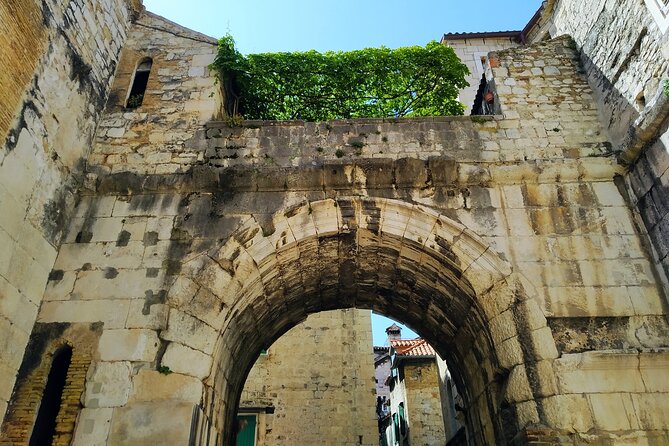
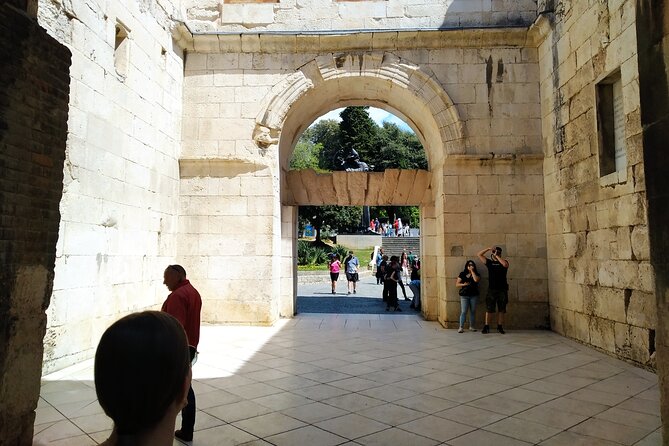
Stop one is the Golden Gate, one of the four main Roman gates into Diocletian’s Palace. It’s the entrance on the road to the north, toward Salona—the capital of the Roman province of Dalmatia and Diocletian’s birthplace.
This is a smart first stop because it frames what you’ll spend the rest of the tour looking at. When you understand that the palace was essentially a complete world with controlled access, you start seeing the old town differently—not as random ruins, but as an intentional plan.
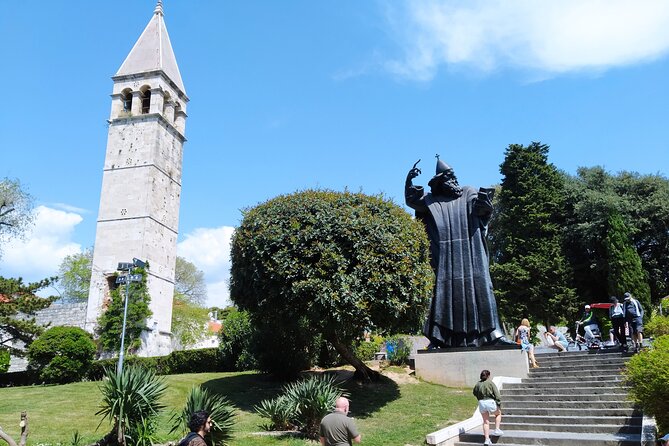
One cool detail: the Golden Gate sits opposite Gregory of Nin, one of Split’s most recognizable landmarks. So even early on, you can connect the Roman layers of the city to the later historical figures that still define Split’s identity.
Practical notes:
- Admission is free for this stop.
- The time here is short—about 15 minutes—so it works well as a warm start without dragging.
A few more Split boat days and tours worth a second look


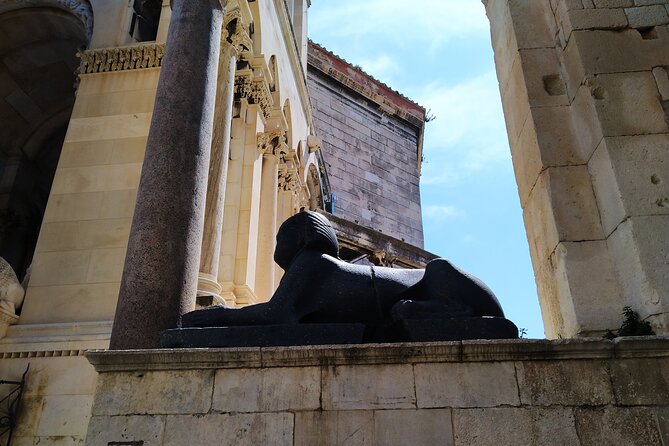
The Peristyle of Diocletian’s Palace: Where the Palace Feels Like a Stage
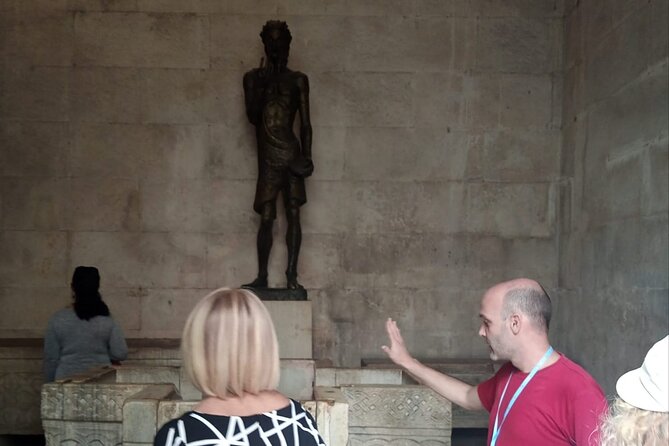
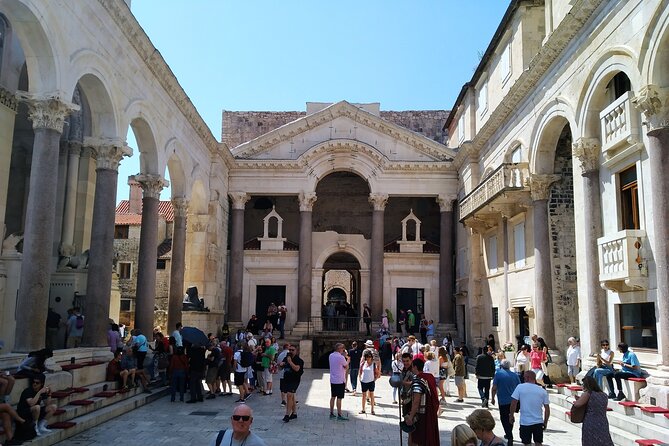
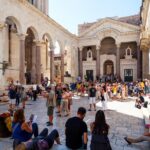
Next you move into the heart of the palace’s layout: the Peristyle, the open imperial square framed by monumental arcades. Before reaching the peristyle, you’ll step through cellar areas connected to how the palace was used during different periods.
This is where the tour really pays off for first-timers. The Peristyle is the kind of place where you can immediately sense power and ceremony—yet your guide ties it to history, including how building use and life changed as Christianity expanded.
If you’re the type who likes to understand how cities evolved, this stop helps you see architecture as a record of social change, not just stone.
Practical notes:
- Admission is free at this stop.
- Expect around 15 minutes.
Cathedral of Saint Domnius: Look Closely Without Needing to Enter
On the Peristyle, you can’t miss the Cathedral of Saint Domnius. You’ll stop outside and the guide points out significant parts and shares the story behind them.
Important detail: you won’t enter inside. That’s actually useful for most people, because you can focus on what’s visible from your position and still get the explanation. For many visitors, it’s also less waiting time, so you keep momentum.
This cathedral is described as one of the best-preserved Roman structures in Split and it’s still in use today. Even from outside, you can appreciate how long-lasting these forms are.
Practical notes:
- Admission is not included for this stop (since you’re not entering).
- Time here is about 10 minutes.
Temple of Jupiter: How a Roman Temple Became a Christian Baptistery
Then you’ll reach the Temple of Jupiter, noted as one of the best-preserved late Roman temples in the world. The location is tied to the idea of divine connection between Emperor Diocletian and Jupiter.
What makes this stop especially satisfying is the later transformation. During the Middle Ages, the temple was converted into a baptistery dedicated to St. John the Baptist. Your guide will help you understand what that shift meant visually and historically—basically, how older structures were reused rather than erased.
Practical notes:
- Admission is not included here.
- Expect about 10 minutes.
Vestibulum and the Private Chambers: The Palace’s Doorway to Power
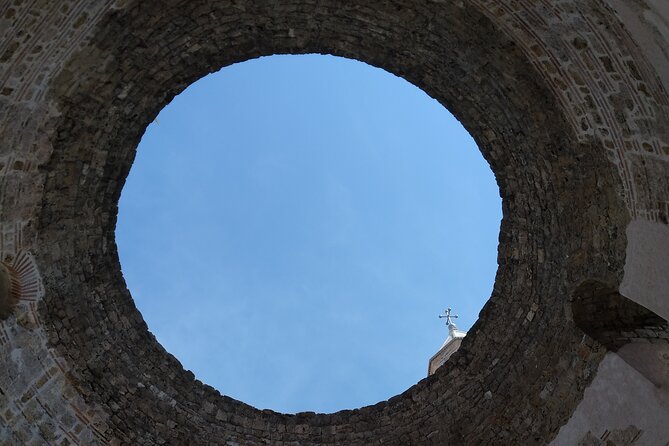
Stop five is the Vestibulum—the pre-entrance to Diocletian’s private chambers. This space was decorated in line with its importance, and you’ll learn what it looked like and what it was for.
This is a great moment if you like the “how did real people live here?” angle. The tour doesn’t just point at the biggest ruins; it also explains the palace’s internal logic, including how private areas related to ceremonial ones.
From this place, you’ll also check up Triclinium—the reception/dining function tied to how the ruler’s life unfolded in the palace.
Practical notes:
- Admission is free at this stop.
- Around 10 minutes.
Riva Harbor: The City’s Main Promenade, Explained
Now you shift from palace core to daily city life. You start on the Riva, Split’s main promenade and meeting point for locals and visitors. Your guide explains how the Riva was built across the centuries and why it became central to everyday life.
Even if you already know this area as the “walk here because it’s scenic” strip, the tour gives you history so you understand why it became that kind of place. You also get a strong view of the southern wall of Diocletian’s Palace from here, which helps you connect street life to the palace mass behind it.
Practical notes:
- Admission is free.
- About 10 minutes.
Tip: If you’re choosing when to take photos, this is often the easiest time to frame the palace wall without sprinting.
Fruit’s Square (Trg Brace Radic): Fort Remains Inside a Pretty Setting
Next is Fruit’s Square, known as Trg Brace Radic. This is a picturesque area just outside the palace grounds, with significant sights around it.
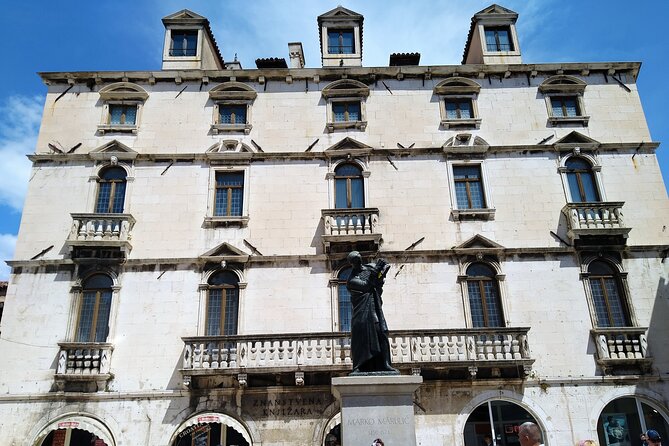
You’ll hear about the monument at the center of the square and about surrounding important features. The square is also dominated by remains of a 15th-century Venetian fort, which adds a surprising layer: this place isn’t just “old town.” It’s old town with military footprints.
Practical notes:
- Admission is free.
- About 20 minutes—the longest stop after the palace core, which suggests it’s where the guide shares extra context.
Pjaca (People’s Square): The Old Town Hall Area and Medieval Energy
You’ll then move to Pjaca, the main square outside the western wall of Diocletian’s Palace. It has attracted visitors since medieval times, and you can see the 14th-century Town Hall along with other interesting structures nearby.
This stop works well for getting your bearings. Once you’ve walked through palace spaces, Pjaca helps you see the public side of Split: where people gathered, watched, traded, and lived their daily rhythms.
Practical notes:
- Admission is free.
- About 10 minutes.
Grgur Ninski Statue: Landmark, Story, and a Small Tradition
Finally, you reach the Grgur Ninski Statue, a dominant landmark of Split. Your guide shares the story of Gregory of Nin, including the highest monument in Split dedicated to him and details about the sculptor.
Then comes the fun local touch: you’re encouraged to rub his toe for good luck. It sounds like a tourist cliché, but it actually helps you remember the moment. It’s also a simple action in an otherwise information-heavy walk, so it breaks up the history nicely at the end.
Practical notes:
- Admission is free.
- About 10 minutes.
What the Mobile Ticket and Short Duration Mean for You
This tour uses a mobile ticket, which usually means less hassle when you arrive—no paper ticket hunting. It also makes the start/end smooth since the experience is scheduled and focused.
The duration (about 1.5 to 2 hours) is a sweet spot. It’s long enough to understand how the palace sections connect, but short enough to keep the rest of your day flexible—beach time, lunch in the old town, or jumping to another attraction on your own.
Weather, Walking, and Footwear: Small Tips That Matter
The experience requires good weather. That doesn’t mean it’s canceled at the first cloud, but it does mean you should treat rain as a real factor.
Since most stops are outdoors and spaced along old-town streets and squares, bring:
- Comfortable shoes with grip
- A water bottle if you’re doing this midday
- Sun protection in summer
Also, since it’s described as suitable for most travelers, you shouldn’t expect extreme stairs or complicated transfers—but you still need to plan for steady walking.
Who This Tour Is Best For
This private history tour fits best if you want:
- A first-time understanding of Split’s layout around Diocletian’s Palace
- A guide who can explain Roman-to-Christian shifts without turning it into a lecture
- A small-group experience where you can ask questions and get clear answers
If you love architecture but hate getting lost in translations, you’ll enjoy the structure. And if you’re traveling with family or a small set of friends, the group price up to 10 people can make the experience feel more affordable.
Should You Book This Private History Tour?
I’d book it if you want Split to feel logical, not confusing. This is the kind of tour that helps you leave with a map in your head: the Golden Gate as the start of the palace world, the Peristyle as the ceremonial heart, then the cathedral and Jupiter temple as proof that cities evolve by reuse.
Skip it only if you’re expecting a long, inside-everywhere tour. This one focuses on what you can see and understand from the street and key palace areas, with explanation built around those views. If that matches your style, you’ll get a lot for your time—especially with a history-trained guide and a route that keeps you moving efficiently.
FAQ
FAQ
How long is the Private History tour in Split?
It lasts about 1 hour 30 minutes to 2 hours.
Where does the tour start?
The tour starts at Ul. kralja Tomislava 15, 21000 Split, Croatia and ends back at the same meeting point.
Is this tour private or shared?
It’s a private tour/activity. Only your group will participate, and the group size is up to 10.
What ticket or admissions are included?
Some stops are free to view, and a couple have admission not included. The Cathedral of Saint Domnius and the Temple of Jupiter are marked as admission not included.
Does the tour enter the Cathedral of Saint Domnius?
No. You’ll see it and learn about significant parts, but you won’t enter inside.
Is this tour dependent on weather?
Yes. The experience requires good weather, and if it’s canceled due to poor weather, you’ll be offered a different date or a full refund.
More Tours in Split
- From Split: Krka Waterfalls, Food & Wine Tasting Tour
★ 5.0 · 9,326 reviews - Blue cave, Mamma Mia and Hvar, 5 islands speedboat tour
★ 5.0 · 7,150 reviews - From Split: Krka Waterfalls, Food & Wine Tasting Tour
★ 4.9 · 6,598 reviews - Split/Trogir: Blue Cave, Mamma Mia, Hvar and 5 Island Tour
★ 4.6 · 6,320 reviews - Blue Cave and Hvar Tour – 5 Islands Tour from Split and Trogir
★ 5.0 · 4,815 reviews
More Tour Reviews in Split
- Split: Krka Waterfalls Trip with Boat Cruise and Swimming
★ 4.8 · 10,519 reviews - From Split: Krka Waterfalls, Food & Wine Tasting Tour
★ 5.0 · 9,326 reviews - Blue cave, Mamma Mia and Hvar, 5 islands speedboat tour
★ 5.0 · 7,150 reviews - From Split: Krka Waterfalls, Food & Wine Tasting Tour
★ 4.9 · 6,598 reviews - Split/Trogir: Blue Cave, Mamma Mia, Hvar and 5 Island Tour
★ 4.6 · 6,320 reviews
Just Your Group in Split
- SPLIT-PRIVATE Walking Tour of Diocletian’s Palace & Old Town
★ 5.0 · 467 reviews - Private Krka Waterfalls tour with 30min Boat Cruse
★ 4.0 · 458 reviews - Split by Private Electric Rickshaw – Palace & Hidden Gems
★ 5.0 · 412 reviews - Private Blue cave, Mamma Mia and Hvar, 5 islands tour from Split
★ 5.0 · 387 reviews - The Best of Split Private Tour
★ 5.0 · 338 reviews
Still deciding? More Split trips we have been out and reviewed
Split Private Tours, compared.
 ★ 5.0SPLIT-PRIVATE Walking Tour of Diocletian’s Palace & Old TownFrom $240467 reviews
 ★ 4.0Private Krka Waterfalls tour with 30min Boat CruseFrom $301458 reviews
 ★ 5.0Split by Private Electric Rickshaw – Palace & Hidden GemsFrom $48412 reviews
 ★ 5.0Private Blue cave, Mamma Mia and Hvar, 5 islands tour from SplitFrom $1,572387 reviews
 ★ 5.0The Best of Split Private TourFrom $199338 reviews
 ★ 5.0Private Full-Day Krka Waterfalls Tour with Wine TastingFrom $665263 reviews
 ★ 5.0Private Boat Tour by local expert – Create Your ItineraryFrom $483261 reviews
 ★ 5.0Plitvice Lakes – Private tourFrom $786222 reviews
Browse the lists this tour appears in