
Reviewed · TROGIR OLD TOWN TRIPS
Trogir walking tour with a local guide
Trogir rewards slow walking and sharp stories. In about 90 minutes with a local guide, you’ll connect Romanesque, Gothic, and Venetian Renaissance landmarks—starting at the Cathedral of St. Lawrence and ending at the waterfront promenade—without feeling rushed. Local guide storytelling is the real engine here.
I love how the walk turns “old stone” into readable history, especially at the Cathedral, where construction began in 1213 and took five centuries to complete. I also love the pacing and size: it’s capped at 15 people, and guides like Daniela, Blanka, Kristina, and Mihaela bring personal, grounded context that makes Trogir feel like a living place, not a museum room.
One thing to keep in mind: this is a short walk. If you’re expecting a long, drawn-out deep lecture that stretches far past an hour, the time can feel snug.
In This Review
- Key things that make this Trogir walk work
- Entering Trogir the Right Way: City-gate start, easy pace, clear route
- Cathedral of St. Lawrence and Radovan’s Portal: the reason you’re here
- John Paul II Square and Town Hall: Venetian vibes in a café-friendly space
- St. Sebastian, Town Loggia, and Palace Cipiko: plague gratitude to law-making
- Garagnin-Fonfogna Museum and the North Gate: entering Old Town’s story
- Kairos bas-relief and Church of Our Lady of Mount Carmel: small art, big meaning
- Riva waterfront promenade and Kamerlengo Castle: your sea-view finish
- Price and value: why $18.14 for 90 minutes can be a smart move
- What you’ll actually enjoy most (and what might annoy you)
- Who this Trogir walk is best for
- Should you book this Trogir walking tour?
- FAQ
- How long is the Trogir walking tour?
- Is the tour in English?
- How many people are in the group?
- What’s the price per person?
- Do I need a printed ticket?
- Where do I meet the guide, and where does the tour end?
- Do I pay separate admission fees at the stops?
- What if the weather is bad?
- Can I get a refund if I cancel?
Key things that make this Trogir walk work
- Radovan’s Portal at the Cathedral of St. Lawrence: a main entrance carved by Master Radovan (early 13th century).
- Bell tower panoramas: big views over Trogir, the island of Čiovo, the mainland, and the Adriatic.
- Venetian civic landmarks: Town Hall stairways, Town Loggia law-and-gossip space, and Palace Cipiko details.
- Small-group energy: max 15 people, so questions stay normal and the guide can keep track.
- Riva promenade to Kamerlengo Castle: sea views, then an early 15th-century fortress at the old-town edge.
- Local storytelling: guides often layer in what it’s like to grow up in Trogir, including wartime perspective.
Stone streets of Trogir, more trips from Trogir
- Blue cave, Mama Mia and Hvar, 5 island speedboat tour from Trogir★ 5.0 · 2,861 reviews
- From Trogir: Three Islands Half-Day Speedboat Tour★ 4.8 · 804 reviews
- Trogir, Žedno: Čiovo Island 100% Off-Road Quad ATV Tour★ 4.9 · 554 reviews
- From Trogir or Split: Full-Day Blue Cave & Hvar Island Tour★ 4.7 · 475 reviews
Entering Trogir the Right Way: City-gate start, easy pace, clear route
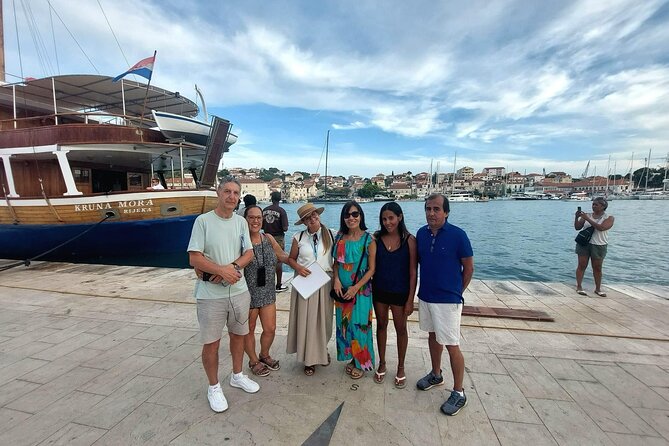
This is the kind of tour that helps you get your bearings fast. You meet at Ul. Gradska vrata 5 (21220) and you finish at Obala bana Berislavića (21218). That means you’re not just circling the same streets—you end where the sea becomes part of the scenery.
The tour runs about 1 hour 30 minutes (it’s listed as approximate), and the group limit is 15. In practice, that small size matters. You get a guide who can keep the walk calm, answer questions without turning it into a free-for-all, and adjust the rhythm as the group moves from landmark to landmark.
One practical note: it’s a good-weather experience. If the weather turns ugly, you may get a different date or a full refund offer. So if you’re planning around weather, try not to schedule this as the “only possible day” of your trip.
Cathedral of St. Lawrence and Radovan’s Portal: the reason you’re here
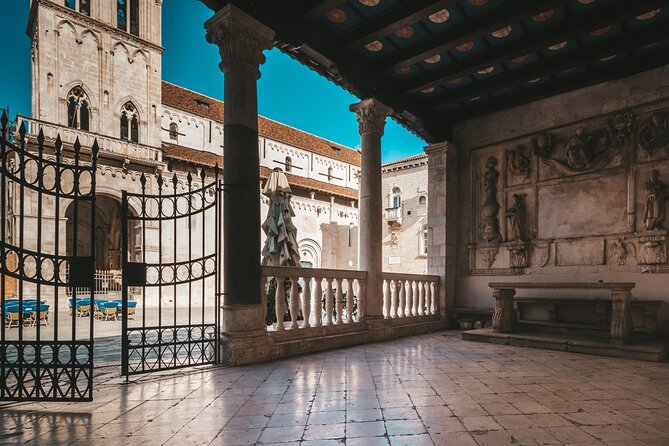
The big opening act is the Cathedral of St. Lawrence. Construction started in 1213 and stretched across five centuries, so the building carries both Romanesque and Gothic language. Inside, it’s designed with three naves—massive, structured, and unmistakably built to last.
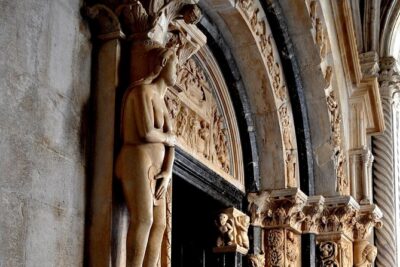
Then you hit the moment that turns heads: Radovan’s Portal. It’s described as the main entrance sculpted and carved by Master Radovan, a craftsman from medieval Trogir, dated to the first half of the 13th century. If you like stonework, this is where you stop walking and start looking closer—figures, carving depth, and the sense of skilled hands doing work that still reads from street level.
After that, the story doesn’t end at the doorway. The Cathedral’s bell tower is part of why this stop feels like a “wow” moment on a clear day. You’re in position for panoramic views over Trogir, the island of Čiovo, the mainland, and the Adriatic Sea. Even if you skip any extra climbing you might see on your own, the guide’s framing helps you understand what you’re looking at.
John Paul II Square and Town Hall: Venetian vibes in a café-friendly space
From the Cathedral area, the walk slides into the softer, everyday rhythm of Old Town. John Paul II Square (Trg Ivana Pavla II) is one of those places that feels like an open-air lounge. It’s surrounded by important historic buildings, but it’s also taken over—comfortably—by local café tables and umbrellas.
This is where the tour becomes more than facts. You’re taught how to recognize civic power in a square: not just pretty buildings, but the way public life shaped the town. If you want a break that still counts as sightseeing, this is it. I love that the tour gives you time to sit with the view instead of marching past everything like you’re chasing a checklist.
Next up is the Town Hall, built in the 15th century. You’ll see an elegant courtyard decorated with coats of arms. And the outside staircase is singled out as one of the standout examples of Venetian architecture in Trogir. In other words, it’s not only about what the building was for—it’s also about how it presented authority and style in public.
St. Sebastian, Town Loggia, and Palace Cipiko: plague gratitude to law-making
Three stops in a row connect everyday life across time—how people built, feared, governed, and celebrated.
First is St. Sebastian’s Church and Clock Tower. The church was built in 1476 by citizens of Trogir who were grateful after being delivered from the plague. That detail changes how you see the building. It’s not just a pretty church stop. It’s a public memory etched into architecture. The church’s architect is listed as Niccolò di Giovanni Fiorentino—also known in English as Nicolas of Florence.
Then the walk shifts to the Town Loggia, dating back to the 13th century. This is a covered space next to the Clock Tower. The guide explains how citizens used to gather here to discuss daily issues, and how the local court met there on certain days to proclaim laws and handle court cases. So you’re standing in a place where speech and decision-making happened. That makes the architecture feel practical, not decorative.
Finally comes Palace Cipiko, often referred to as the Great Cipiko Palace. The palace begins with Romanesque building blocks and takes on a Venetian Renaissance look after extensive remodeling between the 15th and 17th centuries. Niccolò di Giovanni Fiorentino is mentioned again here, including his carving of the south portal. If you’re the type who likes to spot repeated names and artistic fingerprints, this chain of influence is satisfying.
Prefer to walk it? More guided strolls through Trogir

Garagnin-Fonfogna Museum and the North Gate: entering Old Town’s story

As you head deeper into the old core, you’ll encounter the Garagnin-Fonfogna museum, housed in a series of palaces that were once owned by the Venetian family of the same name. You’re essentially introduced to the way Venice-related families shaped what you see today.
This also ties into the North Gate, described as one of the two main historic entrances to the walled town. The museum setting begins right as you step into Old Town through that entrance, so the guide’s job here is to help you understand that the town wasn’t just “a place to live”—it was a fortified, organized space with controlled entry.
If you like history that connects to streets, this portion helps. You start seeing boundaries, not just buildings.
Kairos bas-relief and Church of Our Lady of Mount Carmel: small art, big meaning
Trogir sprinkles in symbolism, and the tour gives you time to notice it. One bas-relief is described in detail: a young man on tiptoe, arms outstretched, holding scales, with a tuft of hair over his forehead and a bald crown. The guide frames it through the idea of Kairos—the right moment. The message is basically: don’t be slow when the moment arrives, because it can slip away if you miss it.
Even if you don’t go “full philosophy mode” on vacation, it’s a memorable intermission. It makes you look at a piece of stone the way you’d read a caption on a painting.
Then you’ll move to the Church of Our Lady of Mount Carmel. It’s historically tied to Trogir’s fishermen, craftsmen, and laborers, and it’s found just off the waterfront promenade in the western part of Old Town. If you’re there on 16 July, the evening brings a traditional procession with the statue of Our Lady. That’s the kind of specific timing detail that turns an architecture stop into a cultural moment.
Riva waterfront promenade and Kamerlengo Castle: your sea-view finish

The tour’s last stretch shifts from streets to the waterline.
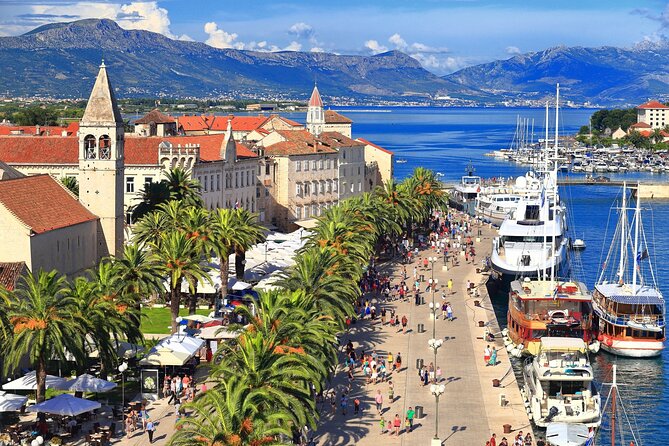
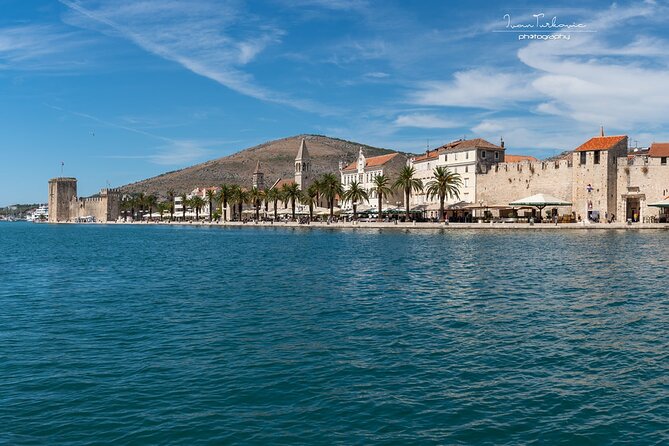
Riva is how locals refer to Trogir’s palm-fringed promenade. It’s wide, flat, and straight, running along the water edge with views across the sea channel toward Čiovo. This part is great because it resets your brain. You’ve been reading buildings; now you’re reading the coastline.
At the end of the promenade sits Kamerlengo Castle, an early 15th-century fortress. The guide points out the location: it stands on the corner of the tiny island that hosts the Old Town. Right nearby you’ll see a local football pitch, a small playground for kids, and stalls for local tour operators. That blend—fortress plus daily life—helps the castle feel less like a monument and more like a landmark embedded in real routines.
When you finish here, you’re well placed to keep exploring on your own. You’re at the edge of the old town, where most people eventually circle back for photos and a late drink.
Price and value: why $18.14 for 90 minutes can be a smart move

At $18.14 per person for about 1.5 hours, this is priced like a practical “orientation plus highlights” tour. The value comes from two things.
First, you get a focused route through major landmarks without paying extra attention taxes. Many stops are noted as free admission for the areas you visit during the tour, so you’re not constantly thinking about ticket desks while your feet are moving.
Second, you’re paying for the local guide angle. The strongest reviews you’ll find with this kind of tour tend to highlight how guides bring personal Trogir context into the facts—sometimes including family ties and even experiences tied to Croatia’s more difficult modern chapters. You can always read about architecture later. What you can’t easily replace is the human layer that helps you understand why certain buildings mattered to real people.
The format also helps. With a max group size of 15, you’re not lost in a pack. That keeps the experience from turning into a head-down photo sprint.
What you’ll actually enjoy most (and what might annoy you)
If you’re asking what makes this walk special, it’s the combination of three ingredients:
- Landmarks that connect to stories: plague gratitude, civic law space, Renaissance remodeling, and symbolic art about timing.
- A guide who slows the mind down: calm delivery, lots of specific detail, and a clear “here’s what to notice” approach.
- A route that ends where you can breathe: Riva promenade and Kamerlengo Castle give you a graceful finish rather than another tight alley.
The main frustration risk is time expectations. This is an hour-and-a-half experience by design, and it may feel even tighter on a busy day or with the group’s pace. If you want a long, hour-by-hour lecture where every stone gets a full backstory, this won’t be that.
Also, because it’s a walking tour in a historic center, you’ll want practical shoes. The streets aren’t described as difficult, but you’ll still be on foot through Old Town’s stone surfaces.
Who this Trogir walk is best for
This tour fits best if you want to:
- See the highlights without getting overwhelmed
- Learn what you’re looking at in the Cathedral and Venetian civic buildings
- Get a local perspective fast, especially from guides such as Daniela, Blanka, Kristina, Michael, Michaela, Christine, and Mihaela (names that show up repeatedly)
It’s also a great “first or second day in town” option, because it helps you prioritize what to revisit later—especially around the waterfront.
If you hate guided walking, or if you prefer total self-guided wandering with no schedule at all, you might find it a bit structured. But if you like a guided backbone with time for pauses, this one works.
Should you book this Trogir walking tour?
I’d book it if you want a smart orientation that pays off immediately. For the price, you get a concentrated set of Trogir classics—Cathedral of St. Lawrence (including Radovan’s Portal), Venetian-era civic stops, and a finishing stretch on the Riva promenade toward Kamerlengo Castle—with a small-group local guide who can make the details stick.
Skip it only if your priority is a long, slow, museum-style visit where you want hours of indoor time. This is a streets-and-views tour. When it ends, you’ll still be in the best area to keep exploring on your own.
FAQ
How long is the Trogir walking tour?
The tour is listed at about 1 hour 30 minutes.
Is the tour in English?
Yes, it’s offered in English.
How many people are in the group?
The maximum group size is 15 travelers.
What’s the price per person?
The price is $18.14 per person.
Do I need a printed ticket?
You’ll get a mobile ticket.
Where do I meet the guide, and where does the tour end?
You start at Ul. Gradska vrata 5, 21220, Trogir, Croatia, and you end at Obala bana Berislavića, 21218, Trogir, Croatia.
Do I pay separate admission fees at the stops?
The listed stops for this experience show admission ticket free.
What if the weather is bad?
This experience requires good weather. If it’s canceled due to poor weather, you’ll be offered a different date or a full refund.
Can I get a refund if I cancel?
It’s non-refundable and cannot be changed for any reason. If you cancel or request an amendment, the amount you paid won’t be refunded.
More Tour Reviews in Trogir
- Blue cave, Mama Mia and Hvar, 5 island speedboat tour from Trogir
★ 5.0 · 2,861 reviews - From Trogir: Three Islands Half-Day Speedboat Tour
★ 4.8 · 804 reviews - Trogir, Žedno: Čiovo Island 100% Off-Road Quad ATV Tour
★ 4.9 · 554 reviews - From Trogir or Split: Full-Day Blue Cave & Hvar Island Tour
★ 4.7 · 475 reviews - Half Day Speedboat Tour to Three Islands from Trogir
★ 5.0 · 401 reviews
Walk Trogir a Different Way
- Trogir: City Highlights Guided Walking Tour
★ 4.9 · 199 reviews - Shipwreck – Blue Lagoon All Inclusive + Trogir Walking Tour
★ 4.4 · 110 reviews - Trogir: Old Town Guided Walking Tour
★ 4.6 · 76 reviews - Trogir Highlights Walking Tour with Local Guide
★ 5.0 · 32 reviews - Split Old Town Walking Tour
★ 5.0 · 25 reviews
Trogir, Stone by Stone
- Blue cave, Mama Mia and Hvar, 5 island speedboat tour from Trogir
★ 5.0 · 2,861 reviews - From Trogir: Three Islands Half-Day Speedboat Tour
★ 4.8 · 804 reviews - Trogir, Žedno: Čiovo Island 100% Off-Road Quad ATV Tour
★ 4.9 · 554 reviews - From Trogir or Split: Full-Day Blue Cave & Hvar Island Tour
★ 4.7 · 475 reviews - Half Day Speedboat Tour to Three Islands from Trogir
★ 5.0 · 401 reviews
Still deciding? More Trogir trips we have been out and reviewed

Trogir Old Town Trips, compared.
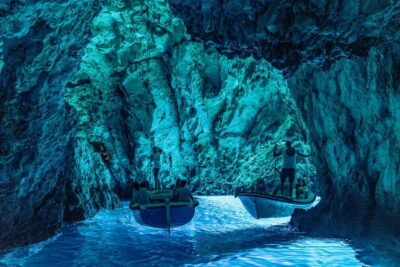 ★ 4.6Blue Cave, Mamma Mia, Hvar and 5 Island TourFrom $1096,320 reviews
 ★ 5.0Blue Cave and Hvar Tour – 5 Islands Tour from Split and TrogirFrom $1204,815 reviews
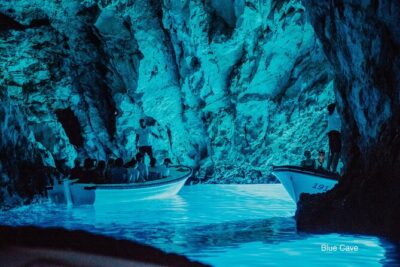 ★ 5.0Blue cave, Mama Mia and Hvar, 5 island speedboat tour from TrogirFrom $1112,861 reviews
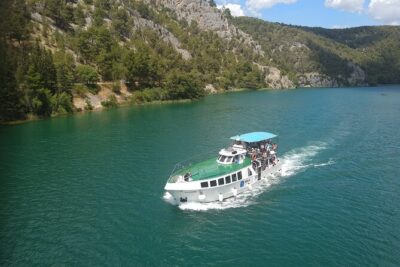 ★ 5.0Krka Waterfalls Day Tour with Boat Ride from Split and TrogirFrom $322,134 reviews
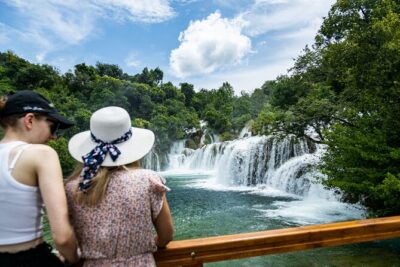 ★ 5.0Krka Waterfalls tour with Trogir Walking tour and Krka panoramic boat cruiseFrom $481,659 reviews
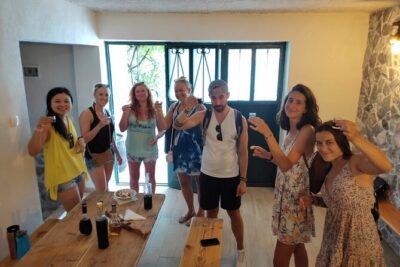 ★ 5.0Krka National Park Tour with tour Guide & Wine tasting from Split & TrogirFrom $501,625 reviews
 ★ 4.5Hvar, Brač & Pakleni islands cruise with lunch & drinks from Split & TrogirFrom $951,452 reviews
 ★ 5.0Mostar and Herzegovina Tour with Kravica Waterfall from Split & TrogirFrom $841,217 reviews
Browse the lists this tour appears in