
Reviewed · SELF-GUIDED TOURS
Sightseeing Split’s Roman Ruins: A Self-Guided Audio Tour
Roman ruins, without the hurry.
This self-guided audio tour turns Split into a walkable story, moving you through Diocletian’s Palace with GPS support and offline audio. I especially like the lifetime access, so you can replay it when you revisit the palace maze. One thing to watch: GPS can put you slightly off at the start, but you can quickly correct and keep moving.
The format is simple: you book, download the VoiceMap app, and start at a time that fits your day. I like that it’s designed for wandering—no group shuffles, no waiting for the next stop—while still guiding you past major areas like the cellars and the Peristyle. Since it uses offline audio, you also avoid the stress of spotty signal in the palace streets and corridors.
If you want a human guide to answer questions on the spot, this won’t replace that. It is self-led, so your phone needs to behave (battery matters), and you’ll be using your own headphones.
In This Review
- Key highlights to know before you go
- Price and value: $14.99 for a palace circuit you can reuse
- Starting at the Riva: the quickest way to get on track
- Using VoiceMap offline in the palace streets
- The walk through Diocletian’s Palace: what each stop is really for
- Entering the palace flow from the Riva
- Brief pause in the cellars
- Mozaik Podrum: a named stop that helps you spot the details
- Triclinium: when dining-space names sharpen your interpretation
- Museum pass: a reminder that not everything is on the street
- Peristyle: the open-space moment
- Vestibulum: a doorway area that helps you read entrances
- Jupiter’s Temple: a landmark stop you’ll recognize
- Palaca Cindro and Silver Gate: the route starts turning outward
- Cathedral: a major focal point in the old core
- Split City Museum and Golden Gate: keep following the named anchors
- The statue stop: a quick listen makes the street feel intentional
- Synagogue and old city hall: stop-to-stop meaning in the tight streets
- Standarac and the chapel: small stops that keep you oriented
- Fish market and the square: finishing with real city energy
- What the audio adds (and where it won’t)
- Timing tips: how to fit it into a Split day
- Who should book this self-guided Roman ruins tour
- Should you book it? The fast decision guide
- FAQ
- Where does the tour start and end?
- How long does the walk take?
- What do I need to bring?
- Does it work without internet?
- Is the tour in English?
- Are entrance tickets included?
- Is there a group or guided escort?
- How flexible is the tour schedule?
Key highlights to know before you go
- Lifetime access in English, so you can repeat the route whenever you want
- Offline audio, maps, and geodata through the palace area
- GPS navigation helps you stay on track through Diocletian’s Palace
- A route that links palace spaces, gates, and the old-city core
- About 1 hour to 1 hour 15 minutes, ideal for a half-day plan
A few more Split boat days and tours worth a second look
- From Split: Plitvice Lakes National Park Guided Tour★ 5.0 · 3,002 reviews
- From Split: Plitvice Lakes Guided Tour with Entry Tickets★ 4.9 · 2,468 reviews
- From Split: Plitvice Lakes National Park Guided Tour★ 5.0 · 2,355 reviews
- Plitvice Lakes National Park Guided Day Tour from Split★ 5.0 · 1,948 reviews
Price and value: $14.99 for a palace circuit you can reuse
At $14.99 per person, this sits in the “good deal for what you actually use” category—mainly because you’re buying a route that stays on your phone for future visits. You’re not paying for museum tickets or timed entry; the experience is the guided walk itself, with audio narration and maps.
What you get that makes the price feel fair:
- VoiceMap app access in English
- Offline access to audio and navigation tools
- A structured walk that covers the big named spaces you’ll see in Diocletian’s Palace and around the historic core
What you should plan for separately:
- No museum tickets are included, so if a stop has an entry fee, you handle it on your end.
- You’ll need your own smartphone and headphones, plus you’re covering any transport to get to Split.
Starting at the Riva: the quickest way to get on track
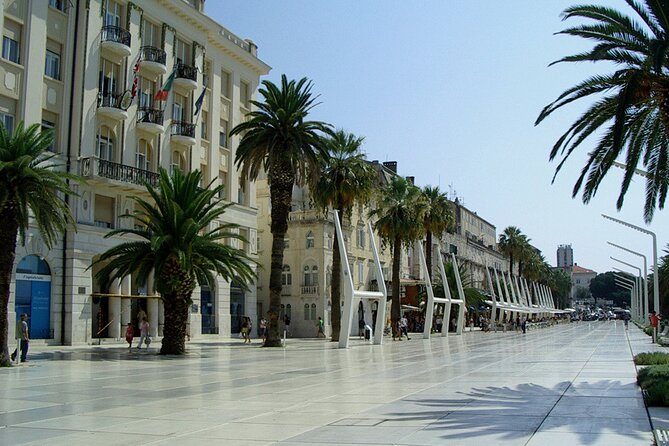
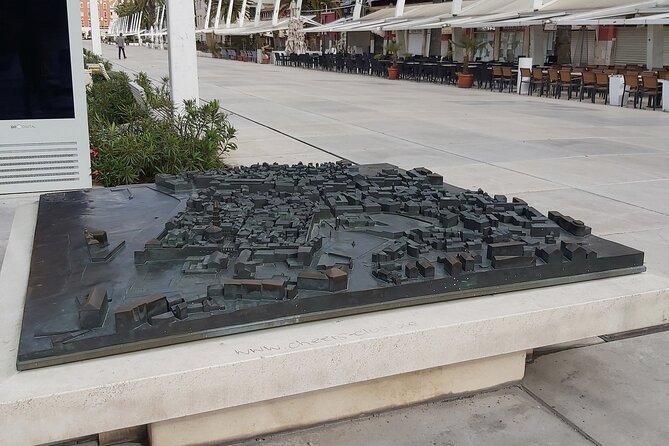
The tour begins on the Riva and meets at the Model of the historical core of the city of Split, Obala Hrvatskog narodnog preporoda 23. Ending point is Radić Brothers Square (Fruit Square) at Trg Braće Radić 5.
Here’s the practical part: because the route is GPS-based, you’ll want to start with your screen awake and location services on. One correction tip: if the GPS seems slightly off right at the beginning, don’t panic. Just match what you see to the Riva area and re-align to the route. After that, the audio-guided flow is easy to follow.
Also, the tour’s availability is listed as effectively all-day (00:00 to 23:59 in the provided date range). That flexibility is helpful in Split, where weather and crowds can swing day to day.
Using VoiceMap offline in the palace streets
This is a smartphone audio walking tour powered by VoiceMap Audio Tours. Your key advantage is that it’s built for offline use: audio, maps, and geodata can all be accessed without relying on constant data.
That matters because Diocletian’s Palace is a dense, stone-heavy maze. GPS usually works fine here, but signals can be unpredictable. Offline mode keeps the experience consistent even when your connection struggles.
My best advice for a smooth run:
- Start early enough that you’re not rushing. The route is about 1 hour to 1 hour 15 minutes, and you’ll probably slow down at the named sights.
- Charge before you go. Audio + GPS is a small drain, and you don’t want to reach the end with a dying battery.
- Wear headphones you’re comfortable with for a full hour walk.
The walk through Diocletian’s Palace: what each stop is really for
The tour is laid out as a forward-moving circuit. You’ll pass through Diocletian’s Palace, then connect to other named landmarks in the old city, and finish at Fruit Square. Below is what to expect from the main named areas, and how each one helps you understand what you’re seeing.
A few more Split boat days and tours worth a second look





Entering the palace flow from the Riva
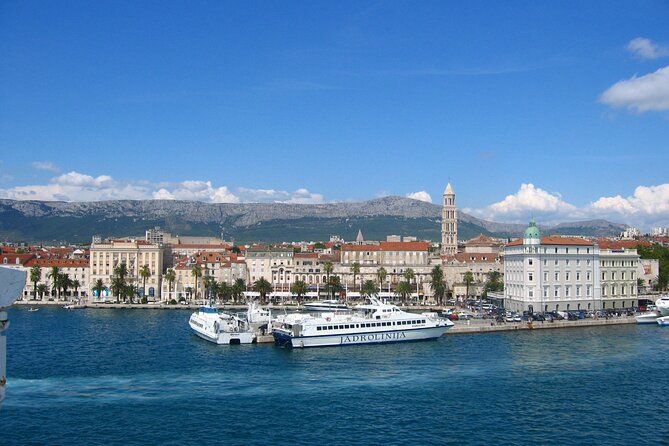
You begin right at the Riva and then head into Diocletian’s Palace. This is a good sequence because the waterfront gives you context for the city’s layout, then the audio gradually shifts you into the palace streets. If you’re arriving in Split for the first time, this structure helps you avoid walking in circles.
Brief pause in the cellars
The tour stops briefly in the cellars. Even without lingering, this kind of stop is valuable because it changes your viewpoint. You’re not just looking at the visible “today” walls—you’re being nudged to imagine the palace in terms of layers: above-ground life and underground space.
If you’re the type who hates short interruptions, treat this as a quick orientation moment. It’s not the time to hunt for entrances; it’s the time to listen and glance.
Mozaik Podrum: a named stop that helps you spot the details
Next you pass by Mozaik Podrum. Even if you don’t go inside anywhere, a named stop like this helps you connect the audio with real surfaces and features you can see around you. That’s the core value of an audio walk: it tells you what to look for while you’re still standing there.
Triclinium: when dining-space names sharpen your interpretation
You then pass by the Triclinium. The word itself is a clue: this is linked to a room type tied to dining. Seeing it in sequence makes the palace feel less like a museum and more like a functioning complex with different spaces and purposes.
Here’s the practical angle: if you take photos, do it right after the audio cue. You’ll capture the spot while your understanding is fresh.
Museum pass: a reminder that not everything is on the street
The route passes by the Museum. Since tickets aren’t included, you’re not expected to enter during the tour. Instead, the museum stop works as a timing signal: you’ve reached a zone where indoor collections may exist, but the audio keeps you on the walking path.
Peristyle: the open-space moment
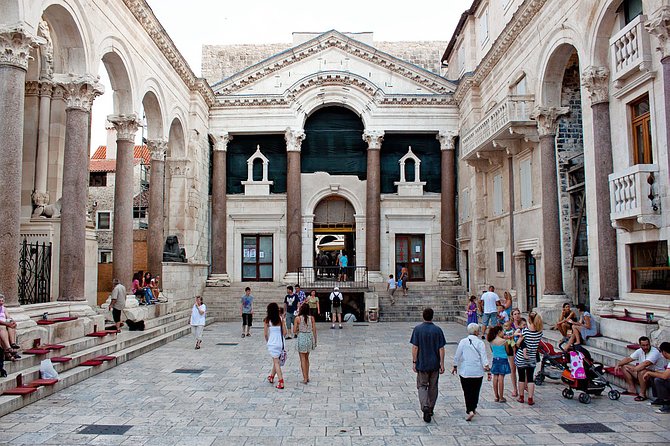
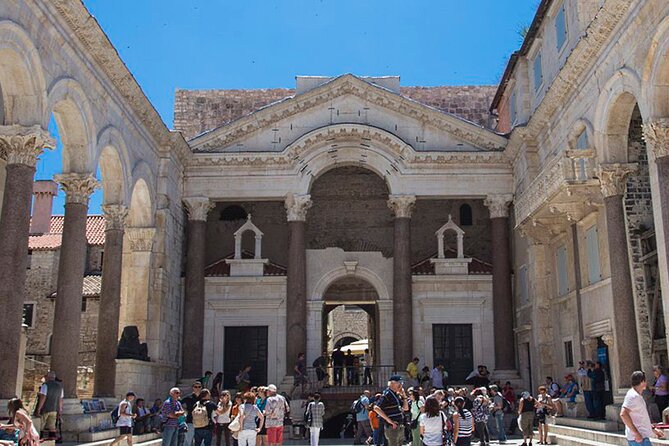
You stop briefly at the Peristyle. This is one of the “breather” areas in many palace layouts—open space compared with narrow corridors—so it’s a natural point to reset your pace. Even a short pause helps because your eyes need a break after tight passageways.
Vestibulum: a doorway area that helps you read entrances
Next is the Vestibulum. A vestibulum-type stop is useful because it trains you to notice transitions: where you move from one kind of space to another. In a place built of named architectural zones, these small stop points make you feel like you’re following a map, not just walking through ruins.
Jupiter’s Temple: a landmark stop you’ll recognize
You stop briefly at Jupiter’s Temple. With a name like that, it’s easy to orient yourself later in Split, too. In an audio tour, this type of landmark matters because it anchors your memory. After this, you can look back at what you’ve walked and connect it to the next gates and city-core sights.
Palaca Cindro and Silver Gate: the route starts turning outward
The tour passes by Palaca Cindro, then Silver Gate. Moving from palace interior spaces toward gates and edges is one of the smartest ways to structure a self-guided walk. It keeps you from thinking the experience ends with the palace walls.
Gates in particular are useful because they give you a sense of direction. Even if you never open the map again, you’ll know you’re moving through named transitions.
Cathedral: a major focal point in the old core
You pass by the Cathedral. This is a good moment to reframe what you’re seeing: the palace isn’t isolated history. It’s layered with later religious and civic life. The audio’s value here is that it helps you read the cathedral area as part of the same historic neighborhood you’ve been walking.
Split City Museum and Golden Gate: keep following the named anchors
Next, you pass by the Split City Museum and then the Golden Gate. These are “names you can carry” after the tour is done. If you want to keep exploring on your own, gates and landmark buildings work like page numbers in a book.
Even better: the audio tour sequence helps you avoid wandering aimlessly after it ends. You’ll know which areas to return to if something catches your attention.
The statue stop: a quick listen makes the street feel intentional
There’s also a brief stop at a statue. These short pauses are often where audio guides do their best work: they point out meaning you might otherwise miss when you’re just looking at stone and placement.
If the audio feels like it’s moving fast here, that’s normal. Use it as a moment to slow down for ten to twenty seconds, not longer.
Synagogue and old city hall: stop-to-stop meaning in the tight streets
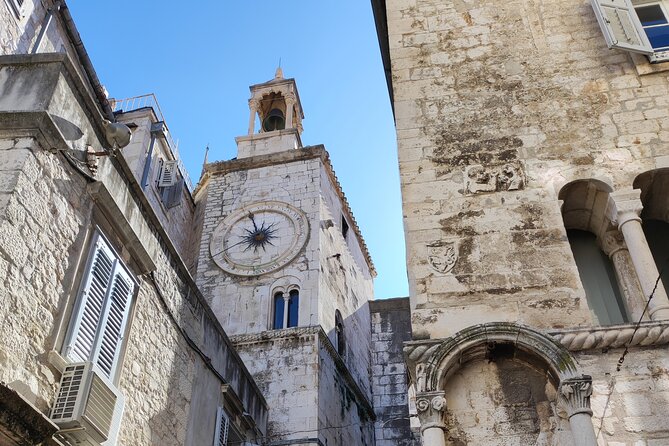
You pass by the Synagogue and then the old city hall. These aren’t palace-only stops, and that’s a plus. The audio walk is building a broader picture of the old-city core, so your understanding becomes more grounded in everyday life beyond Roman palace spaces.
Standarac and the chapel: small stops that keep you oriented
You pass by Standarac and then the Chapel. In a self-guided format, smaller named stops matter because they act like checkpoints. They keep the route from feeling like one long continuous blur.
Fish market and the square: finishing with real city energy
Then you move through the fish market and through the square, ending at Fruit Square. This ending is practical because it lands you in a lively open place where you can easily grab a drink, sit for a bit, or continue walking in any direction.
A big plus here is that it gives your day a natural conclusion point. You don’t end somewhere you have to work to find.
What the audio adds (and where it won’t)
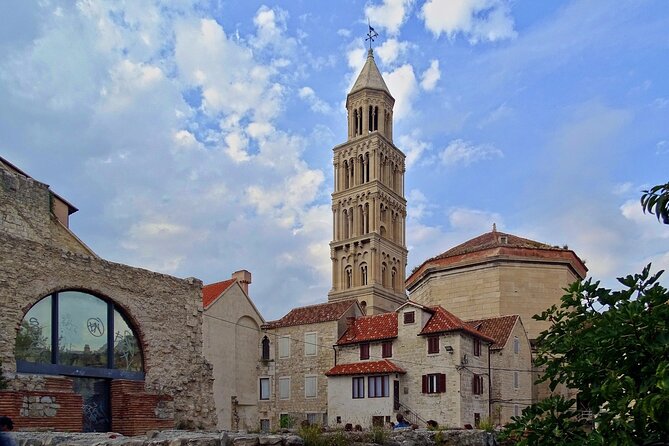
One reason I like this style of tour is that it’s built to help you notice features while you’re standing right there. Instead of reading a plaque you can barely see, the audio guides you through a sequence of named areas like Jupiter’s Temple, the Silver Gate, and the Golden Gate.
It also gives you freedom:
- You can pause, replay a segment, or move at your pace.
- You don’t have to match anyone else’s walking speed.
The trade-off is obvious: there’s no live interaction. If you want to ask questions or get real-time clarifications, you’ll need to rely on your own curiosity or ask someone locally after the walk.
Timing tips: how to fit it into a Split day
With a duration of about 1 hour to 1 hour 15 minutes, this tour works as:
- Your first structured walk in Split (so you get oriented fast)
- A midday break between busier activities
- An easy add-on if you’re already planning to spend time inside Diocletian’s Palace
If you’re doing it in hot weather, start earlier and consider pacing yourself so you’re not rushing to keep the battery alive and your feet happy.
Who should book this self-guided Roman ruins tour
This is a strong match for you if:
- You like independent sightseeing with a route to follow
- You want an English audio guide without paying for live-guide time
- You want offline access so your phone doesn’t depend on reception
Skip it (or think twice) if:
- You want Q&A with a guide
- You don’t want to use your own smartphone and headphones
- You plan to move at a very fast clip and hate listening walks
Should you book it? The fast decision guide
Book this tour if you want a cost-effective, repeatable way to experience Diocletian’s Palace and the surrounding old-city landmarks with offline audio and GPS. It’s also a smart buy if you think you’ll return to Split—lifetime access turns that $14.99 into something you can use more than once.
Don’t book if you’re expecting entry tickets and timed museum access, or if you prefer a live guide with real answers in real time. For most first-time or return visitors who want structure without crowds, this hits a very practical sweet spot.
FAQ
Where does the tour start and end?
It starts at the Model of the historical core of the city of Split (Obala Hrvatskog narodnog preporoda 23) and ends at Radić Brothers Square, also called Fruit Square (Trg Braće Radić 5).
How long does the walk take?
It takes about 1 hour to 1 hour 15 minutes, depending on how long you pause at the stops.
What do I need to bring?
You’ll need your own smartphone and headphones. The experience includes the VoiceMap app and offline audio access, but it does not include devices.
Does it work without internet?
Yes. The tour includes offline access to audio, maps, and geodata, which helps you navigate around the palace area.
Is the tour in English?
Yes. Lifetime access is provided in English.
Are entrance tickets included?
No. Tickets or entrance fees for museums or other attractions along the route are not included.
Is there a group or guided escort?
It’s self-led with VoiceMap audio, and the activity is listed as private for your group. You won’t join a large guided crowd, but you’ll be navigating on your own.
How flexible is the tour schedule?
You can set off at a time that works best for you. The listed opening hours are essentially all day within the provided date range.
More Guided in Split
- From Split: Plitvice Lakes National Park Guided Tour
★ 5.0 · 3,002 reviews - From Split: Plitvice Lakes Guided Tour with Entry Tickets
★ 4.9 · 2,468 reviews - From Split: Plitvice Lakes National Park Guided Tour
★ 5.0 · 2,355 reviews - Plitvice Lakes National Park Guided Day Tour from Split
★ 5.0 · 1,948 reviews - Krka National Park Tour with tour Guide & Wine tasting from Split & Trogir
★ 5.0 · 1,625 reviews
More Tours in Split
- From Split: Krka Waterfalls, Food & Wine Tasting Tour
★ 5.0 · 9,326 reviews - Blue cave, Mamma Mia and Hvar, 5 islands speedboat tour
★ 5.0 · 7,150 reviews - From Split: Krka Waterfalls, Food & Wine Tasting Tour
★ 4.9 · 6,598 reviews - Split/Trogir: Blue Cave, Mamma Mia, Hvar and 5 Island Tour
★ 4.6 · 6,320 reviews - Blue Cave and Hvar Tour – 5 Islands Tour from Split and Trogir
★ 5.0 · 4,815 reviews
More Tour Reviews in Split
- Split: Krka Waterfalls Trip with Boat Cruise and Swimming
★ 4.8 · 10,519 reviews - From Split: Krka Waterfalls, Food & Wine Tasting Tour
★ 5.0 · 9,326 reviews - Blue cave, Mamma Mia and Hvar, 5 islands speedboat tour
★ 5.0 · 7,150 reviews - From Split: Krka Waterfalls, Food & Wine Tasting Tour
★ 4.9 · 6,598 reviews - Split/Trogir: Blue Cave, Mamma Mia, Hvar and 5 Island Tour
★ 4.6 · 6,320 reviews
Still deciding? More Split trips we have been out and reviewed

Self-Guided Tours, compared.
 ★ 4.9Self-Guided Plitvice Lakes Day Tour with Boat RideFrom $581,519 reviews
 ★ 5.0Self-Guided Plitvice Lakes Day Tour with Boat RideFrom $60242 reviews
 ★ 4.3Private Hvar Island E-Bike Tour (Self Guided)From $7615 reviews
 ★ 4.6Self-guided mountain bike tour (non-electric)From $439 reviews
 ★ 5.0Solta Island: Self-Guided Bike Tour from SplitFrom $955 reviews
 ★ 3.0City Walk with Audio Guide in 7 Languages on your PhoneFrom $93 reviews
 ★ 3.5A Self Guided Walking Tour of Trogir TreasuresFrom $63 reviews
Browse the lists this tour appears in